
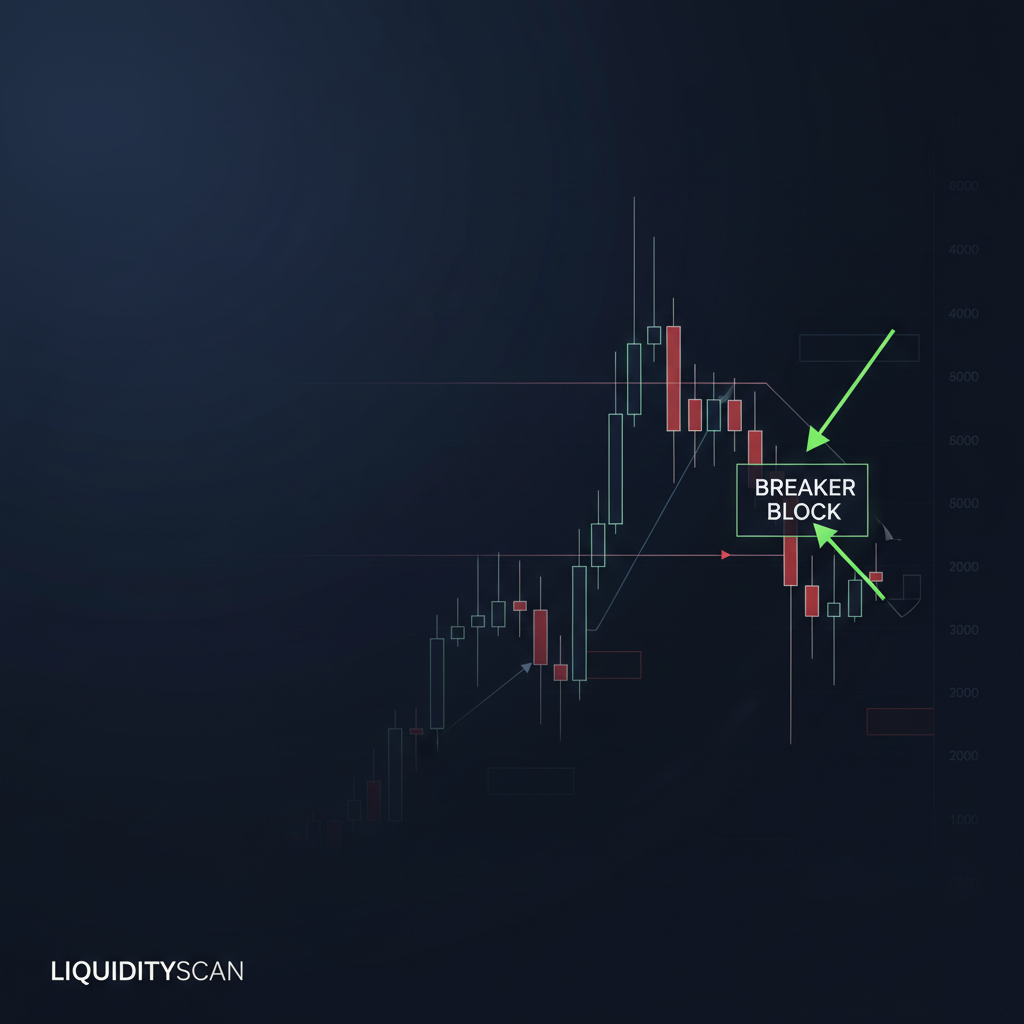
What Is a Breaker Block?
A breaker block is a former order block that failed to hold price, and then flipped roles from support to resistance or vice versa. It marks the spot where a group of orders that expected one direction got trapped, and where price now reacts on the way back.
Think of it as an order block with a story. The zone only earns the "breaker" label after price violates the original block and reverses. Until that break happens, you are just looking at a normal order block, which we cover in depth as a prerequisite below.
The core idea is role reversal. When a bullish order block breaks down, its origin candle can later act as resistance. When a bearish order block breaks up, its origin can later act as support. That flip is what makes it tradable.
How a Breaker Block Forms
A valid breaker needs three ingredients in sequence: a liquidity sweep, a failed order block, and a Market Structure Shift with displacement. Skip any one and you do not have a breaker, you have a guess.
First, price runs a liquidity sweep, taking out a swing high or low where stops sit. This grabs the fuel smart money needs. Second, the order block that formed at that swing fails to defend price, so the level breaks.
Third, a Market Structure Shift confirms the reversal. Price breaks the opposing structure point with displacement, a fast, decisive move that often leaves a Fair Value Gap behind. That failed order block is now your breaker. According to Investopedia's definition of support and resistance, levels that break often reverse their role, which is exactly the mechanism at work here.
Bullish Breaker
A bullish breaker forms from the last down-close candle before a rally that failed. Price sweeps a low, a bearish order block breaks upward, and structure shifts bullish. On the retrace, that broken bearish block becomes support, and I look for longs there.
Bearish Breaker
A bearish breaker is the mirror. Price sweeps a high, a bullish order block breaks downward, and structure shifts bearish. The broken bullish block now acts as resistance on the pullback, giving a clean short zone that aligns with the new trend.
How to Trade a Breaker Block Entry
Once the breaker is confirmed, the trade plan is simple to state and hard to rush. Wait for price to return to the breaker zone rather than chasing the initial displacement move.
For entry, mark the breaker candle body and wick, then set a limit order at the zone or wait for a lower-timeframe confirmation like a Fair Value Gap fill. My stop goes just beyond the swept extreme that created the setup, since a return there invalidates the reversal thesis.
For targets, aim at the next liquidity pool: an opposing swing high or low, or an unmitigated gap. This gives a defined risk-to-reward before you commit. At LiquidityScan I treat the breaker as a trigger only after structure agrees, never in isolation. A breaker fighting the higher-timeframe trend is a low-confidence trade.
Breaker Block vs Order Block vs Mitigation Block
These three are easy to confuse. An order block is the origin zone that holds and continues a move. A breaker block is an order block that broke and flipped roles. A mitigation block is subtler, and the exact difference is where most traders go wrong.
The short version: a mitigation block continues the prior direction after a partial pullback, while a breaker signals reversal after a structure break. I have linked the full breakdown of that distinction below rather than repeat it here.
Frequently Asked Questions
Is a breaker block the same as an order block?
No. An order block holds price and continues the trend. A breaker block is an order block that failed, broke, and then flipped roles to act as support or resistance in the opposite direction.
Do I need a Market Structure Shift for a valid breaker?
Yes. Without a confirmed Market Structure Shift and displacement after the liquidity sweep, the zone has not proven a reversal. It is just a broken level, not a tradable breaker.
Where do I place my stop on a breaker trade?
Place it just beyond the swing extreme that was swept to form the setup. If price returns there, the reversal thesis is invalid and you want to be out cleanly.
Related query paths
To master breakers, build the prerequisites and neighboring concepts in this order.
- What Is an Order Block — the prerequisite concept every breaker starts from.
- Mitigation Block vs Breaker Block — the exact distinction this article deliberately links out to.
- Order Blocks SMC Framework — order blocks in institutional depth.
- ICT Market Structure Framework — the MSS that validates a breaker.
- rejection block in ICT — Compare wick-based reversals with breaker blocks after liquidity sweeps.