
How to Identify a CHoCH on a Price Chart
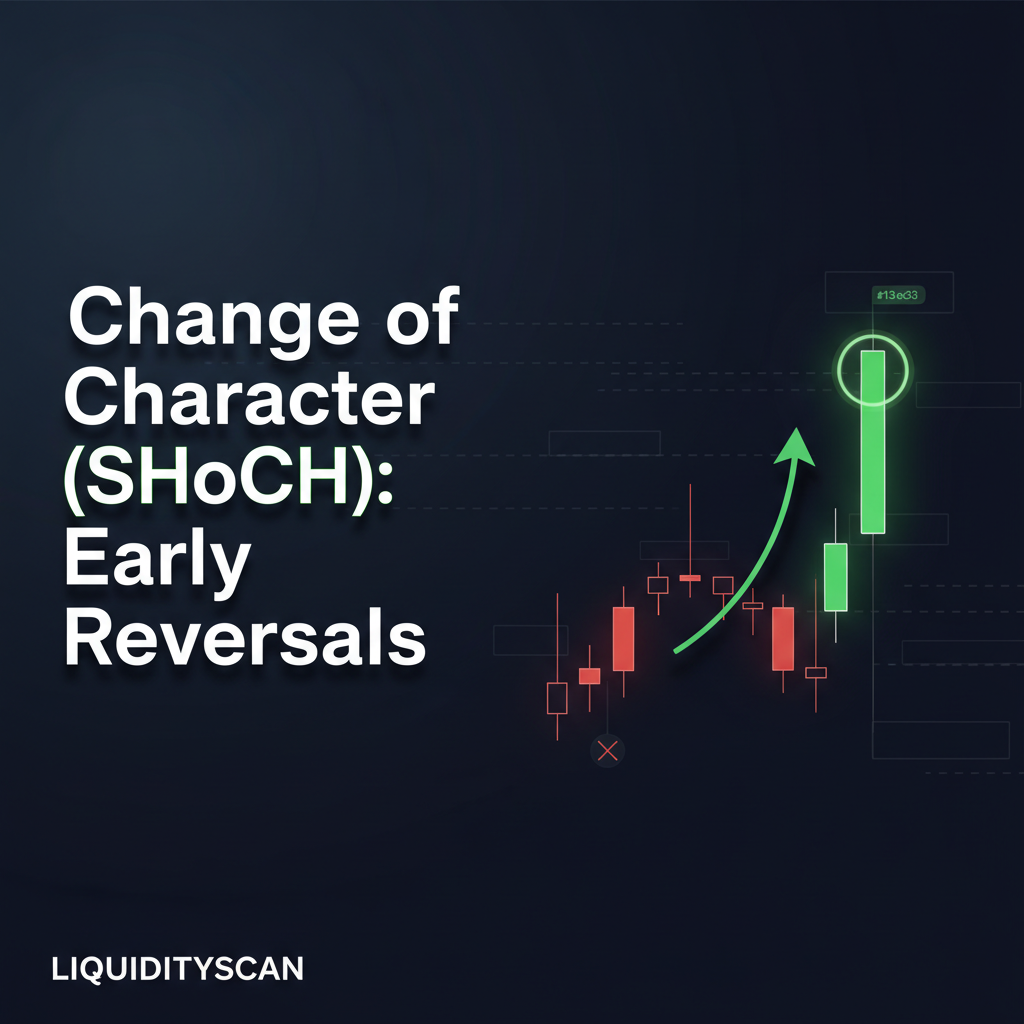
A Change of Character (CHoCH) is the first structural sign that institutional order flow is shifting. It happens when price breaks a swing point in the opposite direction of the prevailing trend, ending the sequence of higher highs and higher lows (or lower highs and lower lows) that defined it.
Unlike a continuation signal, a CHoCH is a warning that the current leg may be exhausted. Read it as a question, not a verdict: has the trend lost its character?
To spot one cleanly, work through three steps:
- Define the trend. Mark the most recent confirmed swing highs and swing lows so the active structure is unambiguous.
- Identify the protected low or high. This is the last swing that the trend defended before its most recent push.
- Watch for the break. When price closes through that protected level against the trend, the character has changed.
Context matters more than the line itself. A CHoCH that prints after a Liquidity Sweep of an obvious high or low, and that aligns with the Higher Timeframe (HTF) Narrative, is far more reliable than one that appears mid-range with no Premium/Discount Array confluence.
Bearish CHoCH: The Shift from Uptrend to Downtrend
In an uptrend, price prints higher highs and higher lows. The protected low is the last higher low before the final push up.
A bearish CHoCH occurs when price sweeps the recent high (taking buy-side liquidity), reverses, and then closes below that protected low. On EUR/USD M15, this often appears as a sharp Displacement candle down through the swing low after a stop run above an equal-highs cluster.
The break tells you that buyers can no longer defend structure. The down-move that creates the CHoCH frequently leaves a Fair Value Gap (FVG) and an Order Block behind — your reference zones for an entry.
Bullish CHoCH: The Shift from Downtrend to Uptrend
In a downtrend, price prints lower lows and lower highs. The protected high is the last lower high before the final push down.
A bullish CHoCH occurs when price sweeps the recent low (taking sell-side liquidity), reverses, and closes above that protected high. The displacement leg up should be impulsive, not corrective — strong, full-bodied candles signal genuine intent rather than a deep retracement.
CHoCH vs. Break of Structure (BOS): The Critical Distinction
This is the single most misunderstood pair in market structure. The mechanical act looks identical — price closes through a swing point — but the meaning is opposite.
- Break of Structure (BOS) is a continuation. Price breaks a swing in the same direction as the trend (a higher high in an uptrend, a lower low in a downtrend), confirming the trend is intact.
- Change of Character (CHoCH) is a potential reversal. Price breaks a swing against the trend, signalling that order flow may be turning.
A useful rule: the first counter-trend break after a run of BOS is the CHoCH. Everything that follows in the new direction becomes a fresh BOS sequence. If you cannot say which trend you are measuring against, you cannot label the break — so always anchor to a defined structure first.
Watch for Inducement before the CHoCH. Smart money often engineers a minor swing to trap breakout traders and gather liquidity before the real structural break. A CHoCH that follows an inducement sweep carries more weight.
How to Trade a CHoCH: Confirmation & Entry Models
A CHoCH is a signal to prepare, not to market-buy the break. The edge comes from waiting for price to return to the zones the displacement leg created.
A repeatable workflow:
- Confirm HTF alignment. Only act on a CHoCH that points toward the Higher Timeframe (HTF) Narrative and draw on liquidity. Counter-HTF CHoCHs are noise far more often than they are turns.
- Mark the displacement origin. Identify the Order Block and Fair Value Gap (FVG) left by the candle that caused the break.
- Wait for the retracement. Let price return to that Order Block or fill the FVG, ideally landing in the correct Premium/Discount Array — discount for longs, premium for shorts.
- Enter on a lower-timeframe confirmation. Drop down a timeframe and look for a smaller CHoCH inside the zone before committing.
- Place the stop beyond the sweep. Your invalidation sits past the liquidity that was taken, not on the structural level itself.
Targets are the opposing liquidity pool — the next external high or low the new order flow is likely to seek.
Frequently Asked Questions about CHoCH
What's the difference between a CHoCH and a Market Structure Shift (MSS)?
They describe the same event with different rigor. A CHoCH is simply the first counter-trend break of structure. A Market Structure Shift (MSS) adds a quality filter: many traders require the break to come with clear Displacement and ideally follow a Liquidity Sweep. In short, every MSS is a CHoCH, but not every CHoCH is strong enough to be called an MSS.
Is there a reliable CHoCH indicator?
Auto-detecting indicators can label swing points and flag breaks, but they only read mechanical structure — they cannot judge whether the break aligns with HTF narrative, liquidity, or premium/discount context. Use them to speed up marking, never as a standalone signal. A scanner that combines structure with liquidity and bias is far closer to how the concept is actually traded.
Related query paths
- BOS vs. CHoCH: The Definitive Guide for SMC Traders
- What is a Break of Structure (BOS)?
- The Definitive ICT Market Structure Framework for Institutional Traders
- The Definitive ICT Market Structure Framework for Institutional Traders
- ICT Price Action vs. Footprint Charts: A Trader's Guide
- What Are Smart Money Concepts? A Trader's Guide to Order Flow
Spot the character change before you do
LiquidityScan tracks market structure, liquidity sweeps, and order flow across crypto and indices, then flags reversals and the institutional bias in real time. Try LiquidityScan's automated scanner and bias tools to catch a CHoCH the moment structure breaks.