
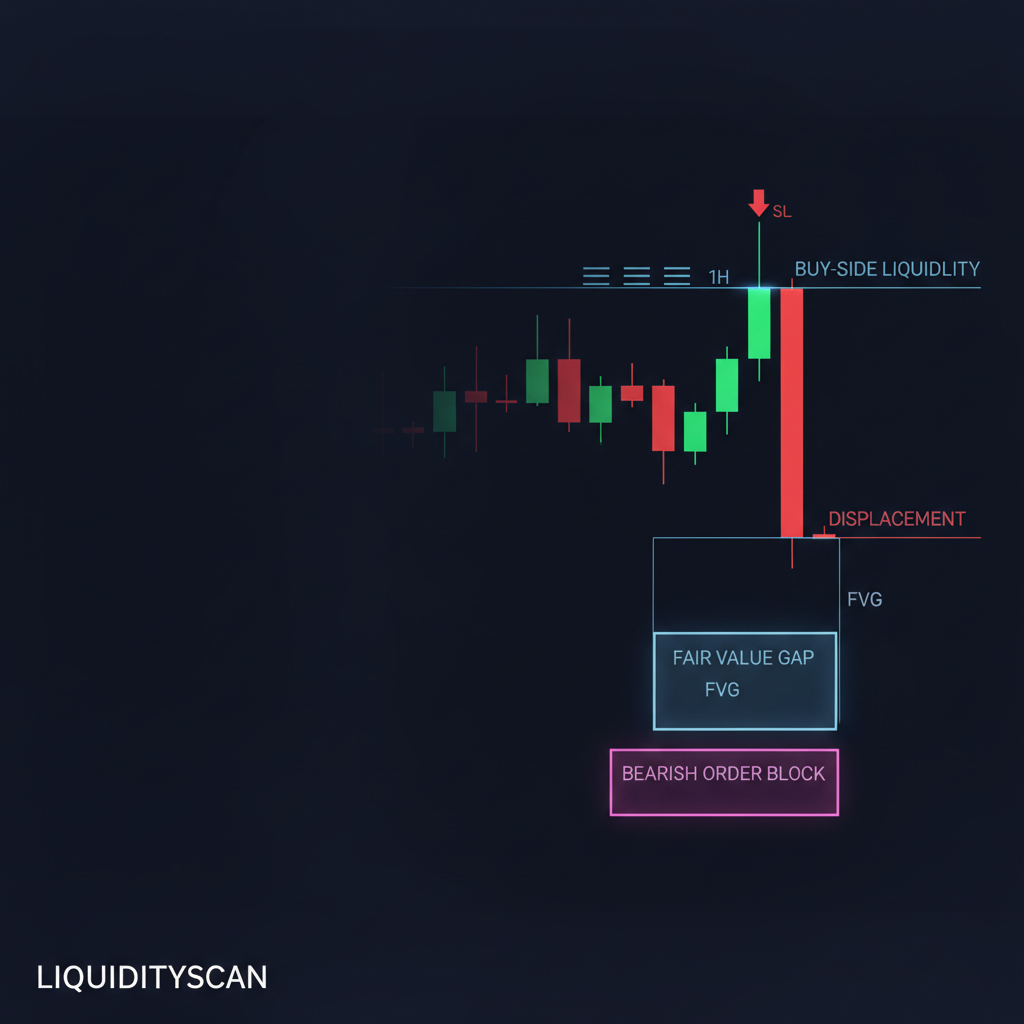
This approach moves away from traditional retail indicators like moving averages or RSI, which are derivatives of price and inherently lagging. Instead, SMC focuses on the cause of price movement: the continuous process of engineering liquidity to facilitate large institutional orders.
The Core Premise: Price Is Engineered
At the heart of Smart Money Concepts is a simple but profound idea. Markets are not a chaotic battle between millions of individual bulls and bears. They are, to a large extent, an engineered environment controlled by the algorithms of central banks, hedge funds, and large financial institutions, collectively known as "smart money."
These entities cannot simply click "buy" on a billion-dollar position without drastically moving the price against them. They require a seller for every buy order. So, where do they find this counterparty liquidity? They create it. They drive price to levels where retail traders have placed their stop-loss orders or where breakout traders will jump in. These clusters of orders provide the liquidity needed to fill their large positions.
A classic retail "double top" pattern is a perfect example. A retail trader sees a resistance level and places a sell order with a stop-loss just above it. An SMC trader sees an engineered pool of buy-side liquidity—all those stop-loss orders—that is likely to be run before the market truly reverses lower. The perspective is completely different.
Identifying the Footprints of Smart Money
If institutions engineer price, they must leave evidence. SMC provides a vocabulary to describe these digital footprints on the chart. These aren't patterns to be memorized, but rather logical components of price delivery.
The key building blocks include:
- Market Structure: Identifying a Break of Structure (BOS) or a Change of Character (CHoCH) is fundamental. This shows when a trend is continuing or potentially reversing.
- Liquidity: Price moves from one pool of liquidity to another. This can be external liquidity (like old highs and lows) or internal liquidity (the fill of an imbalance).
- Displacement: A strong, energetic move in price that leaves behind imbalances. This signals clear institutional intent and often breaks market structure.
- Fair Value Gaps (FVGs): A three-candle pattern indicating an imbalance or inefficiency in price delivery. These gaps are often revisited by price, offering high-probability areas for trade entries.
- Order Blocks: The specific candle (or candle sequence) that initiates a displacement move. A bullish order block is the last down candle before a strong move up, and vice versa. These represent key zones where institutions may defend a position.
Tracking these elements manually across dozens of crypto, forex, and futures markets is a significant undertaking. It's the primary reason we developed the LiquidityScan platform. Our engines automatically scan and detect high-probability structures like FVGs, order blocks, and key structural shifts like a BOS or CHoCH, allowing traders to focus on analysis rather than manual charting.
From Theory to Practice
Adopting SMC is a complete shift in how you view the market. You stop asking, "What is the indicator telling me?" and start asking about the market's narrative, which often revolves around the flow between internal and external liquidity.
For me, the concept of the Judas Swing during the London session was a revelation. I'd watch EUR/USD build clean equal highs during the Asian session, a classic sign of buy-side liquidity. Then, at the London open, price would aggressively spike up, take out those highs, stop out early sellers, and then violently reverse for the rest of the session. It wasn't random noise. It was a structured hunt for liquidity to fuel the real move.
This isn't conspiracy; it's market mechanics. The algorithmic nature of modern markets is well-documented. A working paper from the Bank for International Settlements (BIS) discusses how high-frequency trading algorithms play a dominant role in price discovery and liquidity provision, which aligns perfectly with the SMC view of an engineered market. The market's price delivery algorithm has a function: to seek out and reprice to areas of efficiency. Smart Money Concepts are simply the model traders use to read that process in real time.
By understanding this framework, you begin to see the logic behind the wicks, the stop hunts, and the sudden reversals. You start trading with the institutional flow, not against it.