
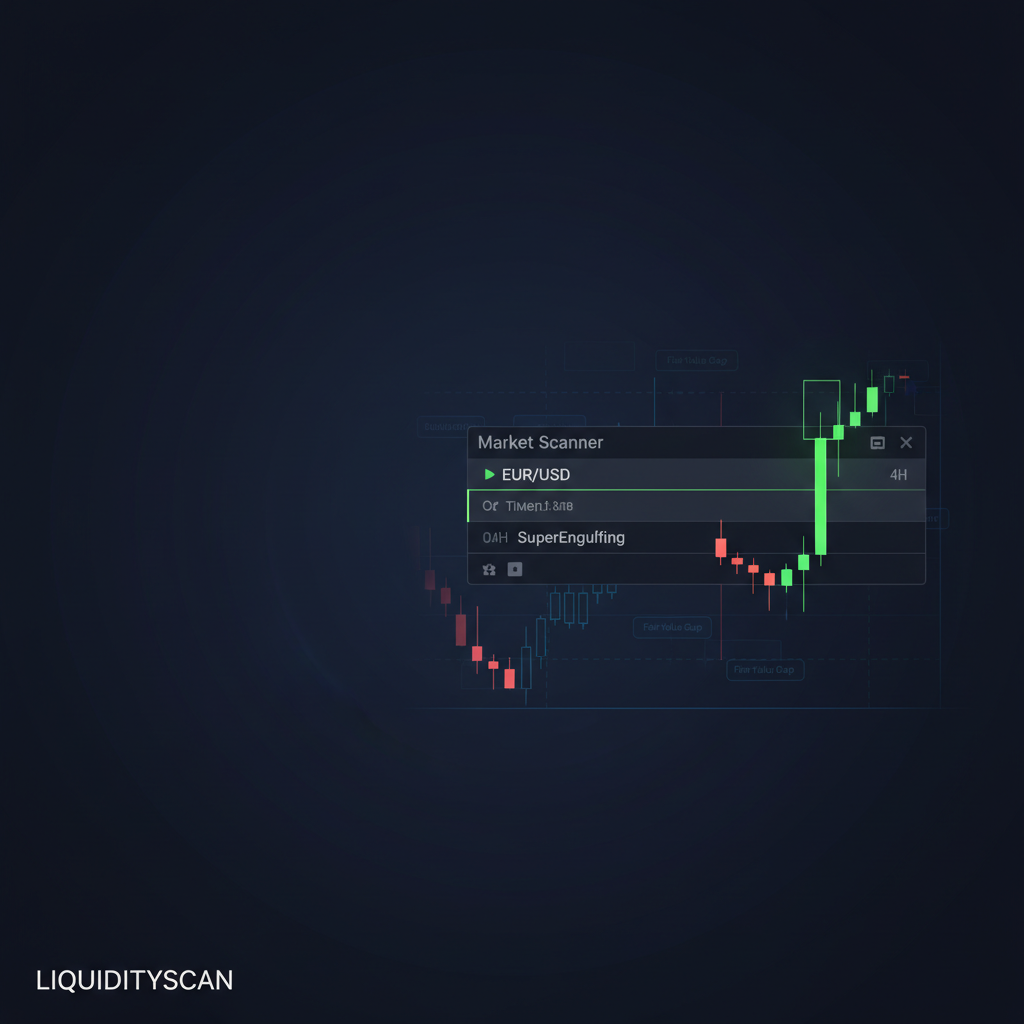
Put plainly, it hunts for the fingerprints of institutional activity in real time, at scale. It won't tell you to buy or sell. What it does is surface high-probability conditions grounded in the core principles of ICT/SMC, so a discretionary trader can spend time on the best opportunities the market is offering instead of clicking through chart after chart.
Key Points
- Real-Time Scanning: Monitors 400+ crypto, forex, and futures markets for ICT/SMC patterns on closed candles, eliminating the noise of live wicks.
- Institutional Focus: Detects high-probability setups like SuperEngulfing candles, changes in the state of delivery (CISD), and three order block (3OB) arrays.
- Multi-Surface Workflow: Comprises three integrated tools—Scanner, Pulse, and Core Layer—to support discovery, monitoring, and deep analysis.
- Methodology-Centric: Built by and for serious practitioners of institutional trading concepts. This is a professional tool, not a retail signal service.
The Three Core Surfaces: Scanner, Pulse, and Core Layer
LiquidityScan isn't a single dashboard. It's an integrated workflow that mirrors how a professional actually works the market: from broad discovery, to focused monitoring, to the analysis that informs execution.
The Scanner: Market-Wide Discovery
The Scanner is the platform's wide-angle lens. It answers one question, and only one: "Where, across all 400+ markets and every timeframe, is a potential institutional footprint forming right now?"
Behind it sit pattern-recognition engines—SuperEngulfing, Candle Range Theory (CRT), Institutional Bias—running on every closed candle. Say a bullish 4H order block forms on GBP/JPY during the London session. The Scanner flags it the moment that candle closes. That's the grunt work of finding a point of interest, done for you.
Pulse: High-Conviction Monitoring
When the Scanner catches something worth watching, that specific setup gets promoted to Pulse. Think of Pulse as a dynamic, high-conviction watchlist. It takes the Scanner's initial alert and follows where the setup goes from there.
Did price come back to mitigate the order block? Has the fair value gap filled? Pulse tracks the story as it develops, pushing updates through the platform and over Telegram. The point is to keep your attention on the handful of setups that match your criteria for engagement—and to keep everything else out of your face.
Core Layer: Deep Analytical Engine
Core Layer is the analytical engine underneath all of it. It's the microscope that takes you from "what" to "why." When the Scanner flags a CISD pattern on ES futures, Core Layer lets you pull up every prior instance of that pattern on that asset and study exactly what price did afterward.
This isn't a tool for live decisions. It's for deep research, for backtesting a model, for building genuine statistical confidence in a setup before you ever risk capital on it. It's the historical, data-driven floor your trading model stands on.
A Data-Driven Approach to ICT/SMC
The concepts inside the ICT/SMC framework are models for reading market dynamics—the way market structure shifts, where liquidity pools, how price delivers between premium and discount. They're a powerful lens for viewing price action. But a lens is useless without light, and data is that light.
Markets are, at bottom, mechanisms for matching orders and transferring risk. That underlying reality—often called market microstructure—is what generates the patterns we trade in the first place. The platform exists to quantify those patterns objectively, with the hype and the confirmation bias stripped out.
I built LiquidityScan because I was sick of the manual grind. I'd burn hours flipping through charts chasing one specific sequence: a liquidity sweep, then displacement, leaving a fair value gap and an order block in its wake. I knew the pattern worked. But spotting it in time, across enough pairs to keep a consistent deal flow going, was a full-time job on its own. The platform takes over that discovery process.
It's a tool for people who already speak the language of institutional trading. It isn't for beginners shopping for easy signals. It's for prop traders, fund analysts, and advanced retail traders who need to scale how many opportunities they can find and validate. The platform finds the setup; you bring the narrative, the risk management, and the call to pull the trigger.