
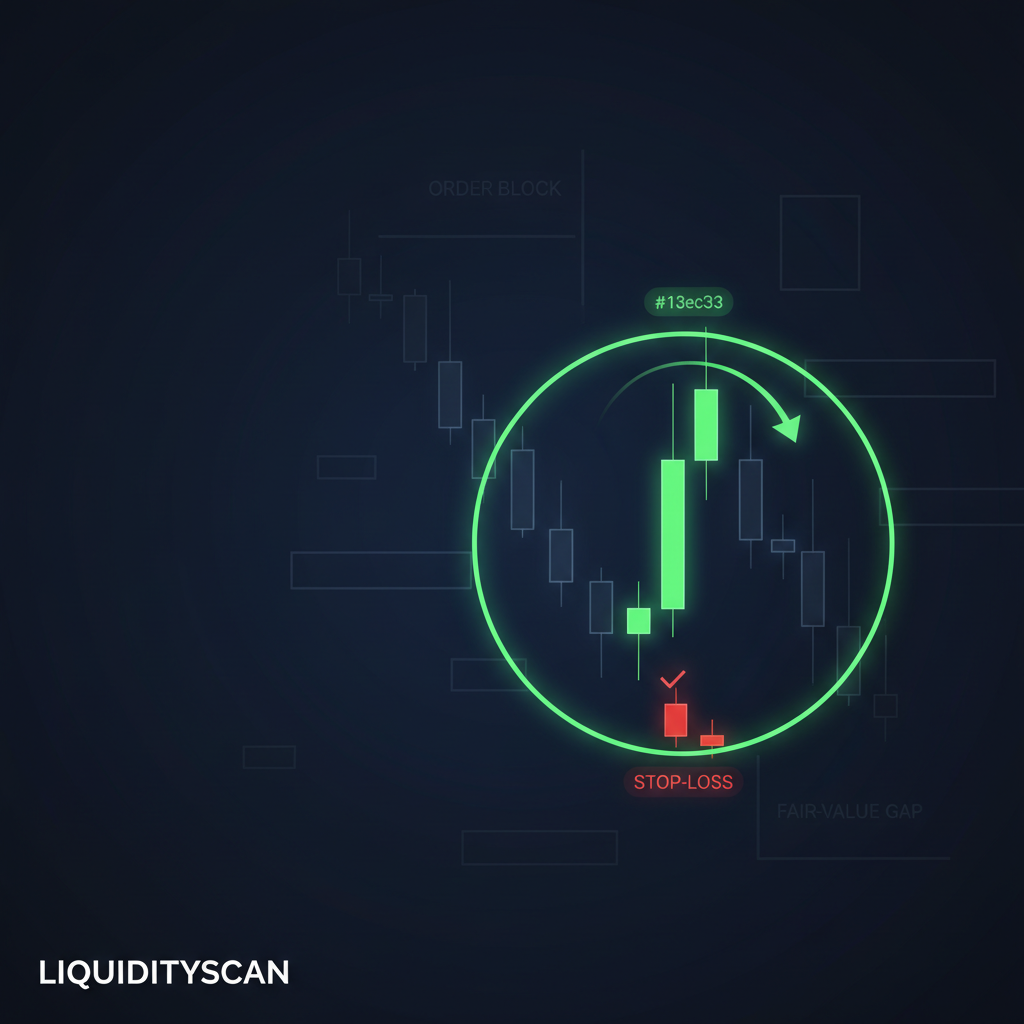
CISD in ICT trading (Change in State of Delivery) is the candle-close-confirmed moment price flips from one delivery direction to the other. It is confirmed when a candle closes back through the opening price of the consecutive same-direction candle series that immediately preceded the move into the most recent swing extreme.
For a bullish CISD, that reference is the open of the down-close candles that drove the final push into the low; for a bearish CISD, it is the open of the up-close candles into the high.
In ICT's framework, price is modeled as algorithmically delivered in one of two states — being delivered higher (bullish) or lower (bearish) — and a CISD is the close that signals delivery has switched sides.
Because it is anchored to a specific candle open and validated only on the close, it is one of the most objective shift signals in the Inner Circle Trader toolkit.
This guide covers exactly what a Change in State of Delivery is, how to identify a bullish and a bearish CISD step by step, why it pairs with a liquidity sweep, how it confirms an entry, and how it differs from a Market Structure Shift (MSS), BOS, and CHoCH.
If you are building the foundations, the definitive guide to ICT trading covers the surrounding framework this concept lives inside.
On this page:
- What CISD in ICT trading means
- How to identify a CISD step by step
- CISD after a liquidity sweep
- How a CISD confirms an entry
- CISD vs MSS vs BOS vs CHoCH
- Common CISD mistakes
- How to find CISD setups automatically
- Related query paths
- Frequently Asked Questions
What CISD in ICT trading means
In ICT's model, the market is always in one of two delivery states: it is either delivering price higher (a bullish state, drawing on buy-side liquidity above) or delivering price lower (a bearish state, drawing on sell-side liquidity below). The "state of delivery" is simply which of those two regimes the algorithm is currently running.
A Change in State of Delivery is the transition between those regimes. It is a mechanical event defined by one thing: price closing through a reference level.
That reference is the opening price of the consecutive same-direction candles that drove the final push into the most recent extreme — the candles being reversed and reclaimed, not the leg moving in the new direction.
For a bullish flip, that is the run of down-close candles into the low; for a bearish flip, the run of up-close candles into the high. When price closes beyond the open of that opposing run, the prior delivery is invalidated and a new state begins.
The close through the open level is the CISD. Displacement — an energetic, expansive move rather than a slow grind — is the quality filter that separates a high-probability CISD from a weak one.
A CISD can technically print without strong displacement, but the close that arrives with displacement is the one that signals genuine institutional order flow drove the reclaim, and it is the version worth trading.
How to identify a CISD step by step
The mechanics are identical in both directions; only the polarity flips. This guide uses the disciplined, candle-level method throughout. Here is the repeatable process for a bearish-to-bullish CISD (price was being delivered lower, then flips up):
- Find the most recent low and the run that made it. Identify the consecutive bearish candles (the "down-delivery leg") that pushed price into its latest swing low — frequently a low that swept resting liquidity.
- Mark the opening price of that bearish run. The reference is the open of the consecutive down-close candles immediately preceding the reversal, at the swing low. That is the price the algorithm started delivering down from. (A looser variant marks the open of the swing's range; the disciplined version above is the one this guide uses and the one ICT teaching favors.)
- Wait for a candle to CLOSE above that open. Not a wick, not a tap — a full-body close above the marked open. That close is the Change in State of Delivery: delivery has flipped from bearish to bullish.
- Grade the strength with displacement. The strongest CISDs close through the reference open with displacement, frequently leaving behind a fair value gap or an order block in the move — your refined entry zone.
For a bullish-to-bearish CISD, invert every step: find the up-delivery run into the most recent high, mark the open of those consecutive bullish candles, and wait for a candle to close below it. That close is your bearish Change in State of Delivery.
Why displacement matters for grading
A CISD candle that closes through the reference open while creating a fair value gap is the highest-quality version of the signal: it confirms the delivery flip and simultaneously hands you a discounted (for a bullish flip) or premium (for a bearish flip) zone to enter from on the retracement.
A slow, overlapping close through the same level technically meets the definition but lacks the institutional footprint, and should be traded with far more caution.
CISD after a liquidity sweep: the highest-probability sequence
A CISD rarely works in isolation. The textbook ICT sequence is sweep, then shift, then enter. Price first runs a pool of stops — a liquidity sweep that takes out an obvious high or low where stops and pending orders rest. In ICT's model, that sweep is the algorithm sourcing the orders it needs.
Immediately after, if delivery is genuinely reversing, price closes back through the opening of the run that created the swept extreme — the CISD. The sweep gives you the reason; the CISD gives you the confirmation.
This is why internal versus external liquidity matters: a CISD that forms right after price raids external liquidity (a major session high or low) is far more significant than one printing inside a consolidation. The deeper the liquidity that was swept, the more meaningful the change in state of delivery that follows it.
How a CISD confirms an entry
On its own, the CISD candle is your confirmation event — the signal that bias has flipped. But entering on the close of a fast displacement candle means a wide stop and poor risk-to-reward. The professional approach is to use the CISD to validate direction, then enter on the retracement into the imbalance the shift left behind.
- Confirmation: the CISD close prints, so bias is now bullish (or bearish).
- Entry zone: mark the fair value gap or order block inside the CISD displacement leg.
- Trigger: enter on the pullback into that zone, anchoring your stop beyond the swept extreme (the wick of the sweep), not at the CISD candle.
- Target: the opposing liquidity pool the new delivery state is now drawing toward.
Because the stop sits past the swing the algorithm just rejected, a clean sweep-plus-CISD entry produces tight invalidation and asymmetric reward.
CISD vs MSS vs BOS vs CHoCH
These terms get used interchangeably, and that costs traders precision. All four describe a "something flipped" event, but they confirm at different thresholds. By the standard ICT/SMC convention: BOS confirms continuation, CHoCH and MSS confirm a structural reversal at a swing point, and CISD confirms the delivery mechanic behind that reversal at the candle-open level.
Terminology varies across the community — some traders use MSS and BOS interchangeably for any structure break — so the labels matter less than the rules behind them. For the structural side specifically, our BOS vs CHoCH guide goes deeper.
| Concept | What it confirms | Reference level | Confirmation rule | Typical use |
|---|---|---|---|---|
| CISD (Change in State of Delivery) | The delivery direction flipped | Open of the consecutive opposing-direction candles into the recent high/low | Candle closes through that open (displacement = high-quality) | Precise reversal/entry confirmation after a sweep |
| MSS (Market Structure Shift) | Structure reversed against the prior trend | Most recent protected swing high/low | Displacement break of that swing (displacement required) | Signalling trend reversal; close cousin of CISD |
| BOS (Break of Structure) | Trend continuation | The prior swing in the trend's direction | Price breaks the swing in the existing trend | Confirming an ongoing trend, trailing bias |
| CHoCH (Change of Character) | First sign trend may be reversing | The last opposing swing point | Break of the last counter-trend swing (no displacement required) | Early reversal warning (SMC term) |
The key distinction: MSS, BOS, and CHoCH all reference a swing point (a high or low). CISD references a candle open — the start of the opposing delivery run.
The technical line between MSS and CHoCH is displacement: an MSS requires a displacement-driven break through the swing, whereas a CHoCH (in pure SMC) can register on any break of the opposing swing.
Because CISD references a candle open rather than a swing point, it often confirms slightly earlier than an MSS and can foreshadow it — one common interpretation treats CISD as the granular, candle-level read of the same reversal an MSS later confirms, though not every CISD precedes an MSS and the two can resolve on the same close.
If your structure vocabulary still feels fuzzy, the primer on market structure in ICT is the place to anchor these terms.
CISD vs CHoCH: are they the same?
No — and this is the most common conflation. A CHoCH is a Smart Money Concepts label that fires when price breaks the last opposing swing; it is commonly taught on a body close through that swing, though many traders accept a wick break.
A CISD fires on a different reference — the open of the opposing delivery run — and requires a body close through that open.
They often align (a CISD frequently leads into a CHoCH), but they are not interchangeable: CISD adds the candle-open anchor and the displacement quality filter that a bare CHoCH does not require.
Common CISD mistakes
- Using a wick instead of a close. CISD is a close-confirmed event. A wick through the reference open is not a Change in State of Delivery — it is often the sweep itself.
- Marking the wrong reference. The level is the open of the consecutive opposing-direction run into the extreme, not a random nearby candle or the swing's wick. Get the run wrong and every downstream level is wrong.
- Ignoring the sweep prerequisite. A CISD with no preceding liquidity grab is far weaker. The best ones reverse delivery immediately after raiding a real pool of liquidity.
- Treating a weak close as tradable. A slow, overlapping close through the open lacks the institutional footprint. Grade it: demand displacement and ideally a fair value gap before sizing in.
- Wrong timeframe alignment. A 1-minute CISD that fights a clean higher-timeframe bearish state of delivery is fighting the prevailing draw. Always read a CISD in the context of higher-timeframe delivery direction.
- Chasing the close. Entering on the CISD candle itself instead of the retracement into its imbalance bloats your stop and wrecks risk-to-reward.
How to find CISD setups automatically
Spotting a Change in State of Delivery by hand across dozens of pairs and timeframes is slow, and the close-confirmation window — when a candle actually completes through the reference open — is rarely when you can be at the screen. Real-time scanning fills that gap.
LiquidityScan's CISD scanner detects these delivery flips the moment a candle closes through the reference open, alongside the context that makes them tradable: the liquidity sweep that preceded the shift, the order block or fair value gap left in the displacement leg, and the timeframe it printed on — across 400+ crypto and TradFi markets.
Instead of watching charts waiting for a close, you get the alert when the state of delivery actually changes, with the sweep and imbalance already mapped. The full feature set is on the what is LiquidityScan overview, and the scanning, alerting, and multi-market coverage tiers are on the pricing page.
CISD removes guesswork from a reversal call: a specific reference level, a specific close, a specific shift in delivery. Master the sweep-then-shift sequence, respect the candle close, grade strength by displacement, and use the imbalance for entry — then let a scanner surface the shifts so you act only when delivery genuinely changes sides.
Frequently Asked Questions
What is CISD in ICT trading?
CISD stands for Change in State of Delivery.
It is the candle-close-confirmed moment price flips from being delivered in one direction to the other, identified when a candle closes through the open of the consecutive opposing-direction candles that pushed price into the most recent swing extreme — the down-close run into a low for a bullish flip, or the up-close run into a high for a bearish flip.
It signals the algorithm has switched delivery direction.
What is the difference between CISD and MSS?
An MSS (Market Structure Shift) confirms when price breaks a protected swing high or low with displacement. A CISD references the open of the opposing delivery run instead of the swing point, so it often confirms slightly earlier.
Many traders treat CISD as the granular, candle-level read of the reversal an MSS later confirms, though the two can also resolve on the same close.
Is CISD the same as CHoCH?
No. A CHoCH (Change of Character) fires when price breaks the last opposing swing and, in pure SMC, does not require displacement. A CISD requires a body close through the open of the opposing delivery run and is strongest when that close carries displacement.
They frequently align, but CISD adds a candle-open anchor and a quality filter a bare CHoCH does not.
How do you trade a CISD?
Wait for a liquidity sweep, then for a candle to close through the open of the opposing run that made the swept extreme (the CISD). Mark the fair value gap or order block left in that displacement leg, enter on the retracement into it, place your stop beyond the swept wick, and target the opposing liquidity pool.
What timeframe is best for CISD?
CISD works on any timeframe, but it is most reliable when the lower-timeframe shift aligns with the higher-timeframe state of delivery and the prevailing draw on liquidity. Set the higher timeframe to your dealing range and draw (for example 1H or 15M), then refine CISD entries on a lower one (such as 5M or 1M).
The fixed pairs are illustrative — the rule is to align the CISD timeframe with the higher-timeframe direction.
Does a CISD need a liquidity sweep first?
Not strictly, but the highest-probability CISDs form immediately after a liquidity sweep. The sweep sources the orders the algorithm needs and gives the reversal its reason; the CISD then confirms delivery has flipped. A CISD with no preceding sweep, especially inside consolidation, is much weaker.
Related query paths
Follow the framework in the order a CISD setup actually unfolds — the liquidity that gets swept, the imbalance the shift leaves behind, and the structure it sits inside:
- Liquidity Sweeps — the stop raid that precedes and justifies a CISD.
- Internal vs External Liquidity — which pool was swept, and why it sets the CISD's weight.
- Fair Value Gaps (FVG) — the imbalance the CISD displacement leaves for your entry.
- Order Blocks — the refined zone to enter the retracement from.
- Market Structure in ICT — the structural frame a CISD reads inside.
- BOS vs CHoCH — the structural cousins a CISD often precedes.
- The Definitive Guide to ICT Trading — the parent framework this concept lives inside.