
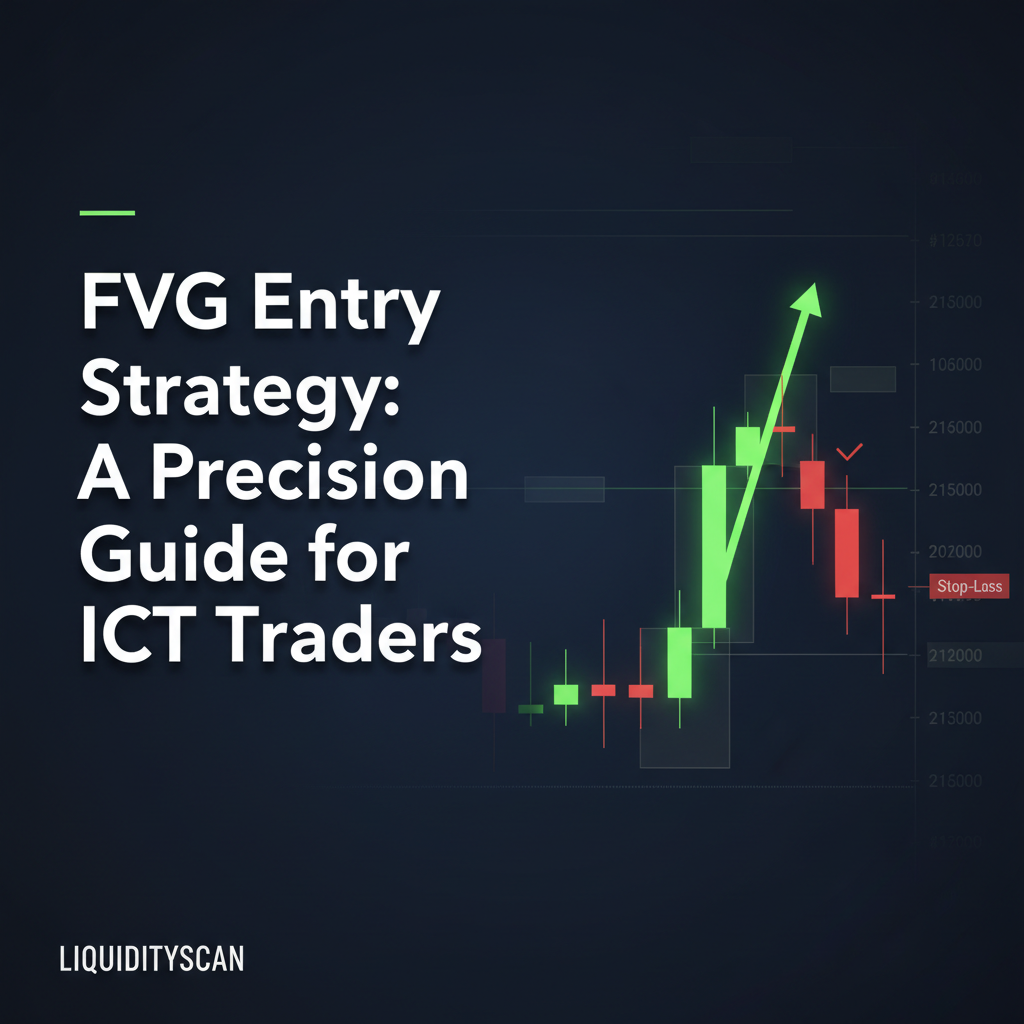
Most traders can spot a Fair Value Gap. Far fewer can pull a clean trade out of one. This guide is about the second part — the mechanics of actually getting in, not just drawing the box.
Defining a Tradable Fair Value Gap
Before any entry strategy is worth your time, the gap itself has to be valid. Not every three-candle imbalance counts. A high-probability Fair Value Gap isn't just a pattern on the chart — it's a footprint left by aggressive order flow, the kind that telegraphs real intent. These gaps form when price moves so fast in one direction that the market never gets to trade efficiently on both sides, a dynamic spelled out even in institutional literature from sources like the CME Group on market dynamics.
A tradable FVG has a few traits I won't compromise on:
- Creation by Displacement: The candle that prints the FVG has to be large and energetic — a clear show of intent to move price. A small, indecisive candle inside a range doesn't qualify.
- Breaks Market Structure: That same move has to produce a clean Break of Structure (BOS) or Market Structure Shift (MSS). This is what tells you the gap belongs to a fresh, committed leg rather than random noise. If you're still fuzzy on the distinction between the two, BOS versus CHoCH is worth a read before you go further.
- Contextual Location: A bullish FVG carries more weight when it forms after sweeping sell-side liquidity and sits in a discount area of the parent leg. A bearish FVG is stronger after a buy-side sweep, parked up in premium. This is straight premium and discount logic.
An FVG that misses these is noise, and trading it is a coin flip. I've watched plenty of traders fire at every little gap during a choppy Asian session on EUR/USD, only to hand their stops over as liquidity for the real move once the London kill zone opened. Context is the whole game.
Core FVG Entry Models: The Retracement and the Inversion
Once you've got a valid, high-probability FVG in front of you, there are two main ways in. Which one you use comes down to how price behaves on its first trip back to the gap.
Model 1: The Classic Retracement Entry
This is the textbook version. A displacement move creates a BOS and leaves an FVG, then we wait for price to retrace into it. The entry isn't slapped on at the edge of the gap — we want confirmation first.
The procedure is the same every time:
- Identify the Higher Timeframe (HTF) FVG: Find a valid FVG on something like the 1H or 15M that lines up with your directional bias. Say we get a bullish BOS on the 15M EUR/USD, leaving an FVG from 1.0720 to 1.0730.
- Wait for the Retracement: Let price trade back down into the boundaries of that gap. This is where patience pays — front-running the entry is how you get swept.
- Seek Lower Timeframe (LTF) Confirmation: Drop to a 1M or 3M chart. As price works inside the 15M FVG, you want a bullish Market Structure Shift on the LTF — say a 1M high breaking with displacement right after the gap is tapped.
- Execute on the LTF Signal: The entry comes off that LTF confirmation. Often it's the small FVG or order block left by the 1M MSS. Stop goes below the low that built the LTF shift, which should still sit inside the larger HTF gap.
This filters out the weak reactions. If price just melts straight through the HTF FVG with no bullish response on the lower timeframe, there's no trade and your capital stays put.
Model 2: The Inversion FVG (IFVG) Entry
So what happens when a gap you thought was valid simply fails? Price drives straight through it without flinching, and that FVG inverts — it flips polarity. A bullish FVG that fails starts acting as resistance. A bearish FVG that fails starts acting as support. It's a deceptively powerful idea.
An Inversion FVG entry tells you continuation is strong. Picture a bearish FVG on the NAS100 5M chart. The market's bullish, and price rips right through that bearish gap. You expected rejection; you got none. That disrespect is the tell — buyers are leaning in hard. Now you watch for price to pull back and test the same FVG, this time as support. A bounce off that level gives you a high-probability long, stop tucked just below the far side of the inverted gap. The reasoning: the inefficiency has been accepted and repriced as a new level of balance.
Refining Your Entry: Confluence and Confirmation
Trading an FVG is rarely about the gap on its own. The best setups show up when the gap lines up with other ICT concepts. Stacking those confluences is what separates real execution from chasing patterns.
One of the more important levels inside any gap is its midpoint — the Consequent Encroachment (CE). A tap of the outer edge is a weak reaction. A deeper push to or just past the 50% CE before reversing tells you price actually engaged with the orders sitting in the gap. Waiting for that CE reaction, especially on indices like ES or NQ during the New York session, tends to hand me a better risk-to-reward entry than fading the edge ever does. If you want the session backdrop, our New York AM kill zone breakdown covers the timing.
The other big one is Optimal Trade Entry (OTE). Pull a Fibonacci from the start of the displacement move to its end — the swing high or low — and mark the 0.62 to 0.79 retracement zone. When a clean FVG sits inside that OTE window, the odds of a strong reaction jump. An FVG at OTE is an A+ setup because you're getting both a price inefficiency and a deep, discounted pullback at once. There's more nuance to the institutional read on it in our piece on OTE versus retail Fibs.
Tracking all of this by hand across dozens of markets isn't realistic. That's where tooling earns its keep. LiquidityScan can be set to alert you only when an FVG forms as part of a confirmed Break of Structure. The CRT (Candle Range Theory) engine hunts specifically for these displacement patterns, so you're not pinged on every random gap — only the ones with structural weight behind them. That lets you put your attention on the FVGs that actually matter and start your LTF analysis from a pre-qualified spot. If you'd rather confirm the gap by hand, validating FVGs with order flow walks through the manual version.
In the end, a working FVG entry strategy isn't one clever trick. It's a process of elimination. You filter for displacement and a BOS, wait for a retrace into the right premium or discount zone, look for confluence with OTE or an order block, then demand confirmation on a lower timeframe before any capital goes out the door. Disciplined, repeatable, and built on the logic of institutional order flow.
Related reading
- OTE Explained: The ICT Optimal Trade Entry Zone
- Balanced Price Range (BPR): The ICT Reversal Zone
- Consequent Encroachment: The 50% FVG Rule
- Step-by-Step Entry Criteria for the 2024 Model
- 5 Common Risk Management Mistakes That Invalidate ICT Strategies
- Silver Bullet Strategy: Complete Checklist & Examples