
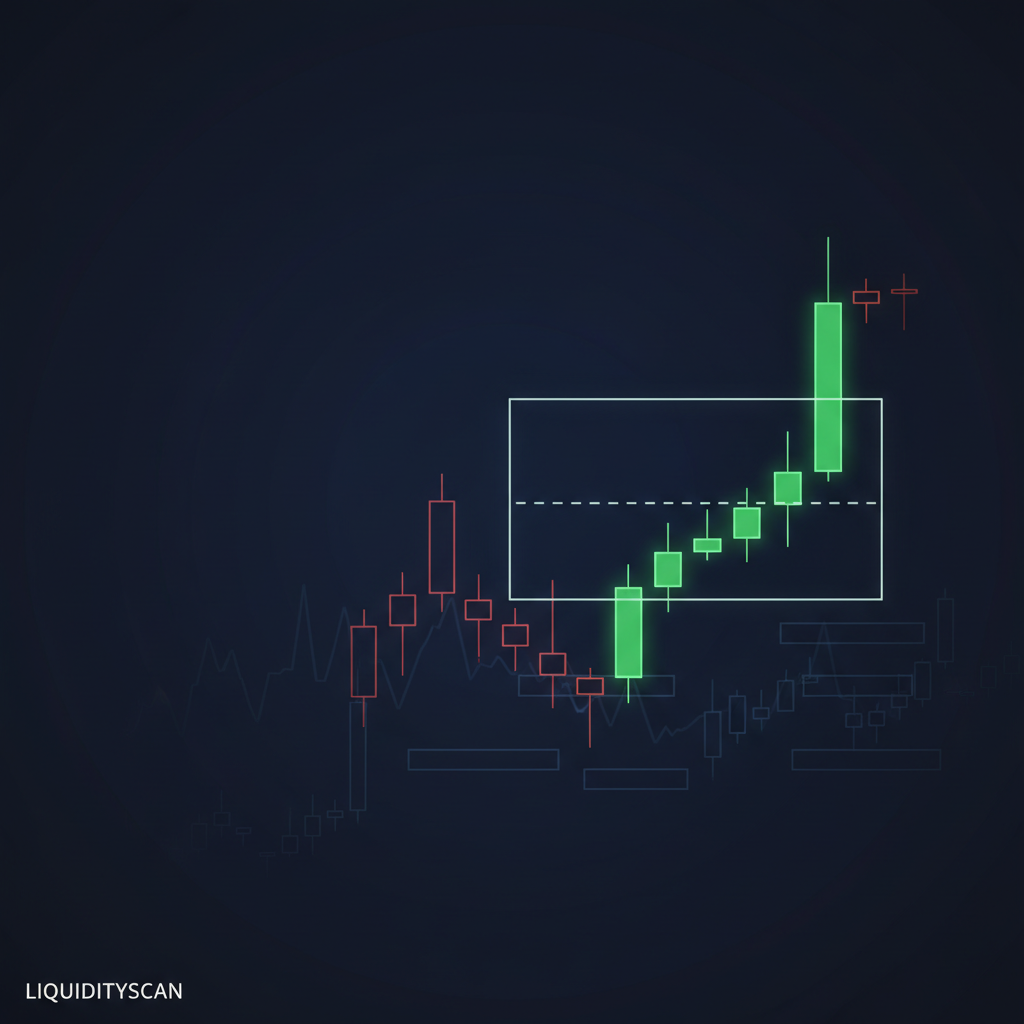
What Is Consequent Encroachment (CE)?
Consequent encroachment, usually shortened to CE, is the exact 50% midpoint of a Fair Value Gap. It is not a separate pattern — it is a level that lives inside the gap.
The idea borrows from the classic 50% Fibonacci retracement, which markets treat as the point of equilibrium. Half of the imbalance is filled at the CE, half remains.
If you are new to the gap itself, the FVG is the three-candle imbalance the CE sits inside — I link a full explainer in the Related query paths below rather than re-teach it here.
How to Find the CE (the Exact 50% Midpoint)
Finding the CE is pure arithmetic. Take the high of the gap and the low of the gap, add them, and divide by two.
CE = (gap high + gap low) / 2. That single price is your consequent encroachment. Nothing else about the gap changes the calculation.
On most charting platforms you can draw a Fibonacci tool from one edge of the gap to the other and read the 50% line directly. That line is your CE — mark it as a dashed level so it stands apart from the gap boundaries.
Why the CE Level Matters
The CE matters because it turns a wide zone into a single decision point. A Fair Value Gap can be dozens of pips or dollars tall, and entering at a random spot inside it is guesswork.
Equilibrium is the key concept. Above the CE you are in the premium half of the gap; below it you are in the discount half. Buyers want discount, sellers want premium.
Partial fills are the other reason the CE earns attention. Price often taps the 50% and reverses without filling the whole gap, so the CE frames both your entry and where to anchor a stop just beyond the gap edge.
How to Trade With the CE
Trading the CE is entry refinement, not a new system. Instead of buying the top of a bullish FVG, you wait for price to trade down to the 50% before committing.
For a long, mark the bullish gap, draw the CE, and let price discount into that midpoint. Your stop sits below the gap low, giving a tighter risk than an edge entry would.
For a short, you reverse it: wait for price to rally into the CE of a bearish gap, then look for a rejection. In my own routine I combine this with order-flow confirmation so I am not blindly limit-buying a level — a guide on validating the fill is linked below.
Tools like LiquidityScan help flag fresh imbalances so you can mark the CE before price gets there rather than after.
CE in Other PD Arrays
The consequent encroachment is not exclusive to Fair Value Gaps. Any price-delivery array with two clear boundaries has a usable 50%.
On an order block, the CE is the midpoint of the block's body or wick range, and price often reacts there before continuing. On a Balanced Price Range (BPR) — where a bullish and bearish FVG overlap — the CE of the overlap is a high-probability turning point.
The rule stays identical everywhere: add the two extremes, halve them, and treat that line as equilibrium.
Frequently Asked Questions
Is consequent encroachment the same as the 50% of an FVG?
Yes. Consequent encroachment is simply the ICT term for the exact 50% midpoint of a Fair Value Gap, calculated as (gap high + gap low) divided by two.
Should I always enter at the CE instead of the gap edge?
Not always. The CE gives a tighter stop and better fill, but strong momentum moves may only tag the edge. Many traders scale, taking part at the edge and part at the CE.
Does the CE work on any timeframe?
Yes. The 50% calculation is timeframe-agnostic, so the CE is valid on a 1-minute gap or a monthly gap. Higher-timeframe CEs simply tend to be more significant.
Related query paths
Start with the gap itself, then work toward precise entries around the CE.
- What Is a Fair Value Gap (FVG)? — the gap the CE sits inside.
- FVG Entry Strategy: A Precision Guide — how to enter on FVGs using the midpoint.
- Validating FVG With Order Flow — confirming the fill before you commit to a CE entry.