
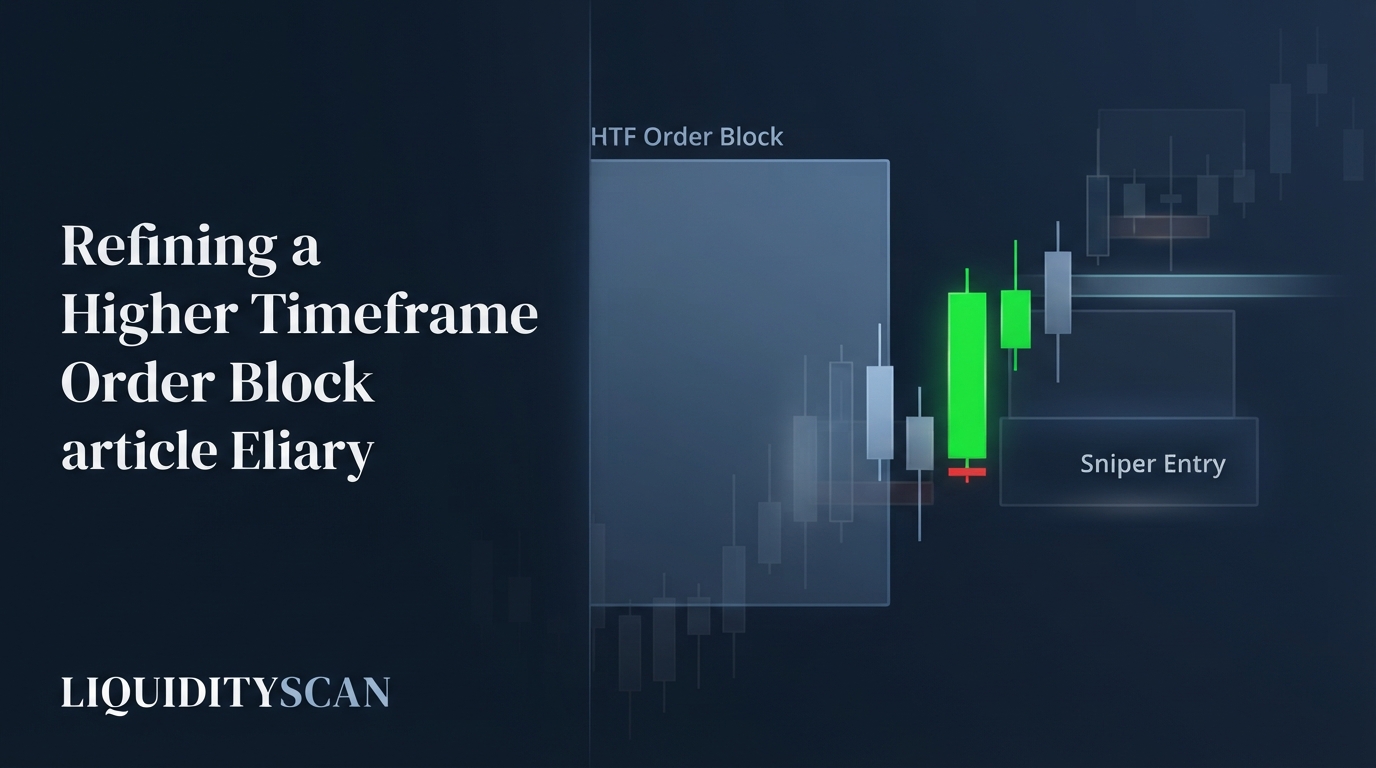
What Is Order Block Refinement?
Order block refinement narrows a wide higher-timeframe (HTF) zone to the lower-timeframe candle at its true origin — the one that produced the displacement leg. The 400-point 4H block becomes a 90-point band, so risk hides behind real structure and reward-to-risk multiplies on an unchanged target.
The Order Block on a high timeframe is a decision zone, not a price. It marks the area where institutional orders were placed before an impulsive move, but that area is deliberately imprecise. Refinement resolves that imprecision. It changes neither your entry idea nor your target — only where risk is defined, which is where reward-to-risk is won or lost.
Two traders can take the identical setup on the same pair, same direction, same target. One risks the full HTF zone and books 2R. The other refines to the origin candle and books 8R. The edge is not the read; it is the resolution of the entry.
An HTF order block is defined by a single candle's range — typically the last down-close candle before a bullish impulse, or the last up-close before a bearish one. On a 4H chart, that candle's body plus wick can easily span 300–500 points on an index or 40–80 pips on a major FX pair. Traded raw, that width creates three problems:
- Fat stop, capped R:R. The same target divided by a 400-point stop yields a fraction of the R available from a tighter stop, no matter how good the read.
- Ambiguous entry. Price can trade 350 points into the block before reversing, so a top-edge limit fills far from the actual turn while a bottom-edge limit may never fill.
- No confirmation. The raw block gives you a zone but no evidence that this specific tap is the one institutions defend rather than a shallow reaction on the way lower.
Refinement fixes all three by finding the sub-structure inside the block that actually holds price.
How to Refine an Order Block Step by Step
The refinement chain moves from HTF context to LTF precision in a fixed order. Each step narrows the zone while keeping the trade anchored to the original HTF read. Do not skip the validation step — refining an invalid block just gives you a precise entry into a losing idea, which is worse than no entry at all.
Step 1 — Confirm the HTF block is valid
Before refining anything, the HTF order block must have already done two things: swept liquidity and produced displacement. The origin candle should sit at the base of an impulsive leg that broke structure with a Fair Value Gap (FVG) left behind.
If the block has not caused displacement, it is not a live order block, and refinement is wasted effort. This is the core validation gate that everything downstream depends on.
Step 2 — Drop to an intermediate timeframe
Move from the HTF block to one intermediate timeframe — 4H to 15m is a clean ratio. Load the 15m chart and isolate only the price action inside the HTF block's range. You are no longer looking at the whole market; you are looking inside one 4H candle's territory, where its internal structure becomes visible.
Step 3 — Find the LTF order block or FVG that caused the LTF displacement
Inside the HTF zone, locate the specific 15m order block or Fair Value Gap (FVG) that produced the displacement leg out of the zone. That LTF structure is the true origin — the narrow band institutions actually left orders in. Your refined zone is now the 15m block, often one-fifth the width of the 4H block.
Step 4 — Refine again to the entry timeframe if needed
For a sniper fill, drop once more — 15m to 3m or 1m — and mark the exact candle inside the 15m block that caused its displacement. This is optional and only worth doing when the pair moves cleanly. On fast or thin markets, stop at the intermediate timeframe; over-refining into 1m noise gets you swept before the move.
Alternatives to a Full Drill-Down
You do not always need to descend three timeframes. Three lighter refinements capture most of the R:R benefit with less screen time:
- Mean-threshold refinement. Trade only the 50%-to-far-edge half of the block. The 50% level is the Consequent Encroachment of the zone; price that trades past it into the deeper half is where reactions cluster. This alone roughly halves your risk versus the top edge.
- Body-only refinement. Ignore the wick and use the candle body as the zone. Institutional interest sits in the body's open-to-close range; the wick is often just the sweep. This trims a large-wicked block substantially.
- FVG-within-the-block. If the impulse out of the block left an FVG that partially overlaps the block, treat the overlap as the sniper zone. It is the highest-confluence pocket — order block and imbalance stacked — and usually the tightest.
These three are not mutually exclusive. The strongest lightweight refinement combines them: take the body-only range, keep the half below its 50% mean threshold, and require an overlapping FVG. When all three agree on the same narrow band, you have found the origin without ever leaving the intermediate timeframe, which is why many traders never need the third drill-down at all.
The Reward-to-Risk Math of Refinement
Refinement multiplies R because the numerator (distance to target) is fixed while you shrink the denominator (stop distance). Consider a long on an index at a target 800 points above entry:
| Approach | Zone width / stop | Distance to target | Reward-to-risk |
|---|---|---|---|
| Raw 4H block | 400 pt stop | 800 pt | 2.0R |
| Refined 15m block | 90 pt stop | 720 pt | 8.0R |
Same trade, same idea, same target. Cutting the stop from 400 to 90 points takes the setup from 2R to 8R — a 4x improvement in payout per unit of risk.
Over a sample of trades, that difference is the gap between a break-even system and a profitable one. A 40% hit rate at 8R is wildly positive, while the same 40% at 2R barely survives costs.
The math generalizes cleanly. Because the stop sits in the denominator, halving zone width roughly doubles R while direction risk is unchanged. So the marginal return on each refinement step is large early and shrinks as the stop approaches the noise floor — the honest reason to refine, and the honest reason to stop.
The illustrative figures above are rounded to make the ratio obvious; on your own data the exact numbers will vary by instrument and session, but the direction of the effect is consistent. Order block refinement is where the R:R edge actually lives, provided you verify the tightened stop still clears real structure on a backtest before trusting it live.
Over-Refinement and When Not to Refine
Tighter is not automatically better. A stop that hugs a 1m candle too closely gets clipped by ordinary noise before the intended move develops. This is the precision-versus-hit-rate tradeoff: every point you shave off the stop raises R but also raises the odds of a premature stop-out.
The failure mode is real. Refine a 4H block down to a 1m origin during London, and a single volatile 15-second spike — a routine sweep of the LTF low — takes you out at the exact level institutions intended to run before reversing. You were right on direction and still lost, because the stop lived inside the noise band.
The balance point: refine until the stop sits just beyond the nearest LTF liquidity pool — the low the market must not break to keep your idea alive — and no tighter. That places risk behind structure, not inside it.
Some conditions make refinement counterproductive altogether. Recognize them and take the wider zone or skip the trade:
- Fast markets. During high-impact news or a runaway trend, price blows through refined LTF zones without pausing. The intermediate timeframe is the floor here.
- Thin liquidity. Illiquid pairs and off-session hours produce erratic wicks that sweep tight stops for no reason. Wider zones survive the chop.
- The HTF block is already tight. If the 4H origin candle is a small-bodied 80-point candle, it is already a usable entry. Drilling further adds fragility for little R gain.
The recurring mistakes cluster around these limits. Over-tightening — chasing a 3-pip stop on a volatile pair — guarantees noise stop-outs. Refining too many timeframes fits the entry to random ticks rather than structure; three drops is the practical ceiling.
And refining a block that never swept liquidity or displaced is precision into a coin-flip. Validate first, respect the draw, and stop tightening once risk clears the nearest pool.
How HTF Context Governs Every Refinement
Refinement only earns its edge on blocks that agree with the higher-timeframe story. Two filters gate every zone:
- Draw on liquidity. The refined entry must point toward the market's Draw on Liquidity — the pool price is being delivered to. A perfectly refined block against the HTF draw is a countertrend gamble with a tight stop, which is the worst of both worlds.
- Premium and discount. Refine bullish blocks in Discount (below the dealing range's 50%) and bearish blocks in Premium. A refined long taken in premium is buying expensive; the tight stop does not fix a bad location.
Context first, refinement second. The drill-down sharpens a good read; it cannot rescue a bad one.
Worked Example: A 4H to 3m Refinement
EURUSD is in a discount relative to its weekly dealing range and the draw is a prior-week high sitting above current price — bias is long. On the 4H, price sweeps a session low, then displaces up and leaves an FVG. The last down-close 4H candle is the order block: range 1.0820–1.0860, a 40-pip zone.
Raw approach: buy limit at 1.0860, stop below 1.0820. Risk 40 pips, target the prior-week high at 1.0980 — 120 pips, so 3R.
Refine on 15m: inside the 4H block, price made a small down-move to 1.0828 then displaced up through 1.0855, leaving a 15m FVG and a 15m order block at 1.0828–1.0838. Refined zone is 10 pips wide.
Refine on 3m: the exact candle that caused the 15m displacement sits at 1.0830–1.0834. Entry 1.0834, stop 1.0827 (just below the 15m low, in liquidity's shadow). Risk is 7 pips to the same 1.0980 target — 146 pips, or roughly 20R.
The idea never changed; only the resolution did. A stop any tighter than 1.0827 would sit inside the sweep and get clipped. This is order block refinement working exactly as intended: same read, same target, radically tighter risk.
Frequently Asked Questions
What timeframe should I refine an order block down to?
Use a consistent ratio and stop when the stop sits just beyond LTF liquidity. A common chain is 4H to 15m to 3m, or Daily to 1H to 5m. On fast or thin markets, stop at the intermediate timeframe. Refining below 1m rarely adds edge and usually adds noise stop-outs.
Does refining an order block increase my win rate?
Not directly — it can slightly lower hit rate because tighter stops are easier to clip. What it increases is reward-to-risk. A refined entry lets a 40% hit rate produce strong returns at 8R that would be marginal at 2R. Refine for R, not for accuracy.
Should I use the wick or the body when refining?
Body-only refinement is a valid lighter method: the candle body holds the open-to-close institutional interest, while the wick is often just the sweep. Using the body trims a large-wicked block and tightens the stop, though you should still keep risk below the nearest LTF low or above the nearest high.
Can I refine an order block that has already been mitigated once?
Be cautious. A block that price already returned to and reacted from has partially spent its orders, so a second tap is lower quality. If you do take it, favor the unfilled FVG-within-the-block pocket rather than the full zone, and demand HTF draw alignment before committing risk.
Related query paths
Follow the natural progression from defining the order block to validating it and then placing precise multi-timeframe entries.
- What Is an Order Block? — nail the definition before you refine one.
- The Core Order Block Validation Rule for SMC Traders — the sweep-and-displacement gate every refinement depends on.
- ICT Top-Down Analysis: Multi-Timeframe Alignment — the HTF-to-LTF framework that governs the drill-down.
- Best Timeframe for Order Block Trading (ICT Guide) — pick the right timeframe pair for your refinement chain.
- Consequent Encroachment: The 50% FVG Rule — the mean-threshold level behind half-zone refinement.
- 3 High-Probability Order Block Entry Models — turn the refined zone into a repeatable entry trigger.
- Bullish vs Bearish Order Block: How to Identify and Mark Each — how it connects to bullish vs bearish order block.