
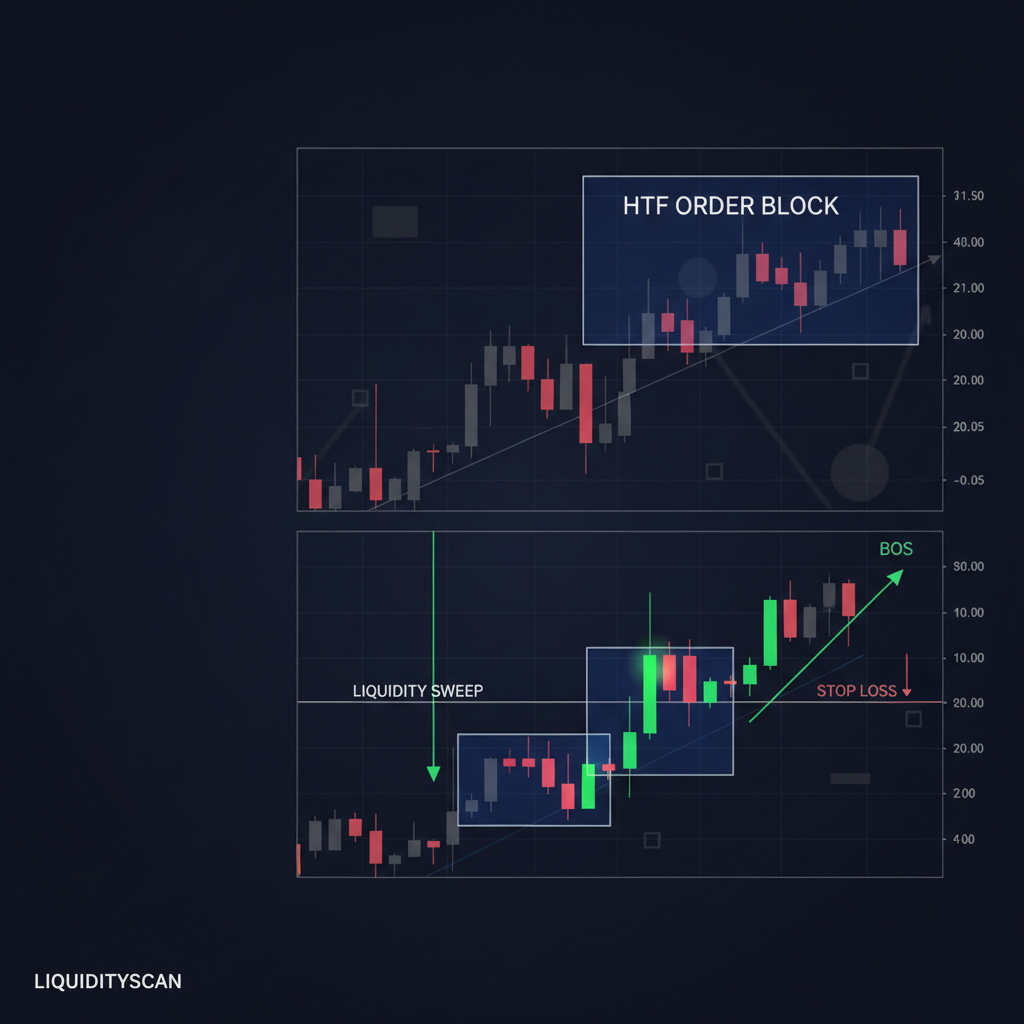
There is no single best timeframe for trading order blocks. The higher timeframe defines where an institutional zone actually matters, and the lower timeframe confirms your entry into it. What people call the "best timeframe" is really a pairing — a bias chart and an entry chart working together. Which pairing suits you depends on how long you intend to hold and when you trade.
An order block on the 1-minute chart means almost nothing without a reason for price to be there. An order block on the daily means a lot, but you'll wait forever to trade it precisely off that chart alone. The answer lives in combining the two.
The HTF defines the zone; the LTF confirms the entry
Split the job in two and the timeframe question mostly answers itself. Your higher timeframe (HTF) is where you mark the order block — this is the zone institutions are likely defending or accumulating against. Your lower timeframe (LTF) is where you drop in to time a precise entry once price reaches that zone.
The HTF gives you significance. A 4H bullish order block sitting below a run of equal lows carries weight because it aligns with a real liquidity draw. The LTF gives you precision. Once price taps that 4H block, you switch to the 5m or 1m to watch for a sweep, displacement, and a shift in structure before committing.
Trading a block without this split is the root of most frustration. You either enter too early off the HTF and eat a deep drawdown, or you enter off an LTF block that has no HTF reason to hold.
The common pairings and who they suit
Most consistent traders anchor to one bias timeframe and drop two to three steps down for entry. The wider the gap between the two, the more patient you need to be. Here are the pairings that hold up in practice.
| Bias timeframe (mark the block) | Entry timeframe (confirm) | Trader type | Typical hold |
|---|---|---|---|
| Daily / Weekly | 1H / 15m | Swing | Days to weeks |
| 4H | 15m / 5m | Day trader (positional) | Hours to a day |
| 1H | 5m / 1m | Intraday | Minutes to hours |
| 15m | 1m | Scalper | Minutes |
Notice the ratio stays roughly constant. You're always stepping down enough to see structure inside the zone, but not so far that the entry loses its connection to the bias. Jumping from a daily block straight to a 1m entry, with nothing in between, is how traders lose the thread — the 1m noise no longer maps cleanly to the daily intent.
Swing traders
Mark blocks on the daily or weekly, refine on the 1H or 15m. You're trading fewer, higher-conviction setups and holding through intraday chop. Wider stops, larger targets, less screen time.
Intraday and scalp traders
The 4H-to-5m and 1H-to-1m pairings dominate here. You get several qualified setups per session, tighter stops, and you're flat by the close. The trade-off is that noise increases as you drop down, so entry discipline matters more.
Session and volatility shift the answer
The right pairing also moves with the clock. During a quiet Asian range, a 1m order block is mostly noise — there isn't enough participation to defend it. The same 1m block during the London or New York open, right inside a kill zone, can produce a clean, fast move because real volume is present.
Higher volatility lets you trade lower. When the market is delivering with force, LTF blocks fill and hold with conviction. In compressed, low-volume conditions, drop your entry timeframe up a notch or wait for the session that gives your setup fuel. Time and price are inseparable here — a valid block at the wrong hour is a bad trade.
The order block tells you where. The session tells you whether it's worth trading at all.
The mistake: hunting blocks with no HTF context
The single biggest error is scanning a low timeframe for order blocks in isolation. Every candle cluster starts to look like a block, and without an HTF bias you have no way to filter the real ones from the decoration. You end up counter-trading the higher timeframe, which is exactly where price is drawing toward next.
Reverse the process. Establish HTF bias and mark the block first. Identify the liquidity your setup is aiming for. Only then drop to the LTF and wait for price to arrive at your zone before hunting an entry. The block is a destination you plan toward, not a pattern you discover by scrolling.
Frequently Asked Questions
What is the best single timeframe for beginners?
If you must start with one pairing, use the 4H for bias and the 15m for entry. It produces enough setups to learn from without the noise of the 1m, and the hold times are forgiving enough to manage a trade calmly.
Can an order block on the 1-minute chart be valid?
Yes, but only when it aligns with a higher-timeframe zone and a live session. A standalone 1m block with no HTF reason behind it has poor odds and should be skipped.
How many timeframes should I actually watch?
Two is enough for most traders: one for bias, one for entry. A third intermediate chart can help bridge a wide gap, but more than three usually creates conflicting signals rather than clarity.
Related query paths
Once you've settled on a pairing, these are the natural next steps for tightening the setup.
- ICT Top-Down Analysis: Multi-Timeframe Alignment — the full framework for stacking HTF bias into LTF entries.
- Why ICT Setups Need Both Time and Price — why the session clock decides whether your block is tradable.
- OTE Explained: The ICT Optimal Trade Entry Zone — how to refine the LTF entry once price taps your zone.
- Liquidity Sweep Explained: The ICT Stop Hunt — the LTF confirmation that turns a block into an entry trigger.
- How to Build a Complete ICT Trading Model (Step-by-Step) — assemble bias, block, and entry into one repeatable model.
- Best ICT Timeframes: HTF Bias to LTF Entry Guide