
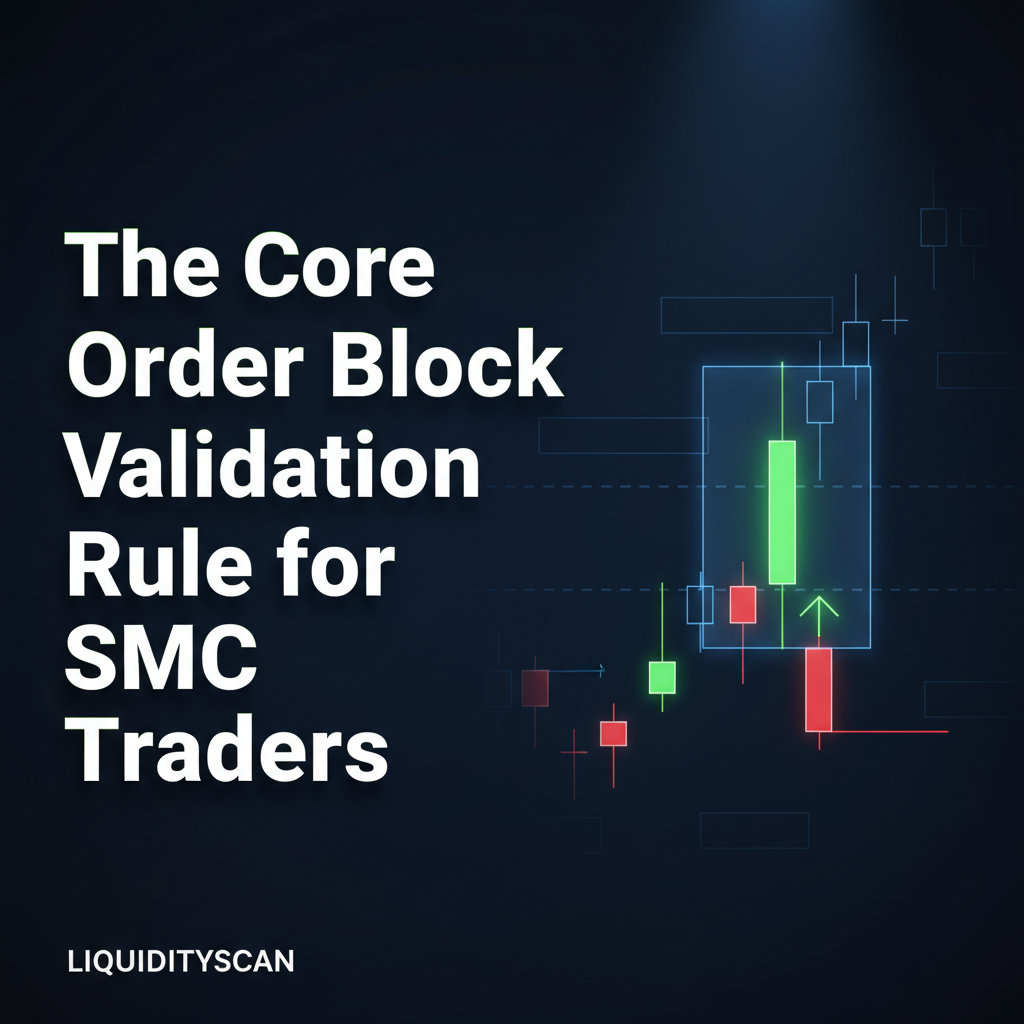
Most traders drown order block validation in endless checklists. The core rule is brutally simple: a valid order block has to create displacement that leaves a Fair Value Gap (FVG) behind. No FVG, no signature of institutional repricing. What you have then is just a price level, not a point of interest worth risking money on.
The Unbreakable Triad: Sweep, Block, Displacement
An order block is not just the last up-candle before a down-move. That's a beginner's definition of an order block, and it gets people stopped out constantly. To a professional, a high-probability block is the origin of a violent shift in order flow — and that shift carries a very specific, three-part signature.
First, price engineers liquidity. It runs a key swing high or low, clears out stops, and trips the breakout orders sitting above or below. That liquidity sweep is the setup. Second, the order block candle forms — the moment institutional orders overwhelm the liquidity that was just engineered. The third step, though, is the only one that decides validation: the move away from the block has to be aggressive, energetic, and inefficient. It has to show displacement.
That displacement leaves a Fair Value Gap (FVG), also called a liquidity void, in its wake. The FVG is your evidence. It's a literal gap in the data, proof that price moved so fast in one direction there was no time for two-sided trade. A balanced market trades continuously, with tight bid-ask spreads — CME Group's own material on market data describes exactly that. An FVG is the opposite: the footprint of a one-sided, institutional repricing event.
Strip out the FVG and you have no confirmation of institutional sponsorship. The block is just a candle. It's unconfirmed, and trading it is a low-probability guess.
Take the EUR/USD 4H chart from early May 2024. Price swept the late-April weekly high near 1.0750. The candle that took the high closed as a large bearish order block. The move down that followed was immediate and forceful, printing a 30-pip FVG between 1.0735 and 1.0705 on the closed candle. That gap was the validation signal — it confirmed the block wasn't a random pivot but the source of a new delivery algorithm. When price later retraced into that block during the London session, it handed traders a high-probability short.
Confluence: Grading the Probability of a Validated Block
Once displacement and an FVG validate a block, the next job is grading its quality. Not every validated block is equal. This is where confluence earns its keep, sorting the A+ setups from the ones you should let go.
Start with location in the overall price delivery array. A bearish order block forming deep in a premium market, after a clean structural break, holds far more often than one forming near equilibrium. Ask one question: does this block let me sell high or buy low? A bullish OB that forms while price is still in premium relative to the operative dealing range is likely to fail. Its location has to agree with the logic of entering from a premium or discount zone.
Next, does the block respect the higher-timeframe narrative? A validated 1H bearish order block nested inside a Daily bearish order block is a powerful thing — the lower-timeframe entry sits inside the controlling institutional logic of the higher one. That alignment across the Daily, 4H, and 1H is the backbone of the whole market structure framework, and reading it correctly comes down to how you track market structure in ICT. A block fighting the higher-timeframe order flow is a liability, full stop.
Last, weigh the liquidity it swept. Did it raid a clean, multi-week high, or just a forgettable little swing point? The bigger the liquidity pool, the more fuel behind the reversal — and the more authority the resulting order block carries.
Here's a simple way to think about it:
| Characteristic | High-Probability OB | Low-Probability OB |
|---|---|---|
| Validation | Creates displacement with a clean FVG. | No FVG, or a very small, sloppy one. |
| Location | Deep in a premium (for bearish) or discount (for bullish) zone. | Near equilibrium or in the wrong half of the range. |
| HTF Alignment | Aligned with Daily/4H order flow and POIs. | Counter-trend to the higher timeframe narrative. |
| Liquidity Sweep | Sweeps a major external high/low (e.g., weekly high). | Sweeps minor internal liquidity or no clear sweep at all. |
Why Validated Order Blocks Still Fail
Even with a textbook validation signature, order blocks fail. I've backtested thousands of these and watched plenty unravel in real time on my own book. Knowing the common failure modes matters just as much as knowing the validation rule, which is why it's worth asking honestly whether order blocks still work the way the textbooks claim.
The number-one killer is mistaking inducement for a true liquidity sweep. Price will often build a picture-perfect order block with a clean FVG, but it never raids a meaningful pool of liquidity. The whole structure is the bait — engineered to pull in early traders right before the real run on a more obvious level. Always ask: is there a cleaner high or low nearby that the market is more likely to hunt?
The second classic mistake is trading a block that's already been mitigated. Once price has traded back into a foundational order block and filled the resting orders, its punch is gone. Some blocks do get revisited, but a first-time test of a pristine, unmitigated block always carries the higher probability.
And context rules everything. A validated bearish order block on GBP/JPY stands a much weaker chance during the dead zone between the NY close and the Asian open. The major kill zones — London, New York — bring the volume and volatility that fuel these institutional moves. A setup outside that window, however technically clean, is suspect. This is where a tool like the LiquidityScan scanner becomes mission-critical: it filters patterns not just by structure but by session timing.
The rule stays simple: demand evidence. An order block is a point of interest. The displacement and FVG that follow are the proof of institutional interest. Focus on that consequence and you filter out the noise, lining your trades up with genuine order flow. It's the shift from spotting patterns to understanding the mechanics that give them power.