
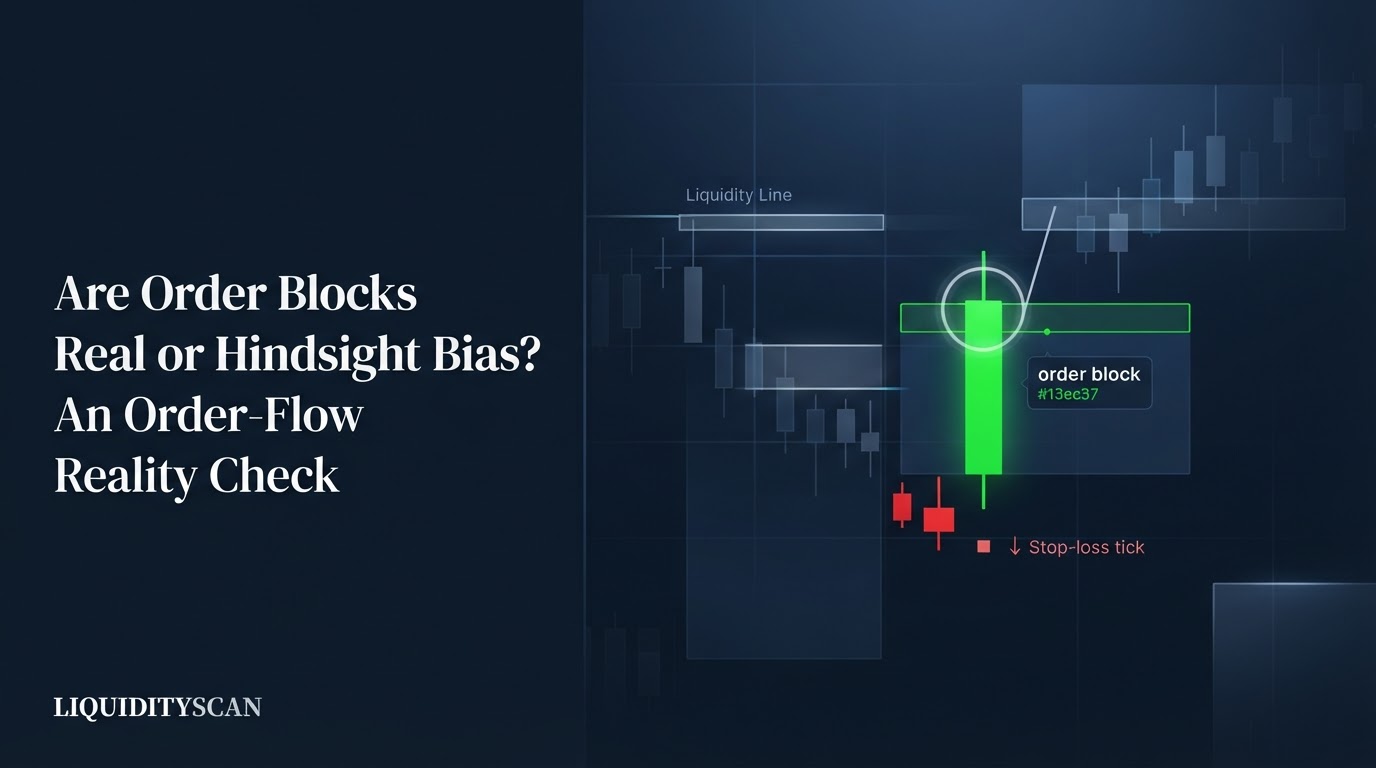
Are Order Blocks Real, or Just Hindsight Bias?
Order blocks are real in one narrow sense: the mechanics behind them — order splitting, resting liquidity at prior consumption zones, and stop clustering — are documented market microstructure. The label itself is a retail invention, and without strict falsifiable rules, most marked order blocks are hindsight.
That answer will not satisfy either camp, which is exactly why it is probably correct. The believer wants to hear that institutions deliberately leave footprints for retail traders to follow. The skeptic wants to hear that the whole construct is astrology drawn on candles. Both positions overreach, and both ignore what execution data actually shows.
This article takes the skeptic's case seriously first, because it is stronger than most Smart Money Concepts (SMC) content admits. Then it separates the parts of the Order Block construct that survive contact with market microstructure from the parts that are pure pattern-fitting. Finally, it shows you how to settle the question on your own data instead of taking anyone's word for it.
The Skeptic's Case: Why Order Blocks Look Like Pattern-Fitting
The strongest argument against order blocks is a base-rate problem. The standard definition — the last down candle before a bullish impulse — is guaranteed to exist before every rally in history. Every up move begins after some down candle. A definition that cannot fail to appear cannot, by itself, carry predictive information.
The skeptic's full indictment has four counts, and each one lands:
- Guaranteed hindsight hits. Scroll any chart backward and you will find a "perfect" order block before every major move, because the definition is satisfied by construction. The relevant question is never whether blocks preceded rallies — it is how price behaved on the next visit, measured across every block, not the memorable ones.
- Selection bias in the evidence base. Social media shows you the retest that bounced to the tick. Nobody posts the forty zones that price sliced through the same week. The public "evidence" for order blocks is a survivorship-filtered highlight reel.
- No institution uses the term. Execution desks talk about VWAP and TWAP schedules, implementation shortfall, participation rates, and child-order placement. No dealing desk marks a candle and calls it an order block. The vocabulary was coined for a retail audience, not borrowed from an institutional one.
- Loose rules make it unfalsifiable. If a zone holds, the block worked. If price trades through it, it was "mitigated" and flips into a Breaker Block. If that fails too, the trader redraws from the wick instead of the body. When every outcome confirms the theory, the theory predicts nothing.
Notice what this indictment actually proves, though. It proves that the loose, undisciplined version of order block trading is unfalsifiable and that its popular evidence is worthless. It does not prove that nothing real happens at those locations. That is a separate question, and it requires looking at how large orders are actually executed.
The Mechanics That Survive Scrutiny
Three pieces of the order block story are not retail folklore. They are standard market microstructure, documented in execution research and visible in order-flow data on any liquid instrument.
Large orders are worked in pieces
An institution that needs to buy $200 million of anything does not lift the offer once. Doing so would move price against its own fill.
Instead, execution algorithms slice the parent order into child orders fed to the market over time — a practice described by the Bank for International Settlements in its Markets Committee report on FX execution algorithms. Iceberg orders, which display only a fraction of their true size, exist for exactly this reason.
This matters because a sliced parent order is rarely filled in one candle. If price runs away before the algorithm completes, unexecuted interest remains — and a return to the original accumulation price is an economically rational place for that interest to reappear. Price revisiting a prior consumption zone and finding passive bids there is not mystical. It is unfinished business.
Stops cluster at obvious levels
Stop orders concentrate where every retail textbook says to put them: above equal highs, below equal lows, beyond swing points. A resting cluster of stops is guaranteed executable volume — precisely what a large buyer needs to fill size without chasing. This is why the sequence "sweep the low, then reverse" recurs: the liquidity sweep converts clustered sell-side liquidity into counterparty volume for accumulation.
Absorption at revisited zones is observable
On footprint charts, you can watch aggressive selling hit a level while price refuses to break — sell-market-order delta stacking up against bids that keep refreshing. That is absorption, and it is measurable, not inferred. When it appears at a previously swept accumulation zone, the order block story and the microstructure story are describing the same event in different languages.
| Order block claim | Microstructure reality | Status |
|---|---|---|
| Institutions accumulate positions in zones, not at single prices | Order splitting via execution algos; iceberg orders | Supported |
| Price returns to these zones and reacts | Unfilled resting interest can re-load at prior consumption prices | Plausible, conditional |
| Sweeps of highs/lows precede the real move | Stop clusters are executable liquidity for large fills | Supported |
| The last down candle marks the institutional order | No mechanism ties intent to one specific candle | Unsupported as stated |
| Every order block should be respected on retest | Most zones hold no remaining interest; algos complete or cancel | False |
The Honest Middle: Retail Label, Real Footprint
Here is the synthesis both camps resist. The label is retail; the footprint is real; and the edge — if you have one — lives entirely in the filters that make the pattern falsifiable. A raw "last down candle" has no edge because it appears everywhere. The construct only becomes testable when you demand evidence that size actually traded there.
Three filters do that work, and each has a mechanism rather than a slogan:
- Liquidity sweep before the block forms. The candle should take out a prior low or high — running resting stops — before the impulse. This ties the block to an observable liquidity event instead of an arbitrary red candle. It answers the question: where did the counterparty volume come from?
- Displacement away from the zone. The move leaving the block must be disproportionate — full-bodied candles, ideally leaving a Fair Value Gap (FVG). Displacement is the visible signature of urgent, one-sided execution. A drift away from the zone signals nothing; an expansion does.
- First touch only. If unfilled interest explains the reaction, the first revisit is where it gets consumed. Second and third touches are testing a zone whose reason for existing has already been spent. This single rule converts the construct from unfalsifiable to falsifiable: one touch, one outcome, logged.
Strip those filters away and the skeptic wins by default. Apply them, and you have a defined, countable event whose forward outcomes can be measured — which is the only standard that matters.
A companion piece on this blog covers the data-driven testing framework in depth; this article's concern is the prior question of whether there is anything real to test. There is, but only in this filtered form.
How to Test Whether Order Blocks Are Real on Your Own Charts
You cannot resolve this debate by scrolling history, because scrolled charts smuggle in the answer. The right edge of a live chart is the only honest judge. Here is a protocol that removes hindsight from the experiment.
Step 1: Freeze the right edge
Use bar replay, or mark blocks live as candles close. The rule is absolute: a block must be marked before price returns to it, with the future hidden. If your platform lets you peek ahead, you are not testing order blocks — you are testing your memory of the chart.
Step 2: Pre-register the rules
Write the definition down before the test: which candle qualifies, sweep required or not, how displacement is measured (for example, leg range at least 1.5 times the 14-period ATR), zone drawn from body or full range, first touch only. Every discretionary choice you leave open is a door hindsight walks through later.
Step 3: Log every candidate, not just the winners
Record each qualifying block at formation, then score the first retest against fixed benchmarks: did price trade to 1R and 2R against a stop beyond the zone before breaking it? Log the blocks that never got retested too. The denominator is the entire experiment; losing it recreates the survivorship bias you are trying to escape.
Step 4: Judge expectancy, not hit rate
Fifty-plus samples per market and timeframe is a working minimum before the numbers mean anything. And a 45% respect rate can be a strong edge at 2.5R average payoff, while a 70% rate can lose money at 0.5R.
Expect results to vary by regime — trending markets flatter continuation blocks, ranging markets chew through them — so segment your log accordingly. LiquidityScan's scanners detect and timestamp qualifying order blocks in real time, which removes the hindsight-marking problem from this workflow entirely.
What Footprint and DOM Data Show at Order Block Retests
Order-flow tools let you watch the retest instead of theorizing about it. Two signatures separate zones that hold from zones that fold.
The absorption signature. Price returns to the zone and aggressive market sells keep printing — negative delta — yet each downtick stalls as the bid refreshes. Cumulative delta diverges from price — sellers spend ammunition into passive size that will not move. Resting bids reloading at a prior consumption price is the closest thing to a "real" order block signature — visible, not inferred.
The vacancy signature. Price enters the zone and the book is thin: no bid refresh, delta and price falling together, large trades printing at the bid and pushing through. Nobody is home. The zone was a last down candle and nothing more, and the market walks through it without hesitation.
A concrete sequence, of the kind you can watch weekly on BTCUSDT. Price sweeps equal lows at 61,650 on the 4H, reverses through 62,400 with two full-bodied candles, and breaks a prior swing high at 63,900 — a Break of Structure (BOS) — before stalling at 65,000. The down candle spanning 61,800–62,400 qualifies under strict rules: sweep, displacement, untouched.
Two days later price rotates back to 62,400. On the footprint, roughly three times average sell volume prints across four 15-minute bars while price holds a 150-dollar range — absorption. The zone produces a move back above 64,000.
Same location, two independent lenses: the SMC trader called it an order block retest, the order-flow trader called it absorption at a prior accumulation shelf. When the zone is vacant instead, both lenses agree in the other direction — and that agreement is the honest reason to take the construct seriously.
Verdict: Order Blocks Are Conditionally Real
So, are order blocks real? Framed precisely: the phenomenon is real, the folklore is not, and the edge is conditional.
- Real: order splitting, iceberg and resting orders at prior consumption zones, stop clustering at obvious levels, and observable absorption on retests. None of this is controversial microstructure.
- Not real: the idea that any last down candle marks institutional intent, that institutions use or honor the term, or that a zone deserves unlimited retests. Traded loosely, order blocks are pattern-fitting with extra vocabulary.
- Conditional: a positive expectancy exists, if at all, only under strict falsifiable rules — sweep plus displacement plus first touch — verified on your own market, timeframe, and log, not on someone's highlight reel.
The question "are order blocks real" ultimately dissolves into a better one: does your specific, pre-registered definition produce positive expectancy on data you did not peek at? The label will not save you and the skeptics will not stop you. The log decides. Run the protocol above for fifty samples, and you will hold the only answer that was ever going to matter — yours.
Frequently Asked Questions
Do institutions actually place orders at retail-drawn order blocks?
Not deliberately, and not at zones because retail drew them. But execution algorithms do slice large orders across price zones, and unfilled interest can re-load near prior fill prices. When a retail-drawn block coincides with a genuine accumulation zone, the reaction is real — the causation just runs through microstructure, not through anyone honoring a rectangle.
Is an order block just supply and demand with a new name?
They overlap but are not identical. Both mark zones where an imbalance originated. The ICT-style order block adds specific qualifiers — a liquidity sweep before formation, displacement after it, and structure break — that classic supply-and-demand zones do not require. Those extra conditions are what make the modern definition testable rather than a renamed rectangle.
Why do most order blocks fail on retest?
Because most qualify only by shape, not by evidence of size. If the executing algorithm finished its parent order, no resting interest remains and the zone is empty. Unfiltered blocks appear before every impulse by definition, so the majority are noise. Filtering for sweep, displacement, and first touch removes most of the empty ones — never all.
Can you see an order block forming in the DOM?
Not as a labeled object — the DOM shows resting limit orders, and icebergs hide most of their size anyway. What you can see is behavior consistent with the concept: bids refreshing repeatedly at one price, heavy sell prints failing to break a level, and delta diverging from price on a retest. You verify reactions, not intentions.
Related query paths
If this reality check sharpened the question for you, these are the natural next steps — from the base definition to validation rules to testing the edge on data.
- What Is an Order Block? — the base definition and anatomy this entire debate is about.
- The Core Order Block Validation Rule for SMC Traders — the strict qualifying rules that make blocks falsifiable.
- Do Order Blocks Still Work? A Data-Driven Framework for 2026 — the companion data framework for measuring whether the edge persists.
- Is Order Block Strategy Profitable? A Data Look — expectancy math and honest performance ranges for OB strategies.
- Bookmap with ICT: Confirm POIs — using DOM and footprint tools to verify absorption at your zones.
- How to Backtest an ICT Strategy the Right Way — the full hindsight-free testing methodology, step by step.
- How to Scan for Order Blocks and FVGs Automatically in Real Time — how it connects to order block scanner.