
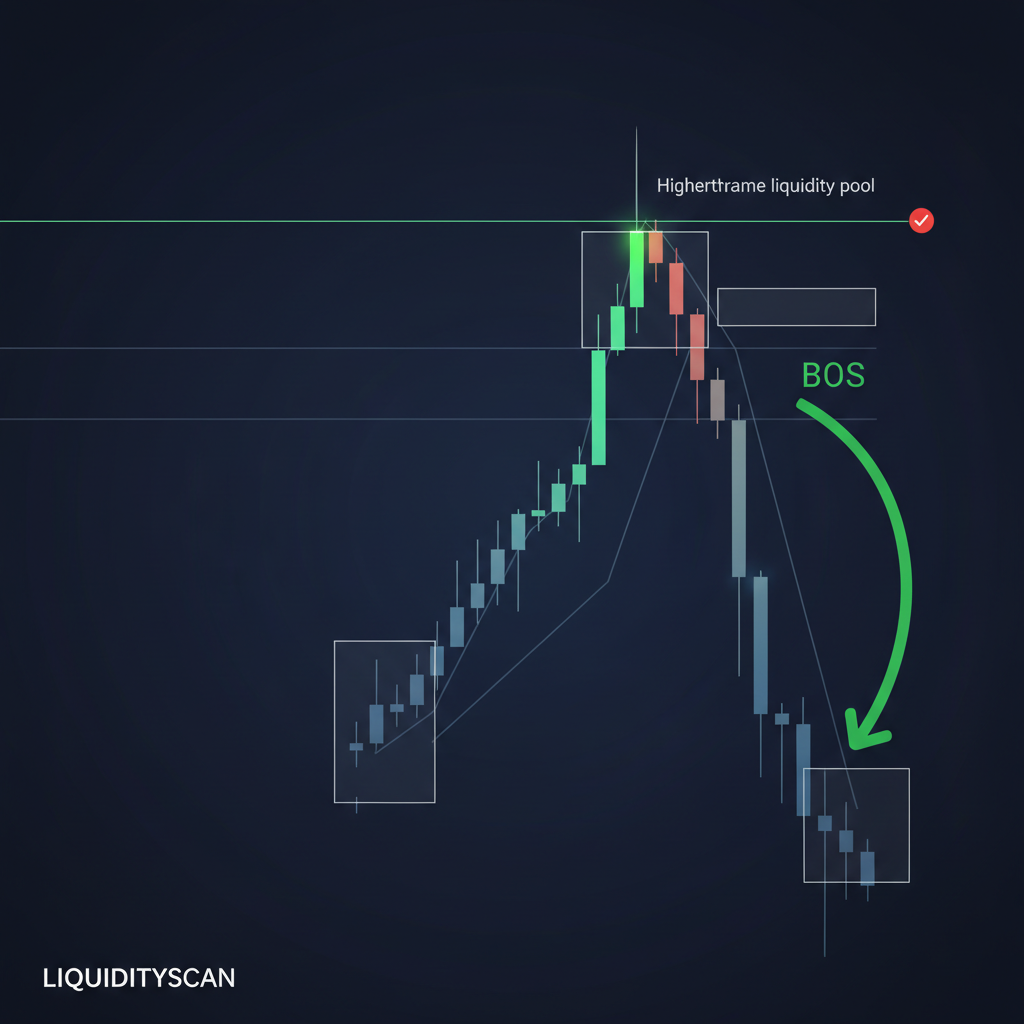
Yes, order block trading can be profitable, but not the way most traders run it. The edge does not come from the block itself. It comes from the context around it: higher-timeframe bias, a clear liquidity draw, and the quality of the mitigation. A raw "buy every order block" system is close to a coin flip once spread and slippage are paid. The profitable version is a filter that throws most blocks away.
That distinction matters because it changes what you measure. Traders who ask whether order blocks "work" are asking about the pattern. The real question is whether your selection process turns a common pattern into a positive-expectancy decision.
What actually drives the edge
Context creates the edge, not the block. An order block is just the last opposing candle before a move that breaks structure. Millions of them print. The ones worth trading share three conditions.
- HTF alignment. The block sits in agreement with a higher-timeframe directional read. A bullish block inside an HTF bearish leg is noise.
- A liquidity draw. Price has a reason to reach your block and a target beyond it, usually a pool of resting orders the algorithm is likely to seek.
- Mitigation quality. How price arrives matters. A sharp displacement leaving the block, ideally with a fair value gap, reads as intent. A slow grind into it does not.
Strip any one of these and the same rectangle behaves differently. This is why two traders using "the same strategy" post opposite results. One is trading blocks; the other is trading context that happens to include a block.
What realistic win rate and expectancy look like
Profitability is an expectancy equation, not a win-rate contest. Expectancy is the honest lens:
Expectancy = (Win% x Avg Win) − (Loss% x Avg Loss)
Order block entries, especially with an FVG or OTE refinement, let you place a tight stop below the block and target a distal liquidity pool. That geometry naturally produces trades in the 2R to 4R range. At that reward profile, you do not need to be right often.
| Avg reward per win | Break-even win rate | Comfortable target |
|---|---|---|
| 1R | 50% | >55% |
| 2R | ~33% | 40-50% |
| 3R | 25% | 35-45% |
A disciplined order block trader running an average of 2R and hitting 40 to 50 percent is comfortably profitable. Notice what that means: you can lose more trades than you win and still grow the account. Chasing a high win rate usually means cutting winners early and destroying the very R-multiple that made the strategy work.
I am deliberately not quoting a single precise "order blocks win X percent" figure, because it is not knowable in the abstract. Win rate depends on your instrument, timeframe, session filter, and how strictly you apply the three context conditions. Anyone citing one universal number is selling certainty that does not exist.
Why naive "every order block" trading fails
Trading every block converts a selective edge into random entry. The failure is structural, not psychological.
On any chart you can mark dozens of order blocks per day across timeframes. The vast majority never had institutional intent behind them; they are simply the last candle before a minor move. Enter all of them and your sample is dominated by low-quality blocks with no liquidity draw and no HTF alignment. The average of that sample regresses toward zero, then goes negative after costs.
Unmitigated blocks are the classic trap. An untouched block looks pristine, so traders anticipate a reaction. But "untouched" often means price has no draw toward it yet, and you are front-running a level with nothing pulling price in. Selectivity is the strategy. The moment you trade every instance, you no longer have one.
The execution errors that sink a sound concept
Most order block losses are execution failures, not concept failures. Four errors turn a positive-expectancy idea into a losing system.
- No HTF bias. Taking blocks in both directions without a top-down read means you are counter-trading the dominant flow half the time.
- Chasing unmitigated blocks. Entering on anticipation instead of waiting for price to arrive with displacement and confirmation.
- Oversizing. A 2R strategy with a 40 percent win rate produces losing streaks of five or six as a matter of routine. Size that cannot survive that variance blows up before the edge pays out.
- Skipping the backtest. Deploying live without ever measuring how your specific rules perform on your specific market.
That last point deserves weight. You cannot know whether your order block variation is profitable until you have tested it across a meaningful sample with fixed, written rules. Backtest by hand, log every trade, tag each by context quality, and measure expectancy per bucket. You will almost always find the high-context bucket carries the account while the low-context bucket bleeds. Cut the bleeders and the same "strategy" becomes profitable, because you have finally isolated the part that had the edge.
Frequently Asked Questions
Do order blocks work better on higher timeframes?
Generally yes. Higher-timeframe blocks carry more significant liquidity and cleaner intent, so they respect context conditions more reliably. Lower timeframes print more blocks but a higher share of noise, demanding stricter filtering.
What win rate do I need for order blocks to be profitable?
It depends on your average R. At 2R you break even near 33 percent and profit comfortably around 40 to 50 percent. Define your reward profile first, then judge your win rate against it.
Are unmitigated order blocks more reliable?
Not inherently. "Unmitigated" describes whether price has returned, not whether there is a draw pulling price there. Without a liquidity target and HTF alignment, an untouched block is just an untested guess.
Related query paths
These are the natural next steps for building a context-first order block edge.
- How to Backtest an ICT Strategy the Right Way — build the sample that tells you whether your rules are actually profitable.
- ICT Position Sizing: Risk, R-Multiples & Consistency — size trades so a normal losing streak cannot end the account.
- ICT Top-Down Analysis: Multi-Timeframe Alignment — establish the HTF bias that filters low-quality blocks.
- Displacement in ICT: Reading Institutional Intent — read the mitigation quality that separates real blocks from noise.
- OTE Explained: The ICT Optimal Trade Entry Zone — refine block entries for tighter stops and bigger R-multiples.
- FVG Fill Probability: What Backtests Reveal About Win Rates — see how data reframes another popular pattern's real odds.
- 3 High-Probability Order Block Entry Models