
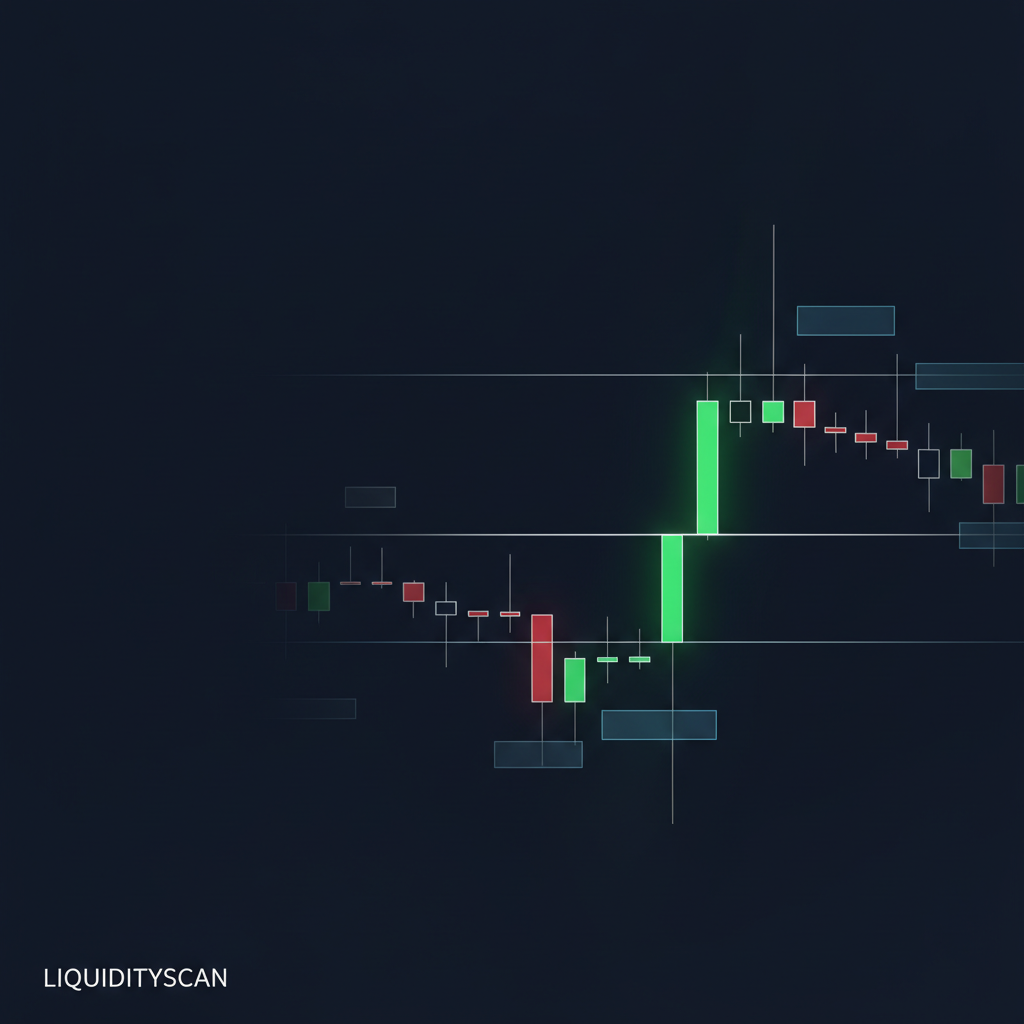
What Is Displacement in ICT?
Displacement is a rapid, forceful price move in one direction that reveals aggressive institutional order flow. In ICT terms, it is the burst of energy that carries price away from a level with intent, not the slow drift of ordinary trading.
The defining trait is momentum. When large participants commit size, price does not meander. It travels quickly through prior structure, and that speed is the signature we are reading.
Think of displacement as the market showing its hand. A normal move keeps you guessing about direction; a displacement move tells you which side just took control.
Displacement vs a Normal Price Move
The difference comes down to three qualities: speed, range, and energy. A normal move produces overlapping candles of similar size that grind sideways or drift. Displacement produces one or several large-bodied candles that expand quickly with little overlap.
That energy has a fingerprint. Because price moves so fast, it often skips a price zone entirely and leaves behind a Fair Value Gap (FVG), an inefficiency where one side barely traded. If a move is genuine displacement, you will usually find that gap inside it. A slow, balanced move rarely leaves one.
Momentum, as described in classic market theory, is the strength behind a directional move. Displacement is simply momentum made visible through candle range and the inefficiency it leaves. For a broader definition of the concept, see Investopedia on momentum.
So when you compare candles, ask: did price expand with force and leave a gap, or did it just wander? Only the first is displacement.
Displacement and the Market Structure Shift
Displacement rarely happens in a vacuum. Its most useful role is confirming a Market Structure Shift, the moment price breaks a swing point in the opposite direction and signals a possible change in control.
A structure break on a weak, overlapping candle is easy to fake. A structure break carried by displacement is far more credible, because the energy behind it suggests real order flow rather than a stop-run that fizzles.
In other words, displacement is the quality control on a break. The shift tells you where control may be changing; the displacement tells you whether that change had conviction.
How to Use Displacement in Your Entries
Displacement is most powerful as confirmation, not as a standalone signal. My preferred sequence starts with a liquidity sweep: price runs an obvious pool of stops, then reverses. That sweep gives context; displacement gives direction.
Once price sweeps liquidity and then displaces the other way, I have two aligned clues pointing the same direction. I am no longer trading a hunch; I am trading a reaction the market itself printed.
From there, the entry lives inside the displacement leg. The FVG it left behind becomes a return zone, and any order block at the origin of the move offers a refined level to wait for. At LiquidityScan we treat that gap as the invitation, not the whole trade.
The rule I keep simple: no displacement, no confirmation. If price crosses a level without energy, I stand aside and let the market prove intent first.
Bullish vs Bearish Displacement
Bullish displacement is a fast expansion higher that breaks structure to the upside and leaves a gap below it. It typically follows a sweep of sell-side liquidity, where price dips to grab stops before driving up with force.
Bearish displacement is the mirror image: a rapid drop that breaks structure downward and leaves a gap above it, usually after a sweep of buy-side liquidity near obvious highs.
The read is the same in both directions. Identify which liquidity was taken, watch for the energetic move that follows, and let the gap it leaves mark your zone of interest. Direction is dictated by which pool got swept and which way the energy then travels.
Frequently Asked Questions
Does displacement always leave a Fair Value Gap?
Almost always. True displacement moves so fast that it skips a price zone, creating an FVG. If a move breaks structure but leaves no gap, treat it as weaker and less institutional in character.
Is displacement the same as a breakout?
Not quite. A breakout describes price leaving a range; displacement describes the energy of the move. A break can happen slowly, but displacement is defined by speed, wide range, and the inefficiency it leaves behind.
Can I enter on displacement alone?
I do not recommend it. Displacement is confirmation, strongest when it follows a liquidity sweep and a market structure shift. On its own, without that context, it can trap you into chasing an already-extended move.
Related query paths
Displacement connects the sweep, the shift, and the gap, so these guides deepen each link in that chain.
- What is a Fair Value Gap (FVG) — the gap displacement creates and how to read it.
- What is Market Structure in ICT — the structure displacement shifts.
- Liquidity Sweep Explained — the sweep displacement confirms.
- FVG Entry Strategy — how to actually enter after displacement.