
Why Position Sizing Matters More Than Entries
Most traders pour their energy into the perfect entry. But two traders can take the same setup and end the month in completely different places purely because of how much they risked on each trade.
Position size is the lever that controls survival. A brilliant read on a liquidity sweep means nothing if a single oversized trade wipes out a month of gains.
ICT position sizing exists inside a wider risk framework — this article owns the sizing math, not the whole system. Get the size right and mediocre entries still compound; get it wrong and even a high-probability edge can bankrupt the account.
The Fixed-Fractional Rule
The cleanest rule is fixed-fractional: risk a set percentage of your account on every trade, no exceptions. One percent is the common anchor because it lets you absorb a long losing streak without emotional damage.
The math is simple. Multiply your account balance by your risk percentage to get the dollar amount you are willing to lose if the stop is hit. That figure never changes based on how confident you feel.
Here is what a fixed-fractional risk of 1% versus 2% looks like across account sizes:
| Account | Risk 1% | Risk 2% |
|---|---|---|
| $1,000 | $10 | $20 |
| $5,000 | $50 | $100 |
| $10,000 | $100 | $200 |
| $25,000 | $250 | $500 |
| $50,000 | $500 | $1,000 |
Notice the dollar risk scales with the account. As your balance grows, your risk grows in step, which is exactly how compounding is supposed to work.
R-Multiples Explained
Once your risk is fixed, stop thinking in dollars and start thinking in R. Your R is simply the amount you risk on a trade — one unit of risk. A trade that makes twice your risk is a +2R winner; a full stop-out is a -1R loss.
Thinking in R removes account size from the conversation. A +3R trade on a $1,000 account and a +3R trade on a $50,000 account are the same quality of decision, even though the dollar figures differ wildly.
R also makes expectancy measurable. If your average result across many trades is +0.3R, you know each trade is worth roughly a third of your risk — a genuine edge, regardless of win rate. Investopedia's overview of the risk/reward ratio is a solid primer if the concept is new.
Sizing From Your Stop Distance
This is where ICT gives you a structural edge. Your position size is not a guess — it falls out of your stop distance. Divide your fixed dollar risk by the distance from entry to stop, and you get the exact size that risks one R.
Say you risk $100 and your stop sits 50 points away; you size for $2 per point. Move the stop to 25 points and the same $100 risk buys you double the size. The dollar risk never changed — only the size did.
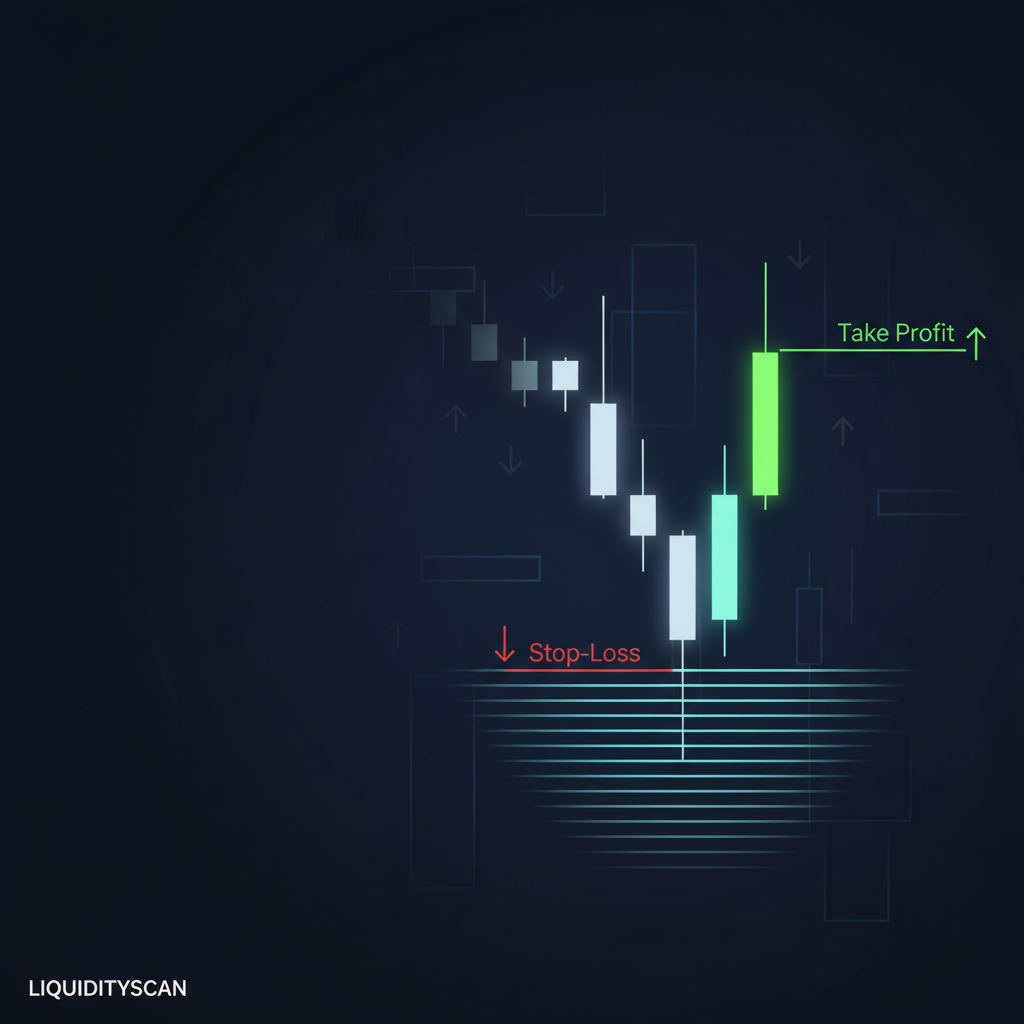
ICT setups shine here because you place stops just beyond swept liquidity — the wick that ran the stops. That location is both logical and tight, letting you size up while risking the same fixed amount. Where you actually place those stops and targets is a topic on its own, linked below.
Consistency, Drawdown & Compounding
Fixed-fractional sizing has a quiet superpower: your risk shrinks automatically in a drawdown. Losing trades reduce the balance, so the next 1% is a smaller dollar figure, softening the decline.
On the way up it works in reverse — a growing balance means each 1% risks more, so wins compound faster. You never have to manually adjust; the percentage does the work.
The tools at LiquidityScan help you spot the liquidity that defines your stops, but the sizing discipline is yours to keep. Log every trade in R over time and your expectancy becomes a number you can trust, not a feeling. That record is what separates a consistent trader from a lucky one.
Frequently Asked Questions
How much should I risk per trade in ICT?
Most disciplined traders risk a fixed 1% of account equity per trade, with 2% as an aggressive ceiling. The exact number matters less than keeping it constant, so a losing streak never threatens your account.
What is an R-multiple?
An R-multiple expresses a trade's outcome as a ratio of the amount you risked. If you risk $100 and make $300, that is a +3R trade. Thinking in R lets you compare trades across any account size.
How does stop distance change my position size?
Your size equals fixed dollar risk divided by stop distance. A tighter stop lets you take a larger position for the same risk, which is why ICT's liquidity-based stops are so efficient.
Related query paths
Sizing lives inside a larger risk system — here is where to go next.
- The ICT Risk Management Framework — the framework this sizing method sits inside.
- Institutional SMC Stop-Loss & Take-Profit Strategy — exactly where to place the stops that drive your size.
- 5 Common Risk Management Mistakes — the sizing errors to avoid.
- The ICT Trading Journal Template — how to track R and expectancy over time.
- What a Profitable Trader Equity Curve Looks Like