
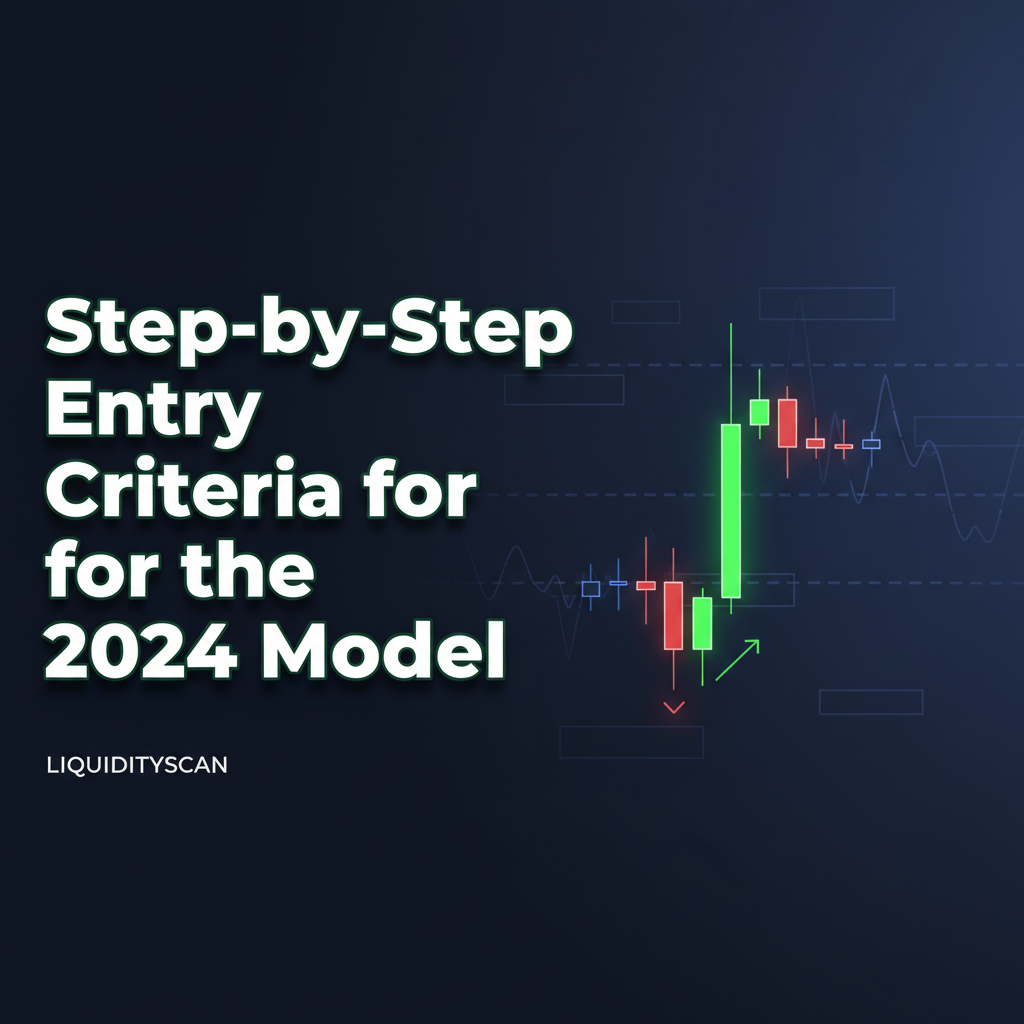
What Defines the ICT 2024 Trading Model?
The ICT 2024 Mentorship Model is a refined, sequence-based intraday framework from the Inner Circle Trader. It strips earlier ICT concepts down to a repeatable entry routine built on time, liquidity, and a confirmed shift in order flow.
Unlike the broader 2022 model, the 2024 version tightens the rules. It demands a precise time window, a clean liquidity sweep, and a displacement-backed Market Structure Shift before any entry is valid.
The purpose is consistency. By forcing every trade through the same checklist, the model removes guesswork and keeps you out of low-probability environments where price is ranging or directionless.
The 5-Step Entry Checklist for the 2024 Model
Treat the following as a strict gate. If any step fails, there is no trade. Each condition must occur in order, and the entire sequence should complete inside a single Killzone.
Step 1: Identify a Key High/Low During a Killzone
Mark your draw on liquidity before price moves. The most reliable pools are the Asia Session High/Low and the Daily High/Low formed prior to the active session.
- Use the London Killzone (02:00–05:00 EST) for EUR/USD.
- Use the New York AM Killzone (08:30–11:00 EST) for indices like NAS100.
- Highlight the nearest old high and old low — these are your target liquidity pools.
Step 2: Wait for the Liquidity Sweep (The Judas Swing)
Price must run one of those pools and trigger a Stop Hunt. This false push beyond the level is the Judas Swing — the manipulation leg that traps breakout traders before the real move.
A bullish setup requires a sweep below an old low. A bearish setup requires a sweep above an old high. No sweep means no signal.
Step 3: Confirm a Market Structure Shift (MSS) with Displacement
After the sweep, wait for price to reverse and break the most recent opposing swing point. This Market Structure Shift must arrive with Displacement — a fast, expansive candle (or candles) that leaves an imbalance behind.
Weak, overlapping candles do not count. Displacement is the energy signature that confirms institutions, not retail, are driving the reversal.
Step 4: Pinpoint the Fair Value Gap (FVG) for Entry
The displacement leg will print a Fair Value Gap — a three-candle imbalance where the wicks of candle one and candle three do not overlap. This FVG is your entry zone.
Mark the gap precisely. Your limit order or refined entry will sit inside it, ideally at the consequent encroachment (the 50% midpoint of the gap).
Step 5: Execute the Entry on a Retracement
Wait for price to retrace back into the FVG. Enter as price taps the gap, not on the impulsive move away from it.
- Set a buy limit inside a bullish FVG after a sweep of lows.
- Set a sell limit inside a bearish FVG after a sweep of highs.
- Cancel the trade if price closes fully through the FVG without reacting.
Example 1: Bullish 2024 Model on EUR/USD (London Session)
EUR/USD forms its Asia range overnight. As the London Killzone opens, price spikes below the Asia Session Low, sweeping resting sell-side liquidity. This is the Judas Swing.
Within minutes, an expansive bullish candle breaks the prior internal high — a clear MSS with Displacement. That same leg leaves a bullish Fair Value Gap below current price.
You place a buy limit at the FVG midpoint. Price retraces, taps the gap, and continues higher toward the Asia Session High and the Daily High, which become your liquidity targets.
Example 2: Bearish 2024 Model on NAS100 (New York Session)
NAS100 opens the New York AM Killzone by rallying above the previous Daily High, sweeping buy-side liquidity. Buyers chasing the breakout are trapped.
An aggressive bearish displacement candle then breaks the last short-term low, printing the MSS. The drop leaves a bearish Fair Value Gap above the new price.
You set a sell limit inside that gap. NAS100 retraces into the FVG during an ICT Macro Time window, then sells off toward the session low. Time, sweep, shift, and gap all align.
Risk Management: Stop Loss and Profit Target Strategy
Stop placement is mechanical in the 2024 model. Your invalidation sits just beyond the swing created by the liquidity sweep.
- For longs: stop a few pips below the Judas Swing low that swept liquidity.
- For shorts: stop a few pips above the Judas Swing high that swept liquidity.
- If price closes back through that level, the premise is broken — exit.
For targets, use the opposing liquidity pool as your draw. Standard Deviation Projections from the swept range help you scale out at the -2 and -4 deviation levels, locking in a clean reward-to-risk profile of 1:3 or better.
Setting Up Your TradingView Charts for the Model
A clean chart speeds up execution. Configure TradingView so every condition is visible at a glance.
- Set your timezone to New York (EST) so Killzone windows align with ICT timing.
- Add vertical session lines for London and New York Killzones.
- Drop horizontal rays on the Asia Session High/Low and prior Daily High/Low.
- Use the 5-minute chart for structure and the 1-minute chart to refine the FVG entry.
- Save it as a template so the layout loads instantly each session.
Frequently Asked Questions
What timeframe is best for the 2024 model?
Most traders map the sweep and MSS on the 5-minute chart, then drop to the 1-minute chart to refine the Fair Value Gap entry. The 15-minute chart helps frame the higher-timeframe draw on liquidity, but execution stays on the lower timeframes.
Can this model be used outside of Forex and Indices?
Yes. The logic of liquidity sweeps, displacement, and Fair Value Gaps is market-agnostic. It works on crypto, futures, and commodities, provided the asset has enough volatility and clear session-based liquidity to produce a clean Judas Swing.
How is the 2024 model different from the 2022 model?
The 2022 model is more flexible and relies heavily on the FVG entry after a structure shift. The 2024 model adds stricter time-of-day filtering and a firmer requirement for a defined liquidity sweep before the MSS, making it more selective and rule-bound.
Related query paths
- How to Build a Complete ICT Trading Model (Step-by-Step)
- Is the ICT 2024 Model Better Than the 2022? A Technical Analysis
- FVG Entry Strategy: A Precision Guide for ICT Traders
- Is ICT Trading Real? A Skeptic's Guide to Smart Money
- The Ultimate ICT Market Structure Framework for Precision Trading
- The Ultimate Guide to DST Kill Zone Adjustments for ICT Traders
Stop hunting for setups manually
LiquidityScan's automated scanner flags liquidity sweeps, Market Structure Shifts, and fresh Fair Value Gaps across forex, indices, and crypto in real time — so you can spot every 2024 Model entry the moment time, sweep, and shift align. Try LiquidityScan's automated scanner and bias tools and trade the checklist, not the chaos.