
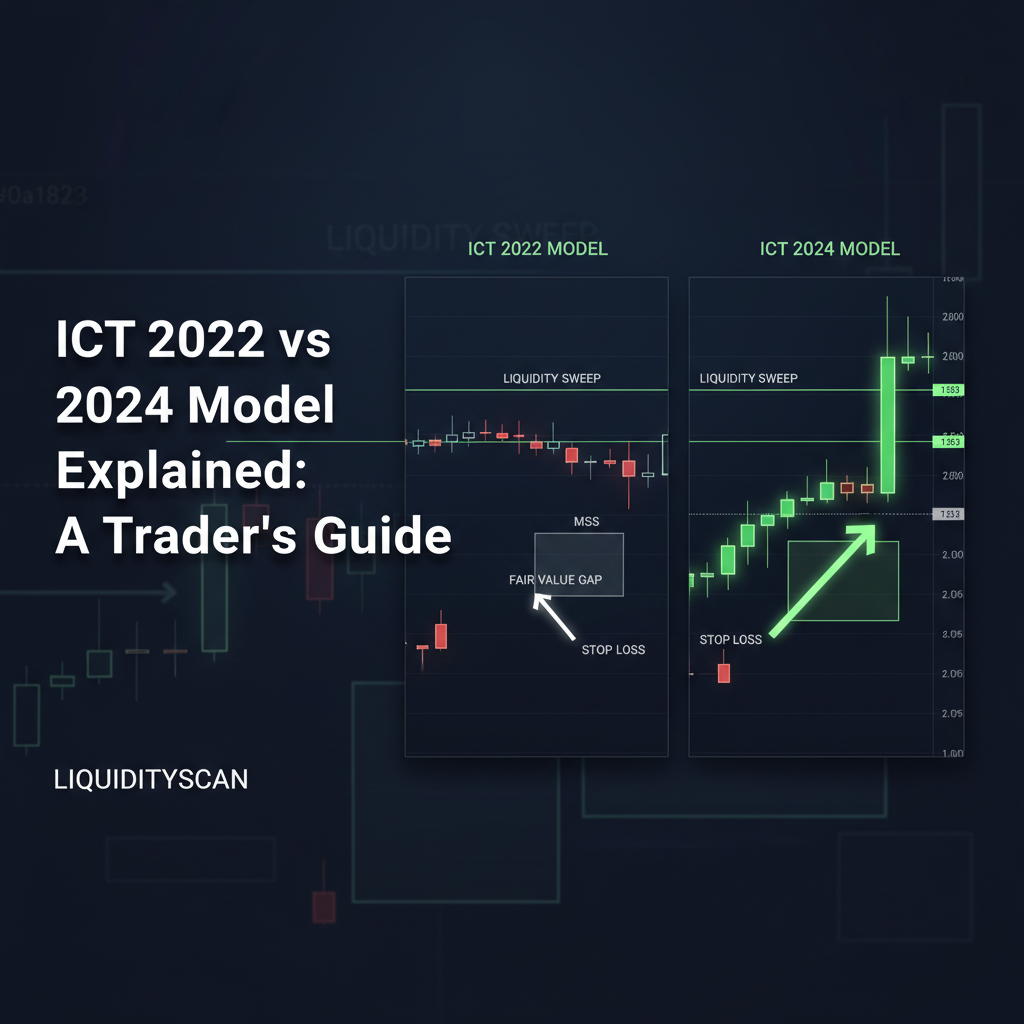
That distinction sits at the heart of how the methodology has evolved. The 2022 model gives you a foundational framework for spotting reversals; the 2024 model bolts a stricter filter on top of it, built to isolate the setups that are backed by the most aggressive institutional participation. Both come out of the teachings of The Inner Circle Trader, which you can study at the source.
Key Points
- ICT 2022 Model Sequence: A liquidity sweep is followed by a market structure shift (MSS), with the entry taken from a fair value gap (FVG) or order block created during that shift.
- ICT 2024 Model Sequence: A liquidity sweep is followed by a powerful displacement leg that causes the MSS. The entry is taken *exclusively* from the FVG formed within that specific displacement leg.
- The Core Difference: The 2024 model's primary filter is the quality and magnitude of the displacement. A weak shift doesn't qualify; it requires a clear, energetic repricing that leaves a pristine FVG in its wake.
- Frequency vs. Probability: The 2022 model presents more frequently across instruments and timeframes. The 2024 model, often called the 'Unicorn' setup, is rarer but is considered a higher-probability entry framework due to its strict criteria.
The ICT 2022 Model: The Foundational Logic
The 2022 model codifies a classic reversal pattern that smart money traders hunt for. It's a chain of events that hints order flow is about to turn. Let's walk through the exact mechanics.
It starts with price trading into a key level of liquidity. Think old highs or lows, session extremes, a weekly high or low — the obvious pools where stops cluster. Once that liquidity sweep happens, you want the market to tip its hand. The signal is a market structure shift: price breaks a short-term swing point against the direction of the sweep. Sweep a swing low, and a bullish MSS is the break of a near-term swing high. If the terminology here feels shaky, the mechanics are laid out in our guide to market structure in ICT.
That shift leaves inefficiencies in the price ladder — most often fair value gaps and fresh order blocks. The 2022 model lets you enter inside any of these formed during the leg that broke structure. You might rest a limit at the edge of the FVG, or at the mean threshold of the breaker or order block that kicked off the move.
It works. But the looser criteria mean it can fire on a minor, fleeting shift that never develops into a real move. The model nails the 'what' — a shift after a sweep — yet says little about the 'how', the force behind that shift.
The ICT 2024 Model: Refining for Conviction
The 2024 model attacks that ambiguity by adding one filter: displacement. Price breaking a short-term high or low isn't enough. The break has to arrive with real force — one or more large, energetic candles that carve out a clean, obvious fair value gap.
Here's the refined sequence:
- Liquidity Raid: Price sweeps a clear pool of internal or external liquidity.
- Displacement & MSS: A high-momentum move immediately follows, breaking market structure. This isn't a timid shift; it's an aggressive repricing that signals a change in the state of delivery. The candle body should close decisively past the structure point.
- Entry on the Displacement FVG: The entry is taken *only* from the fair value gap created by the powerful displacement candle(s). Any other FVGs or order blocks outside this specific price leg are disregarded for this model.
The thinking is simple: genuine institutional reversals don't creep, they explode. That displacement is your proof a major player has stepped in with enough size to overwhelm the opposing order flow — a dynamic the futures exchanges themselves describe well, as you'll see in the educational material from the CME Group. Wait for that confirmation and you're filtering for A+ setups where institutional intent is undeniable. It's also worth pairing the displacement read with SMT divergence across correlated pairs, since two confirmations beat one.
Practical Differences in Execution
So which model do you actually run? It comes down to market conditions and how you weigh risk against frequency.
The 2022 model shines when you're entering inside an already-established trend. Say EUR/USD is in a clean 4H uptrend; price pulls back, sweeps a 15-minute low, then prints a bullish MSS. The 2022 model hands you a valid entry to rejoin the larger move. Here the higher-timeframe trend supplies the conviction that the looser entry trigger lacks on its own — and if you size with structure, the institutional SMC stop loss and take profit approach keeps the risk defined.
The 2024 model, though, is my go-to for major reversals. I want that exact signature at the tail end of a long run on liquidity — say ES futures sweeping a weekly low during the NY kill zone. I won't even look at a long until a powerful displacement leg breaks a 1H swing high and leaves a clean FVG behind. That patience has stopped me from grabbing at a falling knife more times than I can count, and it's the same discipline I push in our trading journal template: log only the setups that clear the bar.
This is exactly why we built the CISD (Change in State of Delivery) algorithm into the LiquidityScan platform. It quantifies and alerts on the very displacement that separates a 2022 MSS from a 2024 'Unicorn' entry. It measures the velocity and the candle-body-to-wick ratio of the move that breaks structure, flagging programmatically when institutional force is likely in play. Automate that detection and you get to focus on context instead of drowning in the noise of every minor, meaningless shift.