
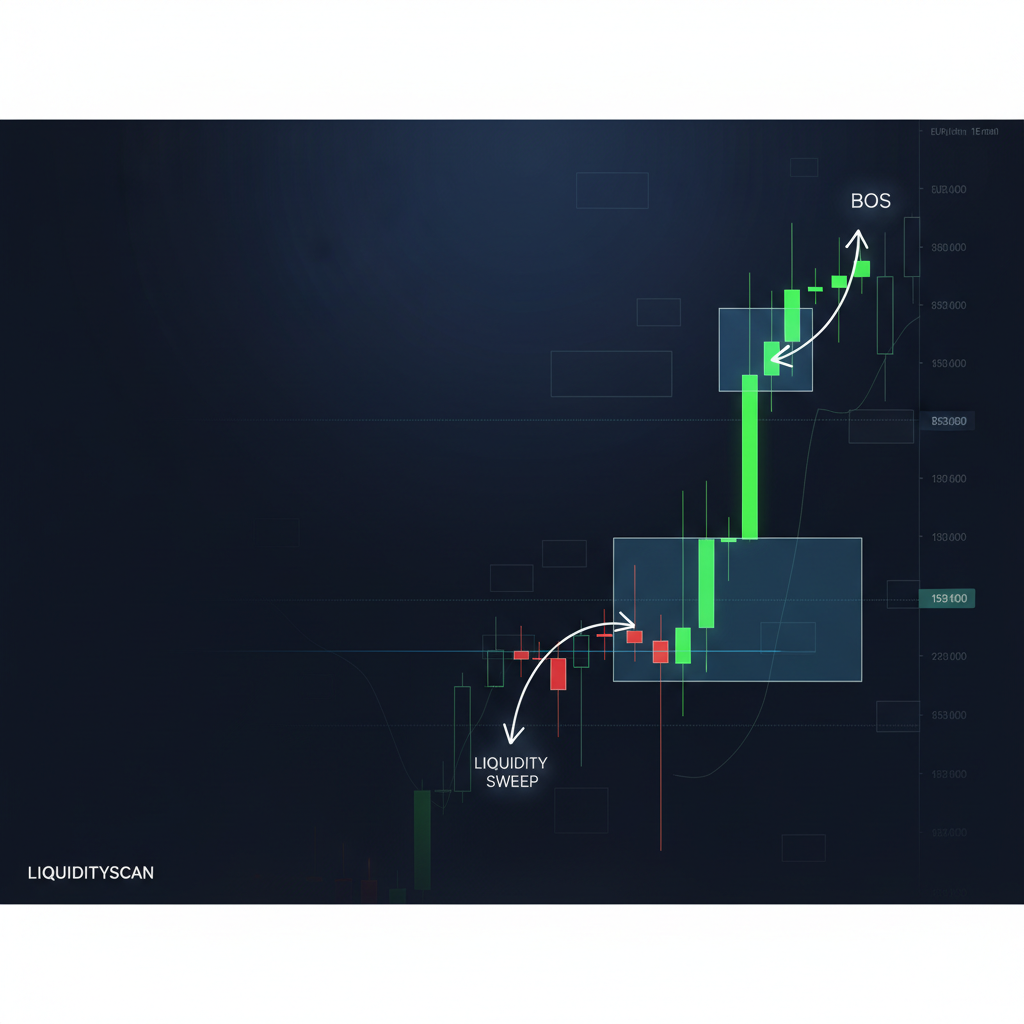
The Judas Swing: An Event, Not a Pattern
Let's be precise. The Judas Swing is not a candlestick pattern you scan for on a cheat sheet. It's a scheduled, time-based event, and its job is to engineer liquidity. Picture a deliberate stop hunt that fires during the high-volume opening of the London or New York kill zones.
The textbook version plays out at the London open, between 2:00 and 4:00 AM New York time (EST). By then the Asian session has carved out a relatively tight consolidation, and two pools of orders are sitting there waiting: buy stops above the Asia high, sell stops below the Asia low. The Judas Swing is the sharp, aggressive move that spears one of those levels, triggers the stops, and baits breakout traders into the wrong direction. It betrays the move it pretends to start, which is exactly where the name comes from. If the idea of a level being deliberately run feels new, our breakdown of what a liquidity sweep actually is walks through the mechanics step by step.
None of this is random noise. It's a feature of how algorithms clear liquidity. A Bank for International Settlements (BIS) working paper on high-frequency trading makes the point plainly: algorithms hunt for liquidity pockets, and clustered stop-loss orders are about the juiciest target there is. The Judas Swing is just that process leaving a footprint you can see on an intraday chart. If you've ever wondered whether the deck is stacked, the same logic underpins the case that the forex market is engineered rather than fair.
Turtle Soup: The Reversal Entry Model
If the Judas Swing is the hunt, the Turtle Soup is the trap snapping shut. Once the stops are run and the false positions are loaded, price tends to reverse hard. Turtle Soup is the entry model built to catch that reversal.
The concept was first laid out by Linda Bradford Raschke and Laurence A. Connors in their book "Street Smarts." Their original model, which they named 'Turtle Soup', was a contrarian play on false breakouts of 20-day highs and lows. The trade was a deliberate bet against the 'Turtles', the famous group of traders who bought new highs and sold new lows.
ICT borrows the idea and drops it onto intraday structure. Instead of 20-day levels, we lean on session liquidity points like the Asian session high and low. The core principle doesn't change: a run on a meaningful liquidity level, followed by a fast failure and reversal, hands you a high-probability entry.
A Unified Framework: From Judas Swing to Execution
Treating these as two separate ideas is one of the most common mistakes I see. They're two acts of the same play. Here's how I identify and contextualize the setup, start to finish.
- Establish Higher Timeframe Bias: Before the session even opens, ask where the draw on liquidity sits on the Daily or 4H. Is price reaching for an old high (external liquidity), or pulling back into a Fair Value Gap (internal liquidity)? A Judas Swing that agrees with that higher-timeframe narrative is a far better setup than one that fights it. If the daily bias is bullish, the ideal long is a Judas Swing that sweeps the Asian session low before running higher.
- Identify the Target: Mark the Asian session high and low on your chart. These are your inducement levels, the spots where resting liquidity is parked.
- Wait for the Timed Event: Patience is the whole game here. I watched this setup fail on London opens half a dozen times before I learned to just wait for the sweep. Don't act during the consolidation. Wait for the London kill zone and watch the Judas Swing attack the Asia high or low. The signal isn't the sweep itself; it's how price reacts after the sweep.
- Confirm with Displacement: Once the level is run, price has to reverse with real energy. You want a strong push back into the range that leaves a Fair Value Gap (FVG) behind. That's displacement, and it tells you institutions are sponsoring the move. A weak, choppy crawl back in is not a signal. A market structure shift (MSS) on a lower timeframe, say the 1M or 5M, confirms the reversal is actually taking hold. If displacement and FVGs are still fuzzy for you, start with what a Fair Value Gap is and then read up on the difference between a BOS and a CHoCH.
- Refine the Entry: The entry usually lives inside the FVG or at a fresh order block the displacement created. An Optimal Trade Entry (OTE) retracement of 62% to 79% into that area gives you a precise point of engagement, and the logic behind those numbers is unpacked in our look at the institutional OTE model versus retail fibs.
Tracking these sequences by hand across a handful of pairs during a volatile kill zone is genuinely hard. That's where tooling earns its place. The LiquidityScan platform, for example, uses its Institutional Bias engine to surface higher-timeframe context, so you can check in seconds whether a Judas Swing on the 15M lines up with the 4H or Daily order flow you expect.
Common Failure Points and How to Avoid Them
The model is powerful, but it isn't bulletproof. It breaks when traders ignore context.
The number-one failure is trading against the higher-timeframe bias. If the Daily is aggressively bearish and you're trying to buy a Judas Swing that sweeps the Asia low, you're stepping in front of a freight train. That 'sweep' is just as likely to be the opening leg of a true expansion as a reversal.
The second is the missing displacement. If price sweeps a low and then drifts back into the range with no conviction and no clear FVG, there's no institutional footprint to trade. That's an indecisive market, not a reversal. Smart money doesn't creep; it displaces.
And respect the clock. This is a time-sensitive model. A sweep of the Asia high at 10:00 AM NY time, well outside the London window, simply doesn't carry the same weight. It's price action, not a structured institutional event. The Judas Swing is a creature of the opening bell, and if you trade more than one session it's worth understanding how London and New York sweeps differ.
See the Judas Swing as the engineered liquidity event and the Turtle Soup as the price-action reversal it sets up, and you connect the 'why' with the 'how'. That's the shift from spotting patterns to reading intent. And that's where the edge actually lives.