
Liquidity Sweep vs Liquidity Grab: Is There an Actual Difference?
A liquidity sweep and a liquidity grab describe the same event: price pushes through a level where stops cluster, fills resting orders, and reverses. The useful convention: sweep names the chart pattern — wick through and reclaim — while grab names the institutional action of collecting orders.
Search any two Smart Money Concepts glossaries and you will find the terms swapped freely. ICT himself rarely says "grab" — his vocabulary is raid, purge, stop hunt, and run on liquidity. The "liquidity grab" phrasing spread later through SMC YouTube channels and prop-firm curricula, where it now dominates.
No exchange, regulator, or academic source defines either term, so nobody owns the correct definition, and anyone claiming the two are formally distinct concepts is describing their own house style, not a standard.
That said, a working convention has emerged across serious SMC and ICT communities that makes both words more useful instead of redundant. This article lays out that convention, the reclaim rule that separates a tradeable sweep from a genuine breakout, the order book mechanics underneath, and the mislabeling errors that quietly destroy backtests.
Treat it as a shared working map rather than dogma: one event, two lenses — and a common vocabulary for everything adjacent to it.
What Is a Liquidity Sweep? The Chart-Pattern Definition
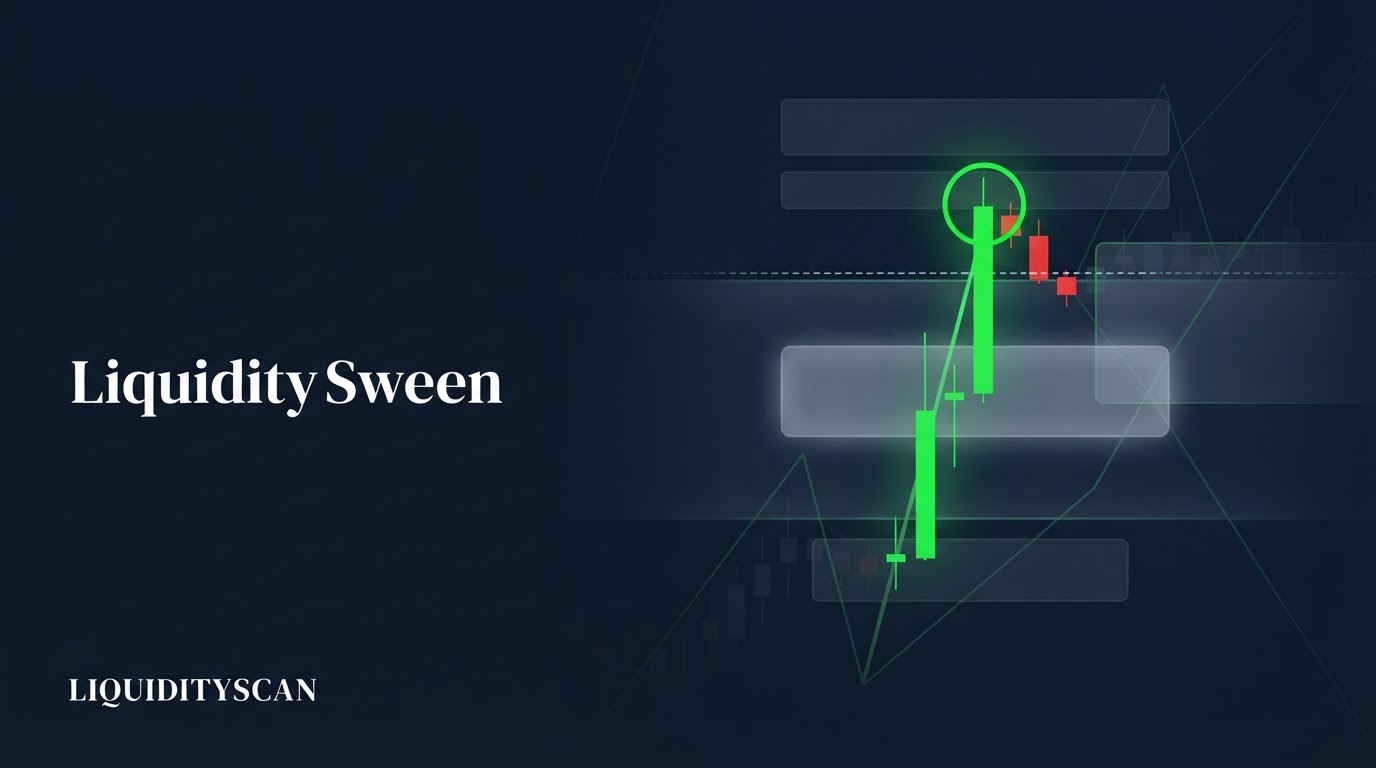
A liquidity sweep is a move that trades through a level holding clustered stop orders and then closes back on the original side of that level. The defining feature is the reclaim: the sweep candle itself, or one within the next one to three candles, closes back inside the prior range. Stops were taken; the breakout did not hold; the level survived.
The levels that qualify are liquidity pools — places where stop orders demonstrably accumulate. The classic set: Equal Highs (EQH) and Equal Lows (EQL), the prior day's high and low, the prior week's high and low, session extremes such as the Asia range, and clean swing points that every retail chart marks identically.
Stops cluster there because traders anchor risk to visible structure — a stop two ticks above "obvious resistance" feels safe. Collectively those stops form Buy-Side Liquidity (BSL) above highs and Sell-Side Liquidity (SSL) below lows: market orders in waiting.
On the chart, the anatomy is consistent. Price approaches the level, penetrates it — typically 0.1% to 0.5% beyond the level on crypto majors, a few pips on EURUSD — stalls almost immediately, rejects, and closes back inside. Drop one timeframe lower and the same event reads as a breakout that fails within a handful of candles, followed by displacement back through the level.
One discipline point that the definition forces on you: a sweep is only a sweep after the reclaim close. While the candle is still open beyond the level, the identical bar is an ordinary breakout in progress. That is not pedantry — it is the entire trade filter, and it is what separates the sweep from every other word in this article.
What Is a Liquidity Grab? The Institutional-Action Definition
A liquidity grab is the same event described from the point of view of the participant doing the grabbing. A fund that wants to sell size without moving the market against itself needs a dense population of buyers. The most reliable buyers on any chart sit just above equal highs: breakout traders entering long via stop-market orders, plus shorts whose protective stops are buy orders.
Push price into that pocket and both groups buy simultaneously — instant counterparties for institutional distribution. The "grab" is the collection of those orders, whatever the candle ends up looking like.
Because grab names the action rather than the pattern, usage drifts in two documented directions. Some communities use grab for smaller, faster intraday events — a two-minute wick through the London high — while reserving sweep or raid for higher-timeframe pools.
Others tie grab specifically to the manipulation leg of the Power of 3 (AMD) cycle — accumulation, manipulation, distribution — where the session-open Judas Swing grabs one side of the book before the real delivery runs the other way. Both usages describe the same underlying mechanic; they just scope it by size or by schedule.
What Actually Happens in the Order Book
Mechanically, a stop order is a market order in waiting. When price touches the trigger, stops above the highs convert into aggressive buy orders hitting the ask.
The resting sell-side book just beyond a resistance level is usually thin — few participants offer passively into a possible breakout — so a modest burst of stop-triggered buying moves price disproportionately far. That is why sweep wicks look violent relative to their volume.
Institutions exploit exactly this: they layer limit sells into the stop-driven burst, absorbing the forced buying. When the stop fuel is spent, aggressive demand vanishes in seconds, and price mean-reverts back through the level.
In extreme cases the same cascade dynamic runs unchecked — the BIS Markets Committee report on the October 2016 sterling flash event examines how stop-loss executions and thin resting liquidity, among other factors, likely amplified a move well beyond what news flow explained. A liquidity grab is that mechanism in miniature, with someone positioned to absorb it.
Liquidity Sweep vs Liquidity Grab: Side-by-Side Comparison
The table below summarizes the working convention. Remember the honest caveat: plenty of competent traders use the two terms interchangeably, and nothing breaks if you do. The distinction earns its keep only because it forces you to separate an observable chart criterion (the reclaim) from an inferred narrative (institutions collected orders).
| Dimension | Liquidity Sweep | Liquidity Grab |
|---|---|---|
| Primary lens | Chart pattern: wick through a pool, close back inside | Institutional action: collecting resting stop orders |
| Confirmation | Objective — reclaim close on the level's timeframe | Inferred — from context, volume, and what follows |
| Typical scope in common usage | Any timeframe; often HTF pools (PDH/PDL, weekly levels) | Often intraday, smaller and faster; session-open wicks |
| Vocabulary family | ICT lineage: raid, purge, stop hunt, run on liquidity | SMC/retail lineage: grab, stop grab, manipulation leg |
| Role in a trade model | Entry trigger once the reclaim confirms | Narrative component — the M in AMD / Power of 3 |
| What it implies next | Reversal bias away from the swept pool | Direction comes from context: reversal after the grab, or continuation once orders are collected |
Practical consequence: when someone tells you "that was just a liquidity grab," ask what the chart criterion was. If the answer includes a close back inside the range, you are both describing a sweep. If there is no criterion — only the assertion that smart money did something — you are hearing a story, and stories are not testable.
The Reclaim Rule: Confirmed Sweep vs Genuine Break
The reclaim rule is the single objective test in this whole vocabulary debate, so it deserves precision. On the timeframe that defines the level, price must close back inside the prior range — ideally on the sweep candle itself, acceptably within the next one to three candles.
Close back inside: sweep confirmed, reversal bias active. Close and hold beyond the level, especially with a successful retest from the other side: genuine break, and the correct label is a Break of Structure (BOS), not a grab.
Worked example, long side failure. BTCUSDT prints equal highs at 118,400 and 118,420 across two 4H swings — an engineered pool of buy stops. Price rallies to 118,760, roughly 0.3% through the pool, on a single high-velocity candle. The next 15-minute candle closes at 118,150, back inside the range, and the 4H candle ultimately closes at 117,900.
That is a confirmed sweep of buy-side liquidity: stops above the highs were converted into exit liquidity, and the reclaim tells you demand beyond the level was absent. Bias flips toward the opposite pool — the sell-side resting under the range lows.
Counterexample, the genuine break. EURUSD trades through the prior week's high at 1.0925 and closes the 4H candle at 1.0941 — above the level, not back inside. Two candles later it retests 1.0925 from above and holds. Nothing was "grabbed and rejected"; buy stops fired and the market accepted the higher prices.
Traders who labeled this a liquidity grab and shorted the retest were not fading manipulation — they were fighting a confirmed breakout, which is how the mislabel converts directly into losses.
After a genuine sweep, expect follow-through with structure: displacement back through the swept level, then a Change of Character (CHoCH) or Market Structure Shift (MSS) on the lower timeframe as the reversal leg takes out its first opposing swing. A sweep that reclaims but then drifts sideways for ten candles without displacement is a much weaker signal — absorption may have happened, but nobody with size is pressing the reversal.
How Sweep and Grab Map to Stop Hunt, Raid, Purge, and Turtle Soup
The surrounding vocabulary causes as much confusion as the sweep-versus-grab pair itself, because five communities coined words for overlapping slices of one phenomenon. The map below places each term.
| Term | Origin / community | What it emphasizes | Relation to sweep and grab |
|---|---|---|---|
| Stop hunt | Generic retail and order flow slang | Intent — someone targeted the stops | Same event, intent-flavored label |
| Raid | ICT ("liquidity raid") | An aggressive run on a session or HTF pool, often kill-zone timed | Same event, usually HTF, timing-aware |
| Purge | ICT | Clearing one side's liquidity before delivery goes the other way | Same event, framed by what comes after |
| Turtle Soup | Linda Raschke; adopted into ICT | The tradeable setup: fade a failed breakout of a prior swing | The trade built on top of a sweep |
| Judas Swing | ICT | The false move at session open — the manipulation leg | A grab with a scheduled time of day |
| Stop run | Futures / order flow desks | Execution mechanics of triggering resting stops | The order book description of the grab |
Read the map by category and it collapses cleanly. Sweep, grab, stop hunt, raid, purge, and stop run all name the event, each stressing a different facet — pattern, action, intent, aggression, sequence, execution. Turtle Soup names a setup that requires the event. The Judas Swing names the event at a specific time. Once you see the categories, apparent contradictions between educators mostly dissolve into lens choice.
Trading the Aftermath — and the Mislabeling Errors That Cost Money
Whichever word you prefer, the money is made after the event, and only if the event was real. The aftermath playbook is short and mechanical.
A Simple Aftermath Playbook
- Mark pools in advance. Equal highs and lows, prior day and week extremes, session ranges — drawn before price arrives. A pool identified after the wick is hindsight, not analysis.
- Demand the reclaim close. No entry while price sits beyond the level. The close back inside is the confirmation that converts "breakout in progress" into "sweep."
- Wait for displacement plus a lower-timeframe CHoCH. The reversal leg should move with energy and break its first opposing swing. Enter on the retrace into the Fair Value Gap (FVG) or Order Block left by that displacement leg.
- Anchor risk to the wick extreme. Stop goes beyond the sweep high or low — if price trades back through it, the sweep thesis is simply wrong. First target: the opposite side of the range or the nearest internal pool, which typically offers 2R to 4R from an FVG entry against a wick-extreme stop.
Common Mislabeling Errors
- Calling every wick a sweep. A rejection wick in the middle of a range took no identifiable pool. No pool behind the level, no sweep — just a wick.
- Fading genuine breaks as "grabs." If price closes beyond the level and holds, that is acceptance. Shorting every break of highs because "it's manipulation" is a countertrend system with no filter.
- Confusing inducement with the sweep. Inducement is the engineered minor pool created in front of the real level to bait early entries; the sweep is the strike on the level itself. Entering on the inducement wick means your stop becomes part of the actual pool.
- Timeframe mismatch. A 1-minute "sweep" against a 4H displacement leg is noise inside someone else's order flow. Confirm on the timeframe that defines the level, or one below it.
- Hindsight labeling in backtests. If you only mark sweeps that reversed, your journal will show a 90% pattern that trades at 50%. Log every pool touch, then apply the reclaim rule blind.
Verification is straightforward on your own data: collect 50 to 100 pool touches on one pair and timeframe, split them by reclaim-versus-acceptance, and measure what followed. Published discretionary backtests of sweep-reversal entries tend to land in broad 40% to 60% win-rate ranges depending on regime, session filter, and displacement requirement — illustrative figures, not promises, and exactly why the filter discipline above matters more than the label.
LiquidityScan's sweep scanner flags HTF sweep-and-reclaim events across crypto pairs in real time, which sidesteps the hindsight problem, but the reclaim rule itself is checkable on any charting platform.
So, liquidity sweep vs liquidity grab: one market event, two vantage points. Say sweep when you mean the confirmed wick-and-reclaim pattern, say grab when you mean the institutional collection of stops — and let the reclaim rule, not the vocabulary, decide whether you trade it.
Frequently Asked Questions
Is a liquidity grab bullish or bearish?
It depends on which side was taken. A grab above equal highs converts breakout buyers into exit liquidity and, once price reclaims the level, carries bearish reversal bias. A grab below lows is the bullish mirror. Before the reclaim close, it carries no bias at all — it is still just a breakout.
What is the difference between a liquidity sweep and a fakeout?
A fakeout is any failed breakout. A liquidity sweep is a failed breakout through an identifiable liquidity pool — equal highs, a prior day extreme, a session range — confirmed by a close back inside. Every sweep is a fakeout, but a fakeout with no pool behind it and no reclaim criterion is just noise with a nickname.
How long should price take to reclaim the level after a sweep?
The strictest read requires the sweep candle itself to close back inside; most practical models allow one to three candles on the level's timeframe. The longer price holds beyond the level, the more the market is demonstrating acceptance of the new prices — and acceptance is the signature of a genuine break, not a sweep.
Do liquidity sweeps work the same way in crypto as in forex?
The mechanism is identical — stops cluster beyond obvious levels in every market. Crypto adds a visible layer: perpetual-futures liquidation clusters behave like stop pools and are publicly estimable, so sweeps of prior day highs or lows often coincide with liquidation cascades. Forex sweeps concentrate more tightly around session opens and kill zones.
Related query paths
Where to go next, in the order the query network naturally unfolds — from the base definition to the setups built on top of it.
- What Is a Liquidity Sweep? — the foundational definition this comparison builds on.
- Liquidity Sweep Explained: The ICT Stop Hunt — deeper mechanics of the stop hunt behind every sweep.
- BSL vs SSL in SMC: Identify Liquidity — learn to locate the pools that get swept before price arrives.
- Equal Highs & Equal Lows (EQH/EQL): Engineered Liquidity — why the cleanest-looking levels attract the biggest grabs.
- Inducement vs Liquidity Sweep: A Trader's Guide to SMC Setups — the adjacent disambiguation that trips up sweep traders next.
- Judas Swing vs Turtle Soup: An ICT Trader's Guide — the two named setups built directly on the sweep-and-reclaim event.
- Why Does Price Reverse After a Liquidity Sweep? — how it connects to why does price reverse after a liquidity sweep.
- what is trendline liquidity and why it gets swept — Explains how diagonal stop pools form and why sweeps target them.