
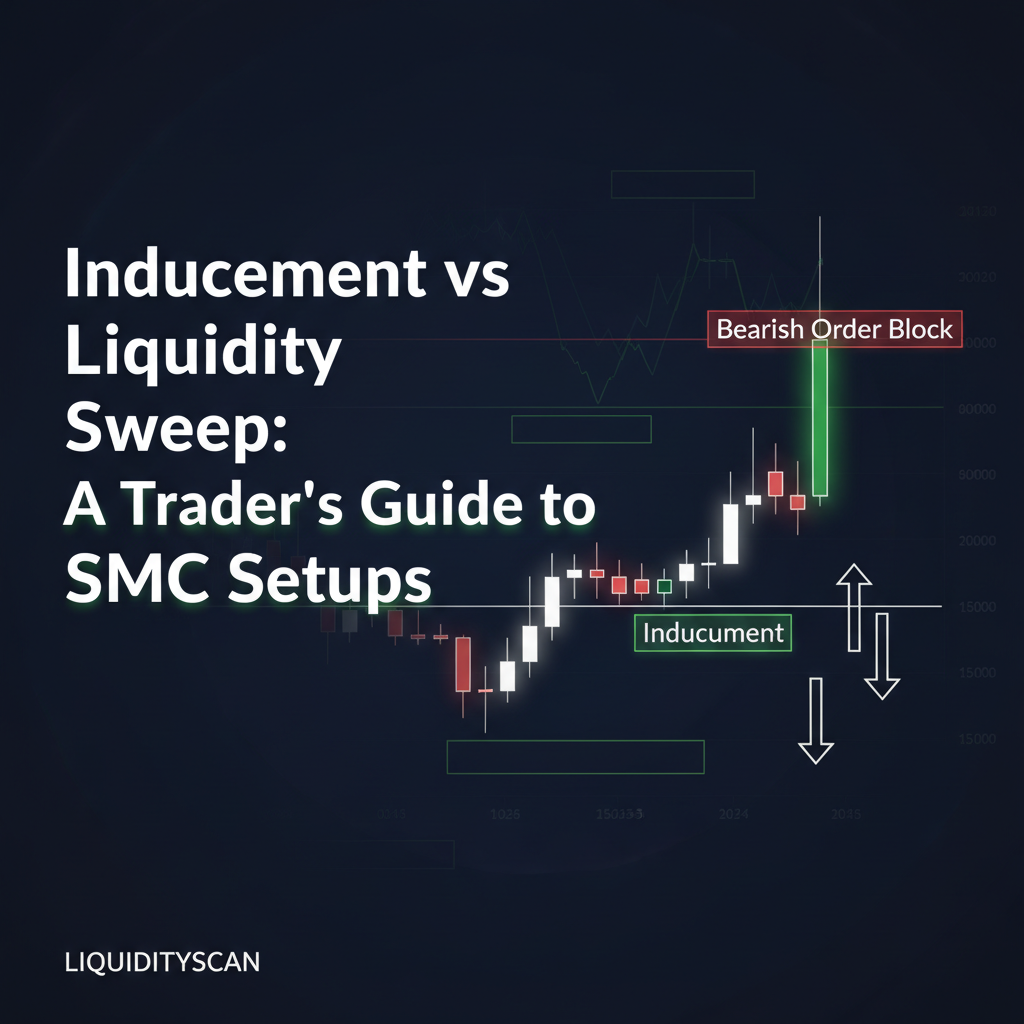
What is the Core Difference Between Inducement and a Liquidity Sweep?
The core difference is function and sequence: inducement is the bait, and the liquidity sweep is the trap springing shut. Inducement is a price pattern engineered to build liquidity, while a liquidity sweep is the action taken by institutional algorithms to harvest that liquidity. You cannot have the sweep without first having the inducement. They are two sides of the same coin, a deliberate one-two punch in price delivery.
| Aspect | Inducement | Liquidity Sweep |
|---|---|---|
| Function | Builds liquidity (the 'bait') | Captures liquidity (the 'action') |
| Nature | A price pattern or structure | A rapid price movement |
| Timing | Forms before the real move | Is the start of the real move |
| Trader Impact | Tempts traders into early, weak positions | Stops out those early positions |
Defining Inducement in Smart Money Concepts (SMC)
Inducement is a specific, engineered price point that appears to be a valid technical level but is designed to fail. It's the first 'obvious' swing high in a downtrend or swing low in an uptrend that traders are conditioned to see as support or resistance. This could be a minor pullback that creates a new high or low just before price reaches a true Point of Interest (POI) like an order block or a significant fair value gap (FVG). Its sole purpose is to gather orders—both stop losses from breakout traders and limit orders from reversal traders—at a predictable spot.
The Psychology of Inducement: Creating the 'Obvious' Trade
Market algorithms don't hunt for random liquidity; they manufacture it. Inducement works by playing on common retail strategies. A small, clean double top? That's likely inducement. A textbook trendline touch that looks too good to be true? Probably inducement. The algorithm creates a picture so clean and simple that it entices a wave of predictable participation. This pool of orders provides the necessary counterparty liquidity for large institutions to fill their own positions at a more favorable price, a fundamental concept of order flow mechanics detailed by exchanges like the CME Group.
Defining a Liquidity Sweep (Stop Hunt)
A liquidity sweep is the aggressive, rapid price move that clears out the liquidity built by the inducement. Also known as a stop hunt or a 'Judas Swing', it's characterized by a sharp wick that pierces the inducement level. The key is that price doesn't sustain its move beyond this level. Instead, it grabs the stops, fills institutional orders waiting just beyond the obvious level, and then sharply reverses. A confirmed sweep is often followed by a strong displacement move in the opposite direction, leaving the baited traders behind.
How to Spot Inducement on a Chart: A Step-by-Step Guide
Identifying inducement before the sweep occurs is a critical skill. It’s what separates the trader who anticipates the move from the one who becomes the fuel for it. Here are the characteristics to look for.
Characteristic 1: The Minor Structural High/Low
Inducement is almost never a major, structurally significant swing point. It's typically a minor high or low within a larger price leg. On a 1-hour chart, for instance, you might be looking for a major swing low as your target. Before price gets there, it may form a small, intermediate low. That intermediate low is the prime candidate for inducement. It’s the level that impatient traders will use to place their buy orders, assuming the bottom is in.
Characteristic 2: Proximity to a Real Point of Interest (POI)
True inducement levels are strategically placed. They form just before a higher-probability POI. If you identify a clean order block in a discount market that hasn't been tested, and price forms a small swing low just above it, that swing low is highly suspect. The algorithm is baiting longs before running their stops to mitigate the true order block below.
Characteristic 3: The Pre-Sweep Liquidity Trap
Look for price action that seems 'too clean'. Does it form a perfect little trendline? A neat, tidy horizontal level that everyone on social media is pointing out? This is often a liquidity trap. Institutional price delivery is rarely that neat. It's messy and efficient. Clean levels are often built to be broken.
Chart Examples: Inducement Followed by a Sweep
Theory is one thing; seeing it on a live chart is another. The sequence is remarkably consistent across all markets, from forex to crypto.
Bullish Scenario: Inducement Below a Swing Low on EUR/USD
Imagine EUR/USD is in an uptrend on the 1-hour timeframe. It pulls back, and on the 15-minute chart, it forms a clear swing low. Many traders will buy here, placing stops just below. But price then drops one more time, wicking below that 'obvious' low—the inducement—to tap into a 15-minute FVG or order block from the prior leg up. It grabs the sell-side liquidity from the stops before reversing with force, creating a Market Structure Shift (MSS) and continuing the original uptrend.
Bearish Scenario: Inducement Above a Swing High on BTC/USDT
Consider BTC/USDT in a bearish environment. After a strong down-move, price begins to consolidate and forms a clean high on the 5-minute chart. This becomes the inducement. Traders shorting this level place their stops just above it. The algorithm then pushes price just past that high, sweeping the buy-side liquidity, to mitigate a higher-timeframe bearish order block. Once the large sell orders are filled, price collapses, leaving the early shorters stopped out for a loss.
The Functional Relationship: Why Inducement Precedes a Sweep
The relationship is causal. Large institutions cannot simply place a massive market order without causing significant slippage. They need a deep pool of opposing orders to execute against. When that natural liquidity isn't present, algorithms are programmed to engineer it. Inducement creates a concentrated cluster of stop-loss orders. The sweep is the mechanism to trigger those stops, which are market orders, providing the necessary liquidity to fill the institution's large position before initiating the real intended move.
Trading Strategies for Inducement Setups
Recognizing the pattern is only half the battle. You need a framework for execution. There are generally two approaches, each with its own risk profile.
Strategy 1: Fading the Inducement Level (High Risk)
This involves placing a limit order at the true POI (the order block or FVG) above or below the inducement level, anticipating the sweep. Your stop loss would go on the other side of the POI. This offers a phenomenal risk-to-reward ratio but is inherently aggressive. You are trying to catch a falling knife, and if your POI analysis is wrong, you will take a direct loss.
Strategy 2: Entering on Confirmation After the Sweep (Higher Probability)
This is the approach I personally favor, especially on volatile pairs. You wait for the sweep to happen. Let the algorithm show its hand. Once price sweeps the inducement level and then displaces aggressively back in the other direction, leaving a Change in State of Delivery (CISD) or a new FVG, you enter on the resulting pullback. The entry price is worse, but your probability of success is significantly higher because the institutional intent has been confirmed. Real-time tools like the LiquidityScan platform are built to detect these powerful displacement moves as they happen, giving you the confirmation you need to act.
Frequently Asked Questions
Is inducement the same as a Judas Swing?
They are very closely related. The Judas Swing is a specific type of liquidity sweep that often occurs during the London Kill Zone, typically running the high or low of the preceding Asian session. So, the Asian high/low acts as the inducement, and the Judas Swing is the sweep that clears it.
Can inducement happen on a 5-minute timeframe?
Absolutely. Inducement and sweeps are fractal concepts; they occur on all timeframes, from the monthly down to the 1-minute chart. On the 5-minute timeframe, you are typically looking at inducement that sets up a move to a 15-minute or 1-hour POI.
Is every minor pullback inducement?
No, and this is a critical distinction. A pullback is simply price moving against the trend. Inducement is a specific, engineered pullback designed to build liquidity before a sweep into a higher-timeframe POI. Context is everything. A pullback that doesn't have a clear POI behind it is just noise, not a high-probability inducement setup.
Related query paths
To deepen your understanding of the components that make inducement setups work, explore these core concepts:
- What is an Order Block in SMC Trading? — Learn to identify the high-probability institutional levels where price reacts after a liquidity sweep.
- What is a Fair Value Gap (FVG)? — Understand these three-candle patterns that signal institutional imbalance and act as powerful magnets for price.
- Market Structure Shift vs Change of Character — Distinguish between a minor CHoCH and a true MSS, which often confirms a successful liquidity sweep.
- LiquidityScan vs TradingView indicators for ICT and Smart Money Concepts — Compare tools for scanning and validating inducement and liquidity sweep setups.
- ICT vs SMC vs price action — Compare the broader frameworks before applying inducement and liquidity-sweep concepts.