
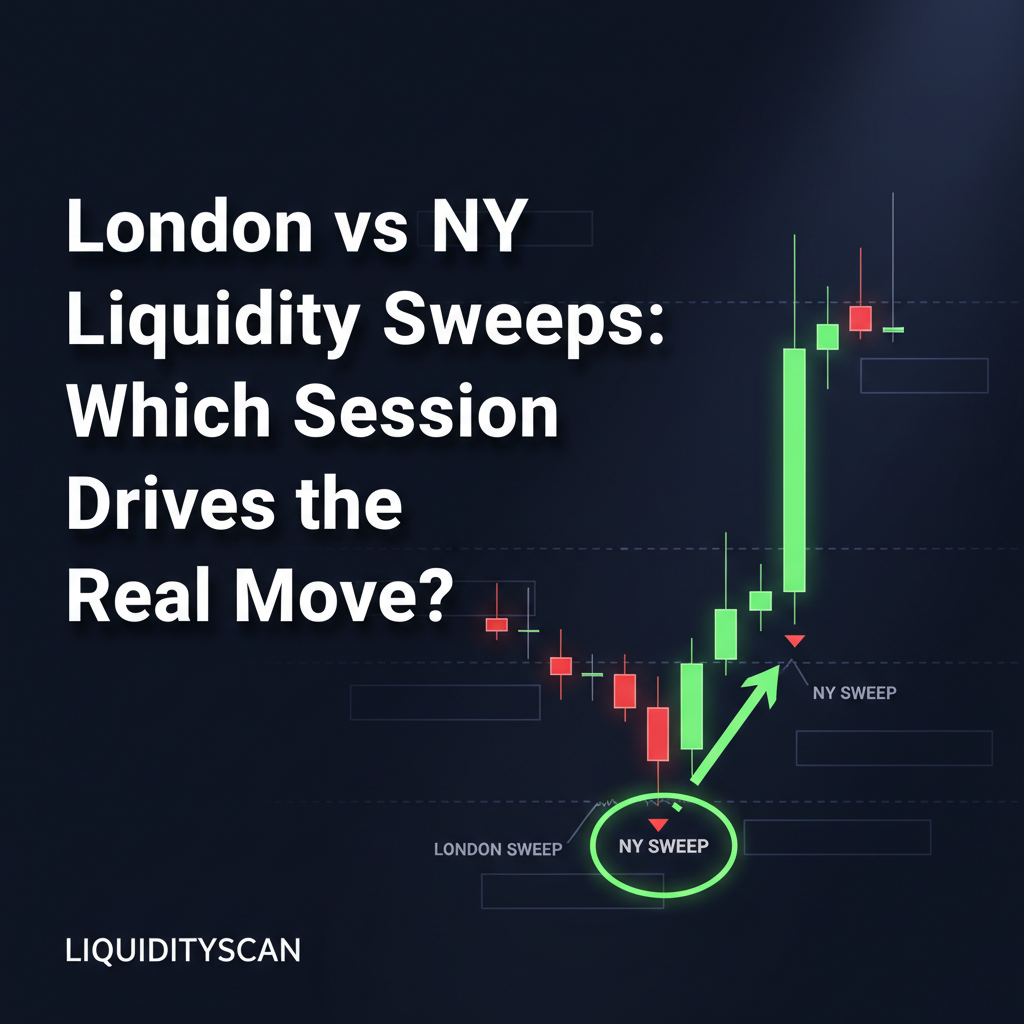
London sweeps usually engineer liquidity for a reversal. New York sweeps tend to accelerate a trend that's already in motion. Once you can tell those two stop hunts apart by their character and their purpose, a lot of the ICT day stops looking random.
The London Open: Engineering Liquidity with the Judas Swing
London doesn't ease into the day. It ignites. The catch is that the first move is usually a lie. The classic London signature is the Judas Swing, a deliberate run on the stop orders parked just above the Asian high or below the Asian low. None of that is random volatility. It's liquidity being manufactured before the session's real directional leg ever starts.
Picture the Asian range as a pool of resting buy stops and sell stops. London's big players have size to fill, and the cleanest way to do it is to push price into one side of that pool. Say they drive EUR/USD below the Asian low. That trips a cascade of sell stops from breakout traders, plus the stop-losses on every late Asian long. The selling pressure that creates is exactly what they need to fill their own large buy orders at a better average price. Once they're loaded, price snaps back the other way and the early sellers are trapped. That's a textbook liquidity sweep doing its job.
For years I tried to trade the initial break of the Asian range itself. It was an expensive habit. What finally fixed it was learning to wait. The trade isn't the sweep, it's the reaction to the sweep. After price runs below the Asian low, I want to see a fast reclaim of that level and a market structure shift on a lower timeframe, usually the M5 or M15. That reclaim is the tell that the Judas Swing is finished and the real move is loading. If you want the full step-by-step on timing that window, the London open kill zone playbook walks through it.
This shows up day after day because London is where the daily narrative tends to get written. It sets the tone, and to do that cleanly it has to flush out the weak hands first. The deception isn't a bug. It's the whole point. If you want to see how it stacks up against the related failed-breakout reversal, the Judas Swing versus Turtle Soup breakdown is worth a read.
New York's Game: Momentum, Continuation, and News-Driven Reversals
If London writes the first chapter, New York usually writes the climax. By the time the NY kill zone opens at 7:00 AM EST, London has normally already laid down a clear directional bias for the day. So NY sweeps behave differently. They're less about luring you in and more about either continuing the move or detonating a reversal.
The most common NY sweep targets liquidity that London built. If London ran a strong bullish leg, a pullback through the NY morning will often sweep a short-term low left behind during London's lunch hour. That dip into a discount array, usually an order block or an FVG, gathers fuel from traders who tucked their stops in too tight, and then it continues the established uptrend. This is the classic OTE (Optimal Trade Entry) setup, and NY volume is what gives it teeth.
The other face of the NY sweep is the news-driven reversal. A high-impact US print like CPI or NFP can tear up London's narrative completely. A sweep right before the 8:30 AM EST drop is common, grabbing liquidity moments before a violent, high-displacement move the other way. Where the London Judas Swing tends to be a methodical reversal, a NY news sweep can kick off a powerful trend leg that runs for the rest of the session.
Comparing Sweep Characteristics
None of this is just anecdote. The differences come straight from volume, who's participating, and how information flows around the 24-hour clock. Side by side:
| Characteristic | London Sweep | New York Sweep |
|---|---|---|
| Primary Purpose | Inducement, trap engineering, setting the daily bias. | Continuation of trend, or high-impact news reversal. |
| Typical Target | Asian session highs or lows. | London session highs/lows or intra-session swing points. |
| Pace & Volatility | Often methodical, followed by a confirmed reversal. | Can be explosive and aggressive, especially around news. |
| Post-Sweep Action | Often leads to a strong reversal that forms the daily trend. | Often leads to a continuation (BOS) or a violent reversal. |
| Associated Pattern | Judas Swing. | OTE pullback or news-driven displacement. |
The Engine Room: Why Volume and Overlap Create These Differences
The split in behavior between London and NY sweeps isn't arbitrary. It falls directly out of institutional order flow and who is at the desk. London is the single largest FX trading center by volume. The Bank for International Settlements' (BIS) Triennial Survey puts London at a staggering 43% of global FX turnover. That much volume hands the big players the cover to engineer something as elaborate as a Judas Swing and accumulate their lines without lighting up the tape with slippage.
The London/NY overlap, 8:00 AM to 12:00 PM EST, is the most liquid stretch of the entire trading day. Both centers are fully open, so volume and volatility peak together, a point CME Group makes in its own educational materials. That's why NY sweeps can hit so hard. They land when the market is running at max capacity, which lets price make fast, high-momentum moves that can actually carry a trend. When there's enough volume to swallow large orders, price has no reason to be subtle about it.
Seen this way, the sweeps stop being chart curiosities. They're artifacts of global capital rolling through different phases of liquidity, which is one of the load-bearing ideas in the ICT market structure framework.
Adapting Your Execution Strategy
Knowing the difference does nothing if you don't act on it. Your execution model has to bend to the session in front of you. This is a big part of building an edge through specialization rather than trying to trade everything the same way.
In London, patience is the whole game. Don't be the liquidity. Treat the first move out of the Asian range as false until the chart proves otherwise. Wait for the sweep. Then wait again for the confirmation: a hard rejection, a displacement candle against the sweep, and a clear market structure shift (MSS) on your execution timeframe. Once that's on the screen, you can frame the trade in the direction of the reversal and target the opposing liquidity pool.
In New York, your read starts with whatever London did. Did it build a clean trend? If so, the highest-probability NY trades are OTE pullbacks that align with it. Look for sweeps of minor lows in an uptrend, or minor highs in a downtrend, that tap a 15M or 1H FVG before the move continues. If London was range-bound or just messy, switch your attention to the US economic calendar. A major release can be the catalyst for the day's real expansion, and it's often kicked off by a sharp sweep right before the number drops.
Either session, post-sweep confirmation is the hinge. This is where a tool like the LiquidityScan platform earns its keep. After a possible sweep, a real-time alert for a Change in State of Delivery (CISD) or a clean SuperEngulfing pattern on a closed M15 candle gives you the objective read you need to pull the trigger. It separates the noise of the sweep from the signal of what institutions actually intend to do next.