
What Is an Asian Range Sweep Scanner?
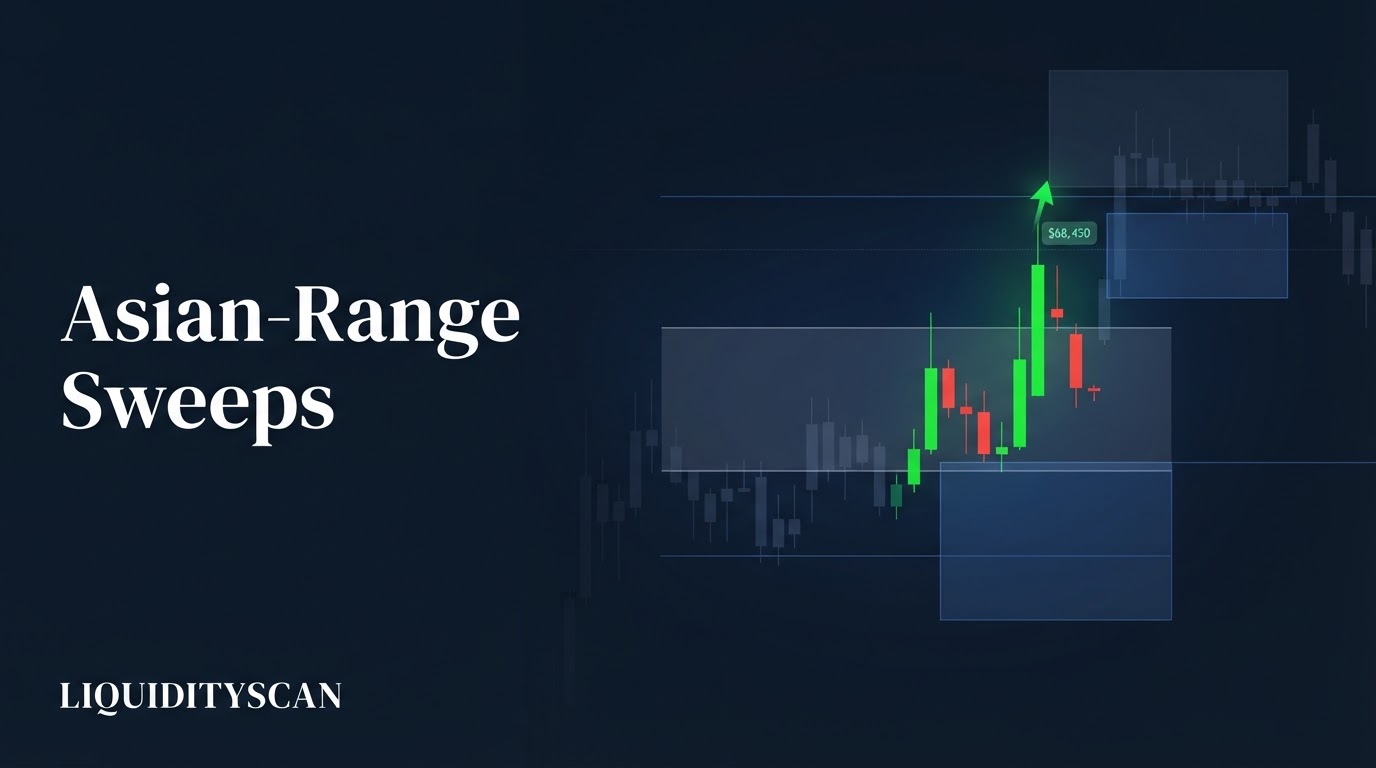
An asian range sweep scanner is an automated tool that marks each coin's Asian-session high and low, reads a daily directional bias, then watches for price to sweep that range against the bias and reclaim in the bias direction. It flags the setup through three stages: armed, swept, confirmed.
In other words, it encodes a specific ICT session model into a repeatable, closed-candle detection loop so you don't have to eyeball dozens of charts at the London and New York opens. The pattern is narrow and rule-based, which is exactly what makes it a good fit for a machine rather than a human watching one chart at a time.
The name maps directly onto the model's parts: the Asian range is the box built overnight, the sweep is the raid on one edge of it, and the scanner is the process that measures both across the whole market at once.
Each of those parts is a hard, testable condition rather than a judgment call, which is why the setup can be defined precisely enough to automate without smearing into subjectivity.
How the Asian-Range Model Works
The model rests on a simple observation about how the trading day is structured. Asia is typically the quiet, low-range session; it builds a tight box. That box's high and low become Buy-Side Liquidity and Sell-Side Liquidity pools — obvious levels where late longs and shorts park their stops.
When London or New York arrives with real volume, price often reaches for that resting liquidity first. The instructive version is when it reaches against the day's higher-timeframe bias: a bearish-bias day where price pokes above the Asian high to run buy-side stops, then rejects and trades back down.
That failed sweep — a Liquidity Sweep that gets reclaimed — is the entry trigger for the model.
So the sequence is: Asia builds a range, London/NY sweeps one edge of it against the daily bias, and a reclaim back through that edge in the bias direction confirms the move. The sweep engineers liquidity; the reclaim signals it has been absorbed and the intended direction is resuming.
- Range: Asian session high/low (New York 20:00–00:00).
- Bias: the day's directional lean from the last closed daily candle.
- Sweep: price takes the Asian edge on the side opposite the bias.
- Reclaim: a lower-timeframe reversal back through the swept level, in the bias direction.
Why the Asian Range Sweep Is Perfect for Automation
This setup is unusually well-suited to a scanner because it has three properties a human handles badly at scale. First, it is once per day — you get one clean cycle per symbol, so there's a lot of idle waiting between the parts.
Second, it is time-boxed — the range only forms in a fixed four-hour window, so the tool always knows exactly when to start measuring.
Third, it is a multi-step sequence, not a single candle pattern. You have to hold the range in memory, hold the bias, then watch for a sweep, then watch for a reclaim — across every coin, all night, without confusing one symbol's state for another's.
Doing that manually means babysitting charts through unsociable hours and inevitably missing setups on coins you weren't watching. An asian range sweep scanner keeps that state for the whole market simultaneously and never blinks.
There is also the discipline problem. Trading this model by hand, it is tempting to act early — to call a sweep before the candle closes, or to talk yourself into a reclaim that hasn't printed. The scanner removes that temptation by only advancing a stage on confirmed candles, so the sequence you see is the sequence that actually happened.
That combination — full-market coverage plus mechanical, no-repaint staging — is what turns a legitimate but tedious session model into something you can actually run every night without burning out on chart-watching.
What the Asian Range Sweep Scanner Detects, Step by Step
LiquidityScan's Asia Range Sweep engine runs the model as a strict, ordered pipeline on closed candles. Here is what happens under the hood for each coin.
1. Mark the Asian range
At the close of the Asian window (New York 20:00–00:00), the scanner records the session's high and low. Those two levels define the box for the coming cycle — the buy-side pool above, the sell-side pool below.
2. Compute the daily bias from an engine confluence
Bias is not a single indicator here. The scanner reads a confluence of the platform's own engines — ICT Bias, CRT, 3OB, and Super Engulfing — on the last closed daily candle and resolves them into one directional lean for the day. Requiring several engines to agree filters out coins with no clear daily story.
3. Wait for the against-bias sweep
The scanner then watches the 15-minute chart for price to sweep the Asian range on the side opposite the bias: on a bullish-bias day it wants the Asian low swept; on a bearish-bias day, the Asian high. A sweep with the bias is ignored — the whole edge is the failed grab against it.
4. Confirm with a bias-direction reclaim
Finally, it looks for a CRT, Super Engulfing, or strong reclaim in the bias direction on the 15m, 30m, or 1h chart — and only when it prints near the sweep or back inside the range. That reclaim is the confirmation leg. Detection is anchored to confirmed, closed candles the whole way through.
Armed, Swept, Confirmed: Watching a Setup Progress
Because the model is a sequence, the scanner exposes its progress as three explicit stages rather than only firing at the end. This is one of the more useful things an asian range sweep scanner does — you can see a setup building, not just its conclusion.
- Armed: the Asian range is marked and the daily bias is set. The coin is now a candidate; the scanner is watching its edges.
- Swept: price has taken the against-bias edge of the range. The liquidity grab has happened; now the tool is waiting on the reclaim.
- Confirmed: a reclaim in the bias direction has printed on 15m/30m/1h near the sweep or inside the range. The full sequence is complete.
Staging matters for workflow. An armed setup tells you which coins to have open before London; a swept setup tells you the trigger is imminent; a confirmed setup is the fully-formed, context-rich candidate. You can prepare rather than react.
Take a hypothetical BTCUSDT cycle to make the stages concrete. Suppose the last closed daily candle is bearish and the engine confluence — ICT Bias down, a bearish CRT, a bearish Super Engulfing — resolves the day's bias to bearish. Overnight, the Asian session (NY 20:00–00:00) coils between 61,850 (high) and 61,400 (low).
Armed: at 00:00 NY the scanner marks that 61,850–61,400 box with a bearish bias attached. BTC is now a candidate, and because the bias is down, the scanner is specifically watching the Asian high — the buy-side pool — for an against-bias sweep.
Swept: into the London open, price pushes to 61,930, wicking above 61,850 to run the stops resting above the Asian high, then closes back below it. The against-bias sweep condition is met; the stage flips to swept and the scanner starts watching 15m/30m/1h for a bearish reclaim.
Confirmed: the next 15-minute candle prints a bearish Super Engulfing that closes back inside the range, near the swept high. The reclaim is in the bias direction and near the sweep, so the setup flips to confirmed. You now have a full picture: swept liquidity above 61,850, a bearish reclaim, and a daily bias that agrees.
What you do with it — entry, invalidation, target — is your decision; the scanner has surfaced the context, not a trade instruction.
Notice how each stage narrows the field. Dozens of coins may arm on any given night, but only some get their against-bias edge swept, and fewer still produce a clean reclaim near the level.
By the time a symbol reaches confirmed, the scanner has already discarded the coins that swept with the bias, swept and kept running, or never reclaimed at all. That filtering is the practical payoff of encoding the whole sequence rather than alerting on the sweep alone.
Manual Asian-Range Tracking vs the Scanner
The value of automating this model is clearest side by side. Tracking it by hand is entirely doable on one or two pairs; it collapses across a market.
| Task | Manual, chart by chart | Asian range sweep scanner |
|---|---|---|
| Mark the Asian high/low | Draw it yourself at 00:00 NY on every pair | Auto-marked at Asian close, all coins |
| Read the daily bias | Judge each daily candle by eye | Confluence of ICT Bias + CRT + 3OB + SE |
| Coverage | The handful of charts you can watch | The whole crypto universe at once |
| Catching the sweep | Must be awake and staring at the right chart | Detected on closed candles, then alerted |
| Tracking sequence state | Held in your head, easy to lose | Explicit armed → swept → confirmed stages |
| Repaint risk | Tempted to act on the live candle | Closed-candle only; no repaint |
Scope, No-Repaint, and Honest Limits
A few boundaries are worth stating plainly so you use the tool correctly. The Asia Range Sweep engine is crypto only — it does not run on TradFi or Hyperliquid markets, because the session model is built around the crypto trading clock.
It also allows one setup per symbol per 24-hour cycle: one Asian range, one bias read, one sweep-and-reclaim opportunity per coin per day.
The no-repaint discipline is the reason to trust a confirmed stage. Every step evaluates on confirmed, closed candles — the live forming bar is dropped — so a sweep that shows as swept stays swept, and a confirmation doesn't quietly un-print after the fact. A scanner that reacted to the live candle could flip its story mid-bar and hand you false triggers.
Finally, be honest about what a confirmation is. It is a context-rich candidate — swept liquidity, a reclaim, and an agreeing daily bias in one place — not a trade call, and the platform publishes no win rate for it. Your entry, stop, invalidation, and position size remain your own risk decisions.
The workflow an asian range sweep scanner enables is straightforward: it arms a setup at Asian close, alerts you as it sweeps and confirms via web or native push, and you decide whether to execute the reclaim.
Frequently Asked Questions
When does the Asian session range get marked?
The scanner records the Asian high and low over the New York 20:00–00:00 window and locks them at the session close. Those two levels define the box for that coin's 24-hour cycle — the buy-side pool at the high, the sell-side pool at the low — which the sweep and reclaim logic then references.
Why sweep against the daily bias instead of with it?
The edge is the failed grab. A sweep against bias runs the stops of traders positioned the wrong way, then reverses — that reversal is the entry. A sweep with the bias offers no reclaim to trade, so the scanner deliberately ignores it and only arms the against-bias side of the range.
Does the scanner work on forex or stocks?
No. The Asia Range Sweep engine is crypto only; it does not run on TradFi or Hyperliquid markets. The Asian-session timing and the daily-bias confluence are tuned to the crypto clock, so the model is scoped to crypto perpetuals rather than applied everywhere.
Can I get more than one setup per coin per day?
No — there is one setup per symbol per 24-hour cycle. Each cycle produces one Asian range, one bias read, and one sweep-and-reclaim opportunity. Once a coin's cycle resolves, the scanner waits for the next Asian session before arming that symbol again.
Related query paths
The Asian-range model sits on top of a few core ideas. Follow these in order — what a sweep is, why it reverses, how to set the bias — to build the full picture.
- What Is a Liquidity Sweep? — the base concept every Asian-range setup is built on.
- Liquidity Sweep Explained: The ICT Stop Hunt — how the stop-run mechanic actually plays out.
- Why Price Reverses After a Liquidity Sweep — the reasoning behind the reclaim leg.
- ICT Daily Bias: How to Determine It — how to set the directional lean the sweep trades against.
- London vs NY Liquidity Sweeps: Which Session Drives the Real Move? — which session usually takes the Asian range.
- Liquidity Sweep Then MSS: Reversal Guide — the sweep-to-reversal sequence in full.
- How to Scan for Liquidity Sweeps and Stop-Hunt Reversals in Real Time — a related angle on liquidity sweep scanner.