
What Is a Liquidity Sweep Scanner?
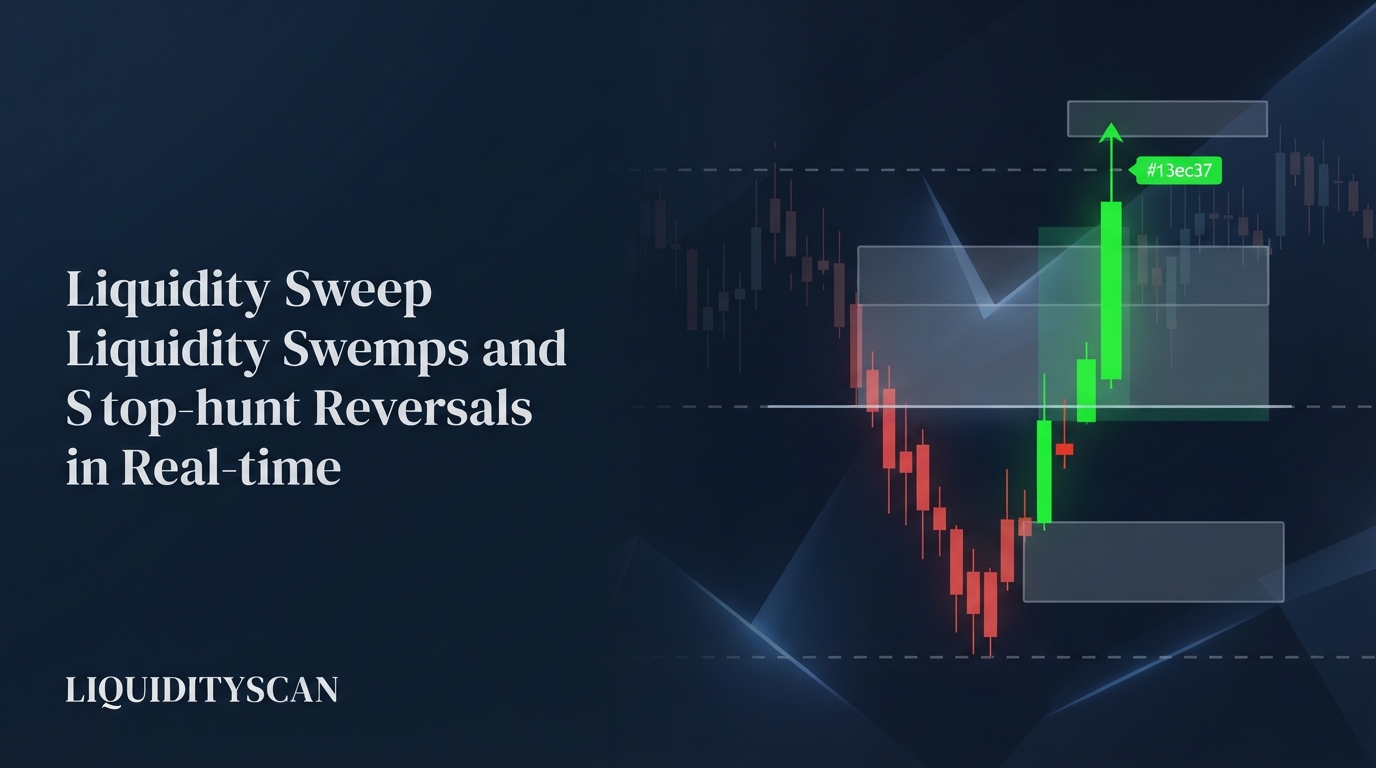
A liquidity sweep scanner is an automated tool that monitors swing highs and lows across many markets, detects when price sweeps one of those levels, and flags only the cases where price then closes back through it on a lower timeframe — the failed-sweep reversal.
That last clause is what separates a real scanner from a wick alert. Thousands of levels get sniped every day; almost none reverse. A trustworthy scanner isolates the sweep that gets rejected and reclaimed, because that is the sequence Smart Money Concepts (SMC) traders actually trade. The rest is noise.
The rest of this guide covers why hunting these by hand fails, exactly what a scanner must detect to be believable, how LiquidityScan's Liquidity Sweep → Reversal engine encodes it, and how you turn a detection into a decision.
Why Manual Sweep-Hunting Doesn't Scale
The setup is simple to describe and brutal to hunt manually. You are looking for a specific two-part event on a specific level, and you have no idea which of hundreds of pairs will produce it, or when.
To do it by hand you would have to mark every relevant swing high and low on every pair, on every higher timeframe you follow, then watch each of those levels continuously.
The instant one gets wicked, you drop to a lower timeframe and wait several candles to see whether price reclaims the level or just keeps going. Miss the reclaim candle and the setup is gone.
The math kills it. Say you track 300 liquid pairs on three higher timeframes — that is 900 charts, each carrying multiple live liquidity pools. The Buy-Side Liquidity (BSL) above equal highs and the Sell-Side Liquidity (SSL) below equal lows are forming and clearing around the clock.
No human watches 900 charts. So you either narrow to a handful of pairs and miss everything else, or you glance in periodically and catch reclaims hours after they closed. Both are how good setups get missed.
A scanner inverts the problem. Instead of you watching levels, the levels watch themselves — the engine re-checks every pool on every closed candle and only interrupts you when the full sequence has completed.
What a Trustworthy Liquidity Sweep Scanner Must Detect
Most tools that call themselves a liquidity sweep scanner fire on a single wick past a prior high. That is worse than useless — it buries you in alerts, because ordinary volatility pokes through levels constantly and continues in the same direction. A wick beyond a level is not a signal; it is a coin flip until price shows its hand.
A scanner you can trust has to confirm three distinct things, in order:
- A real pool of liquidity, not any candle high. The swept level must be a meaningful higher-timeframe swing high or low — a spot where stop orders genuinely cluster (above equal highs, below equal lows). That is the Draw on Liquidity the market was reaching for.
- The actual sweep of that pool. Price must trade beyond the level, not merely approach it. The wick has to take the stops.
- A lower-timeframe reclaim that confirms rejection. After the sweep, price must close back through the swept level on the lower timeframe within a tight window. No reclaim, no signal — the sweep was just continuation.
Detect only the first two and you have a wick alert. It is the third — the confirmed reclaim — that turns a raid into a reversal candidate. A scanner that skips it is selling you the easy 90% and leaving out the part that matters.
How the Liquidity Sweep Scanner Encodes the Setup
LiquidityScan's Liquidity Sweep → Reversal (LSR) engine is built around exactly those three requirements. It does not treat a sweep as a signal; it treats a sweep-then-reclaim as one. Here is how each piece is encoded.
The HTF pool and the HTF→LTF pairing
LSR works on fixed higher-timeframe-to-lower-timeframe pairs: 1W→1D, 1D→4H, and 4H→1H. The liquidity pool is defined on the higher timeframe — a weekly swing high, a daily swing low — so the level carries real weight.
The reclaim confirmation is then hunted on the paired lower timeframe, where you can actually see the rejection form candle by candle. This mirrors how top-down ICT analysis works: the higher timeframe sets the target, the lower timeframe confirms the turn. It does not run sub-hour — the tightest pairing is 4H→1H.
The 5-candle reclaim window
Once an HTF pool is swept, LSR watches the next five lower-timeframe candles for the reclaim. Five is a deliberate constraint. A reclaim that happens immediately after the raid is a clean rejection; a "reclaim" that limps back twenty candles later is a different, weaker event the market has already moved past.
Bounding the window to five candles keeps the signal tied to the sweep that caused it, and filters out slow drift that just happens to cross the level again.
CRT or Super-Engulfing confirmation
The reclaim is not any close back through the level — it has to be a recognized reversal pattern. LSR accepts two, both in the opposite direction to the sweep: a Candle Range Theory (CRT) candle, or a Super Engulfing candle.
A CRT candle is one whose wick sweeps the prior range but whose body closes back inside it. A Super Engulfing candle is a momentum candle that engulfs the prior candle and closes decisively the other way.
So a BSL sweep — stops taken above a swing high — must be reclaimed by a bearish CRT or Super Engulfing to fire a bearish reversal candidate. An SSL sweep below a swing low must be reclaimed by a bullish one. The direction is never ambiguous: the pattern that confirms the turn defines the side.
Closed-candle detection means no repaint
Every step is evaluated on confirmed, closed candles only — the live, in-progress bar is always dropped. This is the difference between a signal you can trust and one that lies to you. A tool that reads the forming candle will show you a "reclaim" mid-bar that vanishes when the candle closes elsewhere.
LSR waits for the close. The sweep is confirmed on a closed candle; the reclaim is confirmed on a closed candle. Once a detection is posted, it does not repaint — the candles that formed it are already history.
What a Good Sweep Scanner Needs vs What LSR Does
The requirements above map one-to-one onto how the engine behaves. Side by side:
| What a trustworthy sweep scanner needs | What the LSR engine does |
|---|---|
| A real HTF liquidity pool, not any candle high | Defines the pool as an HTF swing high/low on 1W, 1D, or 4H |
| Confirmation the pool was actually swept | Requires price to trade beyond the level (the wick takes the stops) |
| A reclaim, not just a wick | Requires an opposite-direction close back through the level |
| A bounded window tying reclaim to sweep | Reclaim must land within the next 5 LTF candles |
| A recognized reversal pattern, not any close | Reclaim must be a CRT or Super-Engulfing candle |
| Unambiguous direction | BSL sweep → bearish; SSL sweep → bullish, set by the confirming pattern |
| No repaint you can rely on | Closed-candle detection only; the forming bar is dropped |
| Coverage you cannot watch by hand | Re-derived market-wide every scan across all liquid pairs |
Life of a Detection: A Worked Example
Take BTCUSDT on the 1D→4H pairing. On the daily, price has printed a clean swing high at 71,400 with a matching high just under it — equal highs, an obvious BSL pool. Late-comers are long into the breakout with stops stacked just above; that pool is a magnet.
Price rallies and the daily wicks to 71,880, trading through 71,400 and taking the stops. On the daily that is just a sweep — not yet a signal. LSR now drops to the paired 4H and starts its five-candle count.
On the second 4H candle after the raid, price prints a bearish Super Engulfing: it closes back below 71,400, engulfing the prior candle. The sweep has been reclaimed, in the opposite direction, inside the window, by an accepted pattern.
LSR posts a bearish Liquidity Sweep → Reversal detection on BTCUSDT (1D→4H). The daily BSL pool was swept at 71,880; the 4H reclaim closed at, say, 70,950. Every level is a closed-candle fact.
Nothing about this detection changes as new candles form — it is a completed, non-repainting event you can now evaluate. Had those five 4H candles come and gone with no bearish CRT or Super Engulfing, no signal would ever have fired, and the sweep would be logged as plain continuation.
The Scan → Validate → Execute Workflow
A detection is the start of your work, not the end of it. LSR surfaces a context-rich candidate — the pool, the sweep, the reclaim — but it is explicitly not a trade call, and it does not tell you to buy or sell. The disciplined workflow has three stages.
- Scan. The engine surfaces the swept-and-reclaimed candidate market-wide. You did not have to watch 900 charts; the completed sequence found you.
- Validate. You bring the context the scanner cannot. Is this bearish reclaim happening into a higher-timeframe premium, with the Draw on Liquidity sitting below? Does it agree with your daily bias, or is it a counter-trend poke you should skip? Is there an obvious opposing pool right above your entry? The scanner found the pattern; you judge whether the pattern belongs in a trade.
- Execute. If context agrees, you build the trade — your entry, your stop beyond the sweep wick, your target at the next pool — and you size the risk. That is yours. LiquidityScan does not place orders, and outside of Super Engulfing's geometric risk-reward ladder, the engines do not hand you entries or stops.
Honest limits
Be clear about what the signal is and is not. It is a high-context candidate: a genuine liquidity event with a confirmed rejection, filtered from noise. It is not a prediction, and there is no published win rate — the outcome depends on the regime, the bias, and the risk you apply, all of which you supply.
A swept level can be re-swept; a reclaim can fail. The scanner buys you coverage and precision on the setup's formation, not a guaranteed result.
How alerts reach you
When a detection fires, LiquidityScan delivers it through browser Web Push, native Android push (FCM), and an in-app bell and toast — not through Telegram, which is a community link only, not a signal channel. Alert pair counts scale by plan.
That is the point of a real-time liquidity sweep scanner: the reclaim closes, the signal posts, and it reaches you while the context is still live — instead of you finding it in the chart hours later.
Frequently Asked Questions
Is a liquidity sweep the same as a wick past a high?
No. Every candle that poked past a level is a wick; only some of those are meaningful sweeps of a real liquidity pool, and far fewer are followed by a reclaim. A trustworthy scanner requires the sweep of a genuine swing high or low plus an opposite-direction close back through it — the wick alone is just volatility.
What timeframes does the Liquidity Sweep → Reversal scanner run on?
It works on three fixed higher-to-lower pairs: weekly-to-daily, daily-to-4H, and 4H-to-1H. The pool is defined on the higher timeframe and the reclaim is confirmed on the paired lower one. It does not run on sub-hour timeframes — the tightest confirmation is on the 1H.
Can the signal repaint or disappear after it fires?
No. Both the sweep and the reclaim are detected on confirmed, closed candles — the live forming bar is always dropped. Once a detection posts, the candles that produced it are already closed history, so the signal is stable and does not repaint.
Does the scanner tell me where to enter and exit?
Not as a rule. LSR surfaces a context-rich reversal candidate — the swept pool and the confirmed reclaim — but it is analysis, not a trade call. You supply the higher-timeframe bias, the entry, the stop beyond the sweep, and your risk. It does not place orders or guarantee outcomes.
Related query paths
Build the foundation under the scanner, then work outward from the pool to the reclaim to the evidence and the sibling engines.
- What Is a Liquidity Sweep? — the core definition every scanner is built to detect.
- BSL vs SSL in SMC: Identify Liquidity — how to mark the pools the scanner watches.
- Why Price Reverses After a Liquidity Sweep — the mechanism behind the reclaim.
- Liquidity Sweep Then MSS: Reversal Guide — the full sweep-to-reversal sequence in depth.
- Do Liquidity Sweeps Work? Data-Driven Look — an honest look at the evidence before you trade it.
- Order Block Scanner: Real-Time OB & FVG — the sibling engine for zone-based entries.
- How to Catch Asian-Range Sweeps Every Session — a related angle on asian range sweep scanner.
- What is the LiquidityScan confluence engine? — See how liquidity sweep signals combine with other scanners into aligned setups.