
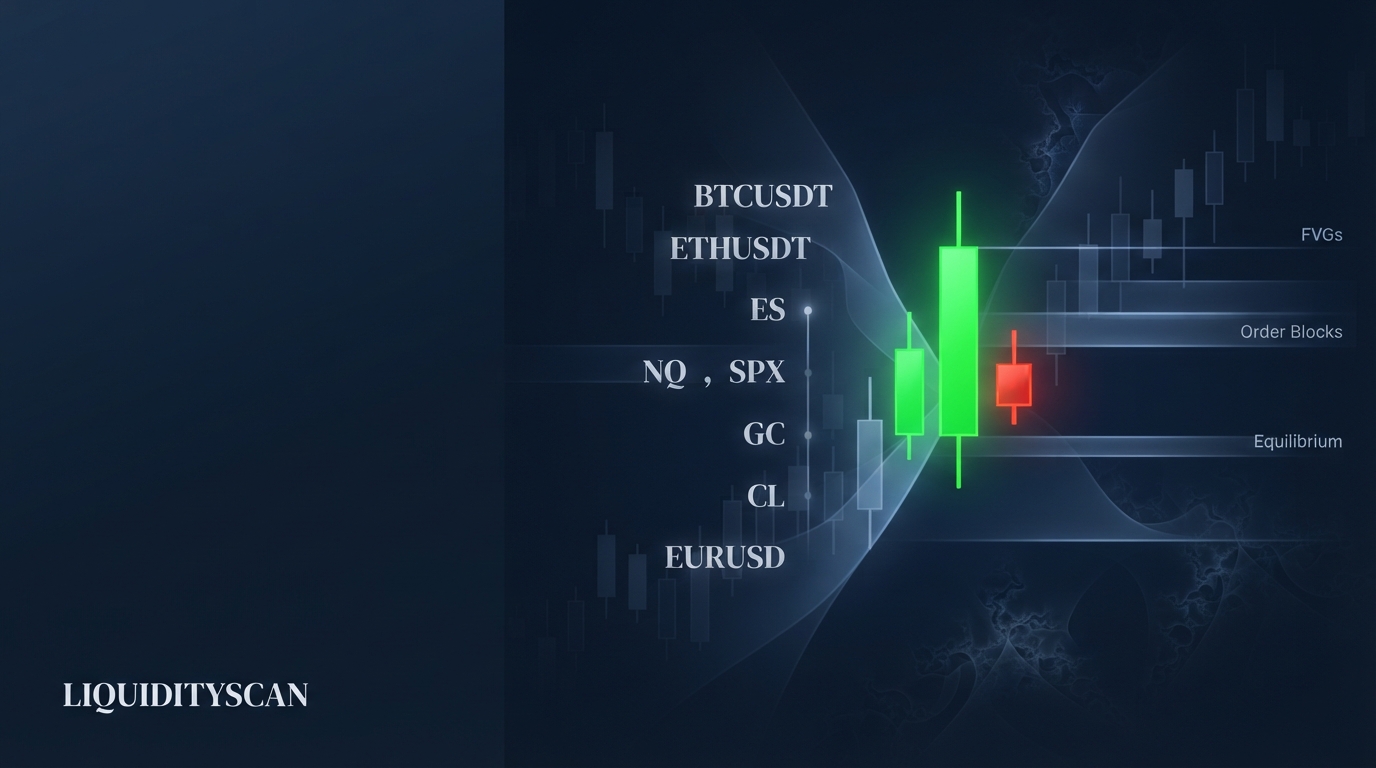
What Markets Does LiquidityScan Scan?
The markets LiquidityScan covers split into two families: crypto and traditional finance. Crypto is USDT-margined Binance Futures perpetuals. TradFi spans Binance TradFi perps (stocks, metals, energy, ETFs) plus Hyperliquid's ~150 licensed markets. Every market runs the same ICT scanners.
That means the same engines that flag a liquidity sweep on BTCUSDT also flag one on gold, an equity index, or an FX pair — the difference is only the underlying and where the price feed comes from. The platform surfaces this split as a single global mode so you never mix crypto noise into a TradFi watchlist by accident.
| Market type | Data source | Notes |
|---|---|---|
| Crypto perpetuals | Binance Futures (USDT-margined) | Hundreds of pairs; must clear the $20M 24h volume floor |
| Stocks & ETFs (TradFi) | Binance TradFi perps / Hyperliquid | Source badge shows which feed; exempt from the volume floor |
| Metals & energy | Binance TradFi perps / Hyperliquid | e.g. gold, oil-style commodity markets |
| Indices | Hyperliquid (licensed) | Index-style TradFi markets |
| FX | Hyperliquid (licensed) | Currency markets; ~150 TradFi markets total on Hyperliquid |
Crypto Coverage: USDT-Margined Binance Perpetuals
The crypto universe is USDT-margined perpetual futures from Binance Futures. This is the deepest, most liquid crypto venue, which matters because ICT concepts lean on real order flow — you want the stops, the sweeps, and the displacement to reflect where size actually trades, not a thin book.
Coverage runs into the hundreds of pairs. The pricing page uses "400+ pairs" as a marketing figure spanning the whole universe; treat that as a round headline number, not a fixed count, because the live list changes with volume and listings. What stays constant is the selection logic below it.
Rather than dumping every listed contract on you, the crypto lists apply a hard liquidity filter (covered further down). So the pairs you actually see — BTCUSDT, ETHUSDT, and the long tail of large-cap and mid-cap perps — are the ones with enough turnover for a sweep or an order block to mean something. Illiquid contracts never reach your feed.
A concrete example: say ETHUSDT prints a run of equal highs near 3,420 over several 4H candles. Those matched highs stack resting stop orders just above them — engineered liquidity.
When price wicks to 3,435, sweeps those stops, and closes back below 3,420, that is the exact Liquidity Sweep geometry the scanner is built to catch, and it prints on the closed 4H candle. Deep Binance liquidity is what makes that sequence trustworthy rather than a random spike.
TradFi Coverage: Binance Perps and Hyperliquid's Licensed Markets
The traditional-finance side is where the coverage widens beyond crypto. Two feeds power it, and the platform tags each TradFi market with a source badge so you always know whether a given name is coming from Binance or Hyperliquid.
Binance TradFi perps bring tokenized-style exposure to stocks, metals, energy, and ETFs — traditional assets traded as perpetuals on the same venue as the crypto book. Hyperliquid contributes roughly 150 officially licensed markets spanning index, stock, commodity, and FX exposure. Together they let you run ICT structure reads on assets that used to require a separate charting stack.
The practical upside: one scanner surface for a gold sweep, an index break of structure, and an FX order block, instead of three disconnected tools. The source badge is not cosmetic — the same underlying can behave differently depending on the feed's hours and liquidity, and knowing the origin helps you judge a signal in context.
Worked example on the TradFi side: a gold market pushes into the New York session, takes out the prior day's high, then fails and closes below it. On an index feed you might see the same failed-auction behavior around a session open — a Judas Swing that runs early highs before reversing.
Because these instruments have real session boundaries, the timing of that sweep relative to the open is far more informative than it would be on a 24/7 crypto chart.
The Hyperliquid contribution matters for breadth. Its roughly 150 licensed markets are what let LiquidityScan reach into index, FX, and commodity exposure that Binance's TradFi perps do not fully cover. The badge tells you which of the two is behind any given name, so comparing a Binance-sourced metal against a Hyperliquid-sourced one is not silently comparing two different liquidity profiles.
The Crypto vs TradFi Global Mode
To keep two very different market families from blurring together, LiquidityScan exposes coverage as a global Crypto / TradFi mode. Flip the mode and the entire product — signal lists, grids, watchlists — filters to that asset class. It is the primary way to scope everything you see to the markets you actually trade.
- Crypto mode shows only the USDT-margined Binance perpetuals, filtered by the volume floor.
- TradFi mode shows the stocks, indices, metals, energy, ETFs, and FX names, each carrying its Binance-vs-Hyperliquid source badge.
This separation matters because the two families do not trade the same way. Crypto is a 24/7 book with no session close; TradFi instruments track real market hours. Mixing them in one list would make time-of-day concepts noisy, so the mode keeps each universe clean and lets session logic stay meaningful on the TradFi side.
It also keeps your attention scoped. If you only trade crypto perps, TradFi mode is simply off and nothing from that universe intrudes on your feed, watchlist, or alerts.
If you have shifted to trading gold or an index during a particular week, flip to TradFi and the whole surface — including which scanners are relevant — narrows to that world. The mode is the single lever that answers "which of the markets LiquidityScan covers am I looking at right now."
Why the Same ICT Scanners Work on Both Markets
ICT and Smart Money Concepts are built on liquidity and structure, and those ideas are market-agnostic. A Liquidity Sweep above equal highs, a Break of Structure, a Fair Value Gap — these describe how a book delivers price, not a property of Bitcoin specifically. Stops cluster above obvious highs whether the chart is BTCUSDT or an index.
That is why one detection engine can run across the whole universe. The three-candle imbalance that defines an FVG is the same geometry on ETHUSDT and on gold; the engine does not care what the ticker is. What changes across markets is context, not the pattern rule.
The biggest contextual difference is time. Crypto trades continuously, so kill-zone and session timing is a softer filter. TradFi instruments have real opens and closes, which makes session structure — the London and New York windows, the daily open — carry more weight, because a genuine close resets the auction. Read TradFi signals with that timing lens on.
One scanner deliberately does not cross over: the Asia Range Sweep. Its whole model marks the Asian-session range and sweeps it against a daily bias, which assumes a continuous 24-hour crypto tape. It is crypto-only and does not run on TradFi or Hyperliquid markets. Every other engine spans the full coverage.
The $20M Volume Floor and the TradFi Exemption
Coverage is only useful if it is not drowned in noise, so the crypto lists enforce a hard liquidity gate: any pair with 24-hour quote volume below $20,000,000 is filtered out entirely. It never appears in a signal list, no matter what pattern printed on it. This is why you do not see setups on dead micro-cap perps.
The reasoning is mechanical. ICT setups depend on real liquidity being taken — a sweep only means something if there were actually stops and orders to run. On a pair doing a few hundred thousand dollars a day, a "sweep" is often just a wick from thin book. The floor removes that class of false positive up front.
TradFi names are exempt from the $20M floor. Many legitimate stock, metal, and index perps trade under $20M of daily volume on Binance, and applying a crypto-scale liquidity gate would wrongly erase valid coverage. So the floor is a crypto-specific quality filter, and the TradFi universe is judged on its own terms.
The distinction is between coverage and quality control. Coverage is about which markets exist in the product; the volume floor is a downstream filter that decides which crypto pairs are worth showing. Keeping the two separate is why the floor can be strict on crypto without collateral damage to a perfectly valid, lower-turnover TradFi name.
Coverage Limits and How It Maps to the Scanners
Every scanner runs across the covered universe, with the one documented exception. The core engines — Super Engulfing, ICT Bias, CRT, Order Block detection (OB+ / OB++), FVG nesting, Market Structure (BOS / CHoCH), Liquidity Sweep → Reversal — all evaluate both crypto and TradFi markets. Only the Asia Range Sweep is fenced to crypto.
A few honest limits are worth stating plainly:
- Coverage is not a recommendation. A market appearing in the list, or a signal firing on it, is a detected pattern — not a call to buy or sell. LiquidityScan is an analysis tool; you still do the judgment.
- The universe is dynamic. The exact pair count shifts with listings and volume, which is why "400+" is a marketing headline rather than a fixed guarantee.
- Signals are read on closed candles. Every engine detects on confirmed, closed candles across all markets, so nothing repaints — but that also means you wait for the close on TradFi and crypto alike.
- The source shapes the read. A Binance-sourced TradFi name and a Hyperliquid-sourced one can carry different liquidity and hours, so the same pattern deserves slightly different confidence depending on the badge.
None of this narrows what the scanners can find — it just frames how to use the coverage honestly. The engines detect structure across a broad, dynamic universe; your job is to weigh each candidate against its market's context, liquidity, and session before it becomes a trade.
Used correctly, the breadth is the point: one place to see ICT structure across crypto perps and TradFi at once. But the markets LiquidityScan covers are the raw material for your analysis, not a shortcut around it — the coverage hands you candidates, and you decide which ones deserve a trade.
Frequently Asked Questions
Does LiquidityScan scan spot markets or only perpetuals?
The crypto coverage is USDT-margined Binance perpetual futures, not spot, because perps carry the deepest, most consistent order flow for ICT reads. TradFi assets are likewise delivered as perpetuals through Binance TradFi perps and Hyperliquid's licensed markets, so the whole covered universe is perpetual-style contracts rather than spot pairs.
Can I trade forex and gold signals on LiquidityScan?
Yes. FX and metals live on the TradFi side. Gold and energy come through Binance TradFi perps and Hyperliquid, and FX markets come through Hyperliquid's licensed set. Switch the global mode to TradFi and check the source badge on each name to see which feed is supplying that market.
Why don't I see signals on some small-cap coins?
The crypto lists hard-filter any pair below $20,000,000 in 24-hour quote volume. If a small-cap perp is trading under that threshold, it is excluded on purpose, so a thin-book wick is never mislabeled as a real liquidity sweep. TradFi names are exempt from this floor and follow their own coverage rules.
Do all the scanners work on TradFi markets?
Nearly all of them. Super Engulfing, ICT Bias, CRT, Order Block, FVG, Market Structure, and Liquidity Sweep engines run across both crypto and TradFi. The one exception is the Asia Range Sweep, which assumes a continuous 24-hour tape and is crypto-only — it does not run on TradFi or Hyperliquid markets.
Related query paths
Once you know which markets LiquidityScan covers, these guides go one level deeper into how the platform detects, validates, and prices its coverage.
- What is LiquidityScan? — the full picture of what the platform is and does.
- How the LiquidityScan Scanner Works — from raw candles to a detected setup, step by step.
- Does ICT Work on Crypto? SMC for Bitcoin — why liquidity concepts translate to the crypto tape.
- LiquidityScan vs Manual Scanning — the coverage-and-time case for automating the sweep.
- Is LiquidityScan Reliable? — how detection is validated across markets.
- LiquidityScan Pricing Explained — how tiers gate timeframes, alerts, and depth across the same coverage.
- Does LiquidityScan Give Buy/Sell Signals? Context Engine vs Signal Service — a related angle on does liquidityscan give signals.
- who is LiquidityScan for — See which trader types use LiquidityScan across its supported markets.