
Do ICT Concepts Work on Crypto?
Short answer: yes, but you cannot copy a forex playbook onto Bitcoin without adjusting it. The core Inner Circle Trader ideas describe how price seeks liquidity and rebalances inefficiency. Those forces exist in every liquid market, crypto included.
What does not transfer cleanly is the timing layer. ICT was built around forex sessions and central-bank behavior. Bitcoin has neither a closing bell nor a central bank, so parts of the framework need rewiring rather than a straight copy-paste.
My own take, after years of running these setups on both markets: the reading of intent is identical, the clock is not. Once you accept that, the transition from forex charts to Bitcoin stops feeling like a foreign language and starts feeling like the same game on a faster board.
Why Smart Money Concepts Translate to Bitcoin
Smart Money Concepts translate because they rest on structure that is universal, not on a specific asset class. Three pillars carry over almost untouched.
First, liquidity. Retail traders on crypto cluster stops in the same predictable places, above equal highs and below obvious swing lows. A liquidity sweep grabs those stops before price reverses, exactly as it does in forex.
Second, algorithms. Major exchanges route enormous order flow through market makers and automated systems. Price is engineered toward pools of resting orders, which is the whole premise ICT is built on.
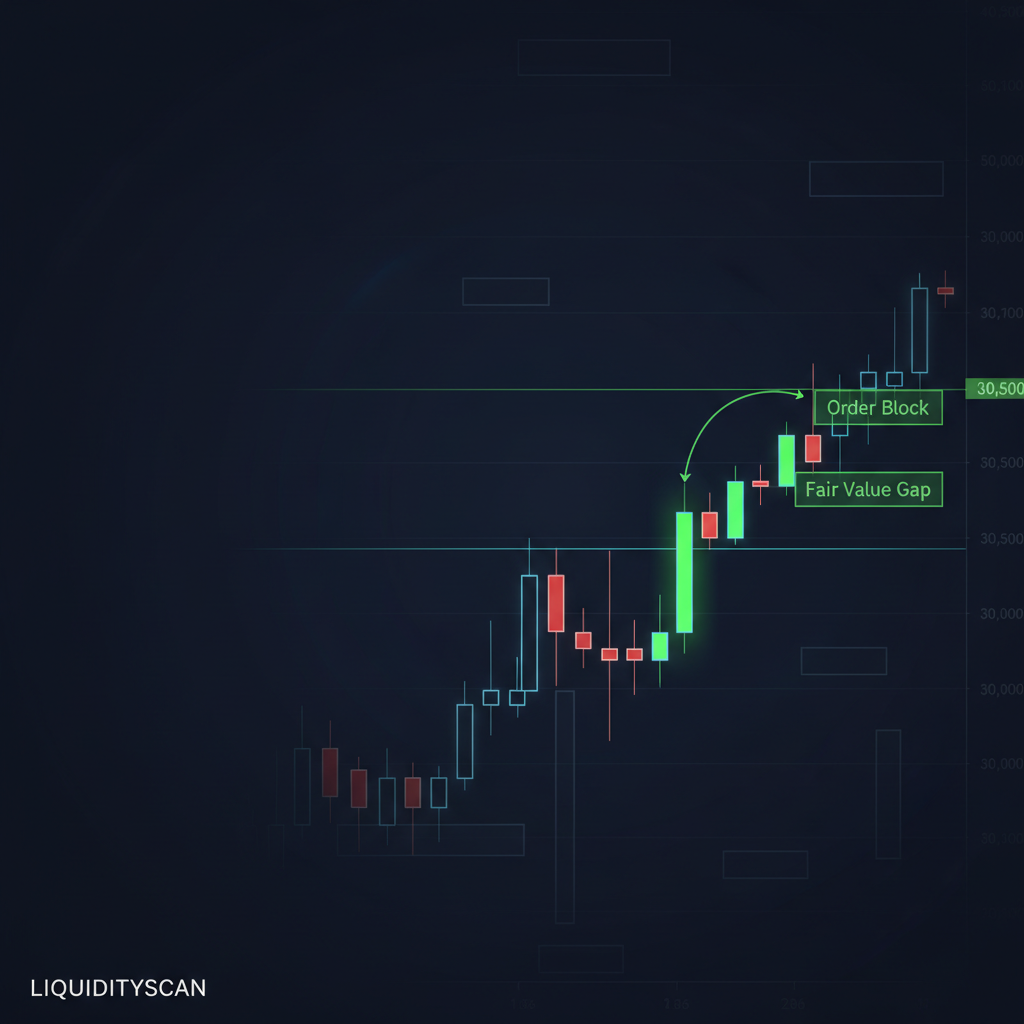
Third, order blocks and fair value gaps. Institutions and large desks leave the same footprints on Bitcoin candles, so the toolkit you already use to mark order blocks and fair value gaps applies directly to BTC and altcoins.
If you want the mechanics behind the stop hunt itself, that logic is unchanged on crypto and I link it below rather than re-teach it here.
What's Different in Crypto
This is where honesty matters. Several structural features of crypto genuinely change how you apply ICT, and pretending otherwise costs money.
The market runs 24/7 with no true session close. There is no daily reset that "prints" the previous session's range, so setups that depend on a clean session open lose some of their sharpness. Weekend gaps that forex traders exploit are largely absent, since Bitcoin trades straight through Saturday and Sunday.
There is also no central-bank CBDR anchor. The Central Bank Dealers Range that ICT uses to frame forex volatility has no crypto equivalent, because no institution manages Bitcoin's price the way a central bank stewards a currency.
Volatility is higher and more sudden. A liquidity sweep on BTC can travel far further than on a major pair, so stops and targets need wider tolerances. Liquidity is also exchange-specific: order books differ across venues, and a sweep visible on one exchange may look milder on another. According to Investopedia, cryptocurrency markets are decentralized and trade continuously, which is the root of most of these differences.
How to Adapt Kill Zones & Liquidity to Crypto
Kill zones still work, but you cannot assume London and New York own all the movement. Bitcoin sees genuine expansion during Asian hours and around US equity opens, so the windows that matter shift with participation.
The practical fix is to treat kill zones as volatility windows rather than fixed clock slots. Track when your specific pairs actually expand, then build your session map from that data instead of inheriting the forex template wholesale.
Liquidity mapping itself is unchanged. You still identify internal and external liquidity, mark the pools, and wait for price to raid them. The concept holds perfectly on Bitcoin; only the timing of when those raids fire needs recalibration.
One habit that helped me: I stopped anchoring every session to a fixed hour and instead watched where the previous day's highs and lows sat. Price on Bitcoin gravitates toward those obvious levels regardless of what the clock says, so those pools became my primary map and the session windows became a secondary filter.
Practical Tips for ICT on Crypto
Watch BTC dominance. When capital rotates between Bitcoin and altcoins, dominance often sweeps liquidity and shifts structure before the coins themselves move, giving you an early read on where flow is headed.
Keep the same toolkit. Liquidity, order blocks and fair value gaps remain your three-lens read on every chart. Do not invent crypto-specific indicators; the ICT stack is already complete.
Respect volatility with position sizing. Because BTC sweeps run wide, size smaller and give setups room to breathe rather than tightening stops into the noise. This is where automated scanning earns its keep. I use LiquidityScan to flag sweeps and order blocks across crypto and traditional markets, so I am reacting to structure instead of hunting for it manually.
Balanced verdict: SMC works on Bitcoin, but it rewards traders who adapt the timing and volatility layers rather than those who paste forex rules onto a 24/7 chart.
Frequently Asked Questions
Does ICT work on Bitcoin?
Yes. Liquidity sweeps, order blocks and fair value gaps all appear on Bitcoin because they describe universal market structure. You mainly need to adapt session timing and account for higher volatility.
Do kill zones apply to a 24/7 crypto market?
Partially. The concept holds, but fixed forex windows do not capture all crypto movement. Treat kill zones as volatility windows and map when your specific pairs actually expand.
Is there a CBDR for crypto?
No. Bitcoin has no central bank, so the Central Bank Dealers Range has no direct equivalent. You replace that anchor with observed volatility patterns and liquidity mapping.
Related query paths
Start with the method, then layer in the crypto-specific adaptations.
- The Definitive Guide to ICT Trading — the full method to apply on Bitcoin.
- Liquidity Sweep Explained: The ICT Stop Hunt — the mechanic works the same on crypto.
- ICT Kill Zones: Complete Guide — timing, and why it shifts for a 24/7 market.
- Internal vs External Liquidity — how to map the pools you will raid on BTC.
- ICT vs Traditional Technical Analysis: A Trader's Guide
- Going Full-Time With ICT Trading: An Honest Roadmap
- What Is the ICT Trading Strategy? A Methodology Guide