
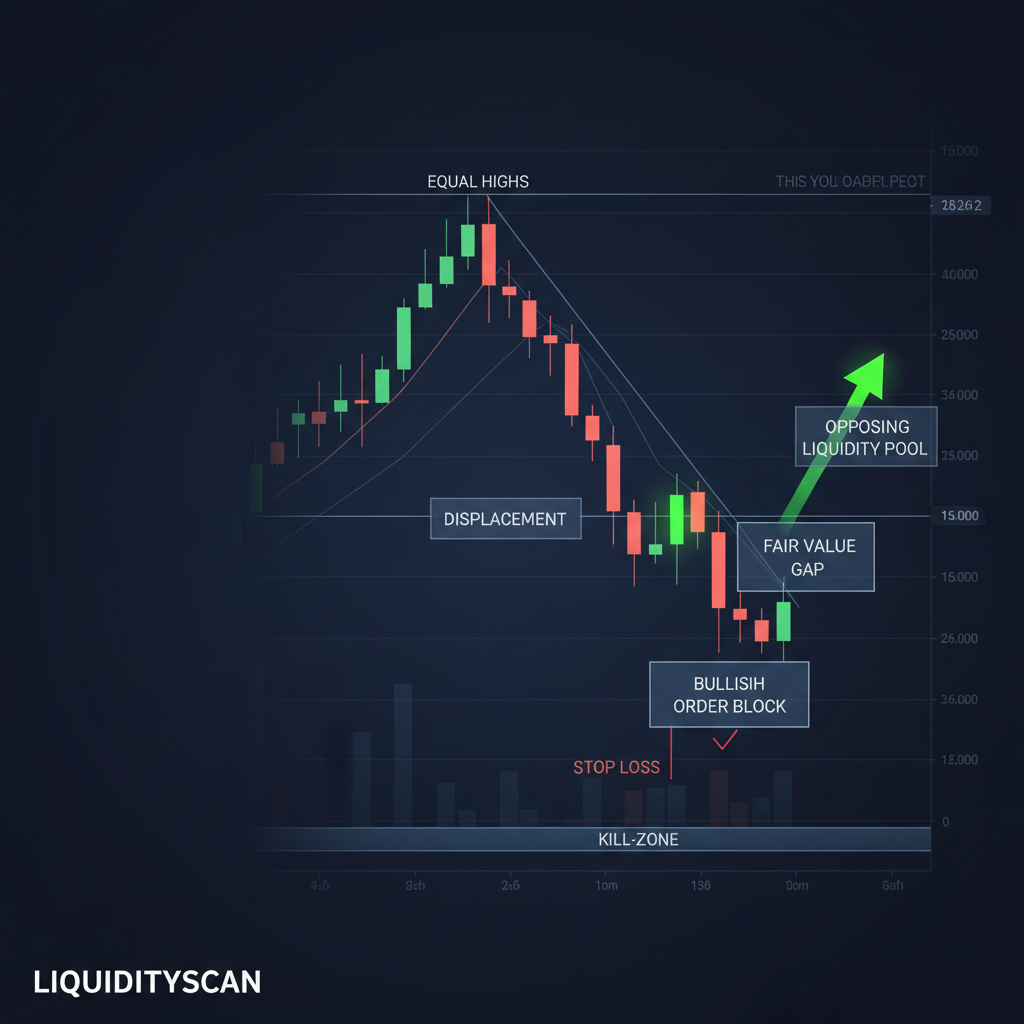
The ICT trading strategy is not one entry pattern — it's a structured methodology for reading institutional order flow. Inner Circle Trader (ICT) concepts describe how a price-delivery algorithm moves markets between pools of liquidity, and the "strategy" is the process you run to align with that movement. Order blocks, fair value gaps, and breakers are tools inside the method, not the method itself.
That distinction matters. Traders who collect setups plateau. Traders who run the process improve because every trade answers the same ordered questions in sequence.
Why ICT is a method, not a setup
ICT is a framework because a single pattern carries almost no information on its own. An order block only means something once you know the higher-timeframe bias, which liquidity it formed against, and whether price reached it during a meaningful time window. Strip that context away and you're pattern-matching, not reading order flow.
The information gain of ICT sits in the layering. Each stage filters the one before it, so a valid trade is the intersection of several independent conditions — not a shape you liked on the chart. That's why two traders can look at the same order block and reach opposite conclusions: one ran the full sequence, the other saw a rectangle.
The core ICT loop, stage by stage
The method runs as a five-stage loop, top-down. You resolve each stage before moving to the next, and if a stage fails, you stand aside.
- HTF bias / draw on liquidity. Start on the higher timeframe and decide the direction price is most likely being delivered — the "draw." Ask which liquidity pool is the magnet: a prior high, a low, a swing that's begging to be taken. Bias sets the only direction you're allowed to trade for the session.
- Liquidity mapping. Mark buy-side and sell-side liquidity — resting stops above highs and below lows, plus equal highs/lows and inducement that engineer late entries. This tells you where price wants to sweep before it reverses.
- PD arrays / POIs. Inside the premium/discount range, locate the specific delivery zones: order blocks, fair value gaps, breakers. These are your points of interest — where a reaction becomes likely once liquidity is taken.
- Time. Overlay the kill zones — London, New York AM, the session windows where displacement actually happens. A perfect POI touched at the wrong time is a lower-probability trade. Time gates price.
- Entry + risk. Only now do you refine an entry — a sweep into your POI, displacement confirming intent, a defined stop beyond the invalidation, and a target at the opposing liquidity you mapped in stage one.
Notice the loop is directional. Bias narrows liquidity, liquidity narrows arrays, time narrows when, and entry narrows how much you risk. By the time you click, five filters agree.
How the stages filter each other
| Stage | Question it answers | Fails when… |
|---|---|---|
| HTF bias | Which way is price drawn? | No clear draw on liquidity |
| Liquidity | Where are the stops? | No pool to sweep or target |
| PD arrays | Where does price react? | POI is in the wrong half of the range |
| Time | When is it live? | Outside a kill zone |
| Entry + risk | How do I express it? | Stop wider than the reward |
What running the method looks like in practice
A typical session isn't hunting charts for order blocks. It's a checklist. You define the daily draw, mark the pools above and below current price, wait for the kill zone, and let price sweep liquidity into a POI that sits on the correct side of premium/discount. If the sweep and displacement arrive, you take the entry. If they don't, you log the miss and wait.
The edge isn't the order block. The edge is refusing to trade one until bias, liquidity, and time all agree.
This is also why ICT scales across markets and timeframes. The tools change weight — crypto respects opening gaps differently than indices do — but the loop is identical. Bias, liquidity, arrays, time, entry. Master the sequence and every new concept slots into a stage you already understand.
Frequently Asked Questions
Is ICT a strategy or a methodology?
A methodology. It's a structured process for reading institutional order flow, and individual setups like order blocks or the Silver Bullet are strategies expressed inside that process.
What is the single most important stage?
Higher-timeframe bias and the draw on liquidity. Everything downstream — which liquidity matters, which POI is valid — depends on knowing the direction price is being delivered.
Do I need every stage to take a trade?
Ideally yes. The method's edge comes from confluence. Skipping time or liquidity turns a filtered decision back into pattern-matching.
Related query paths
Once the loop makes sense, these deepen each stage in order.
- How to Build a Complete ICT Trading Model (Step-by-Step) — turn this method into your own written, testable model.
- ICT Top-Down Analysis: Multi-Timeframe Alignment — the practical mechanics of stage one, HTF bias.
- Buy-Side vs Sell-Side Liquidity (BSL/SSL) Identification — how to map the liquidity pools in stage two.
- Why ICT Setups Need Both Time and Price — why the time stage gates every POI you find.
- OTE Explained: The ICT Optimal Trade Entry Zone — a precise way to handle the entry stage.
- ICT Prop Firm Strategy: How to Pass the Challenge
- How to Draw a Dealing Range in ICT (Correctly)
- What Are the 4 Trading Zones? ICT Dealing Range