
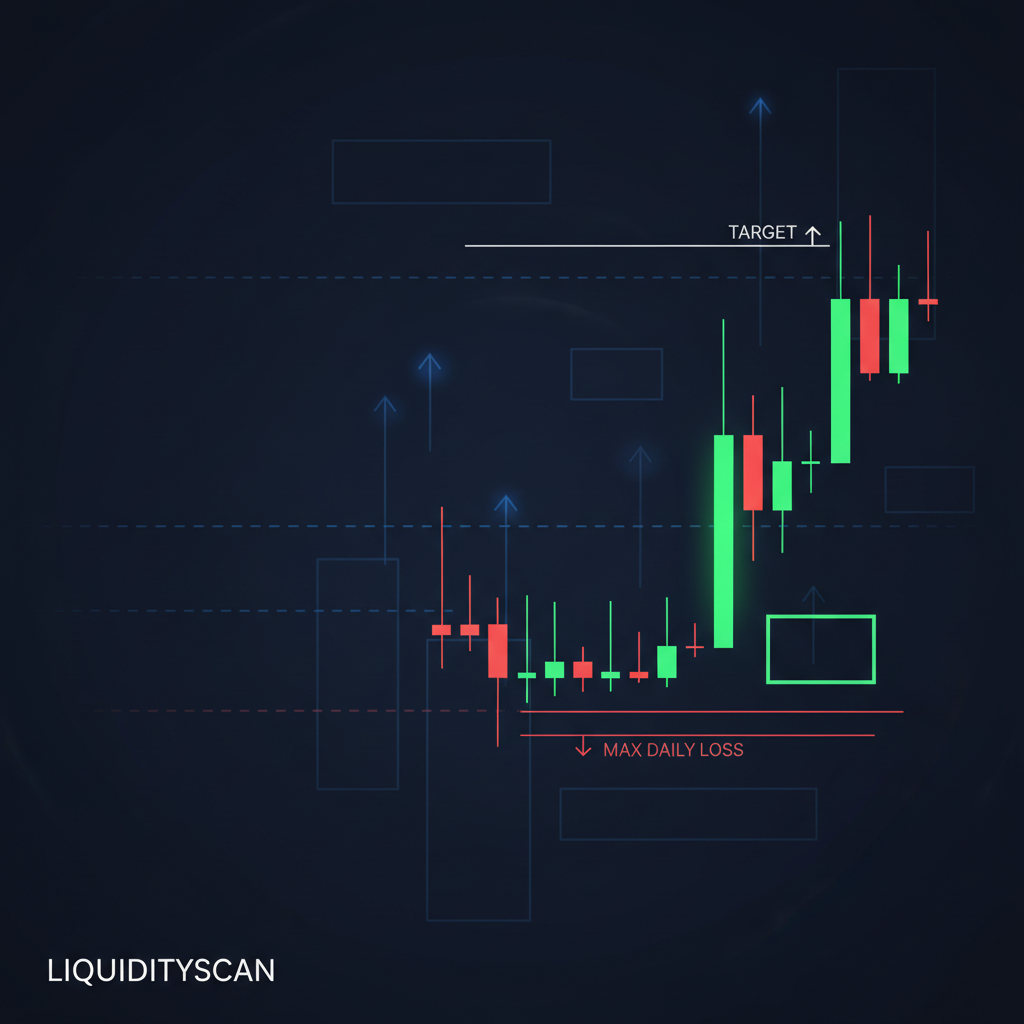
To pass a prop firm challenge with ICT, you don't need a new setup — you need to fit one high-probability model to the firm's specific drawdown and target rules, then take fewer trades than you think you should. Most evaluations are lost to over-trading and daily-loss breaches, not to bad analysis. The winning approach is boring: trade one kill-zone, one setup, size every position against the max-daily-loss limit, and stop for the day the moment you hit your planned R.
The evaluation is an exercise in restraint measured by a spreadsheet. Your edge only matters if you're still funded when it shows up.
Why most traders fail the challenge (and it isn't their ICT)
Traders fail evaluations because they treat the target as a deadline. A typical Phase 1 asks for 8-10% inside 30 days with a 5% max daily loss and a 10% trailing or static max drawdown. That target is achievable in a handful of clean trades — but the moment a trader frames it as "I need to make money today," the ICT model stops being a filter and becomes an excuse to click.
The failure sequence is predictable. A missed London move creates urgency. Urgency lowers your standard for what counts as a valid setup. You take a marginal entry outside the kill-zone, it loses, and now you're trading to recover — which is exactly the state the daily-loss limit is designed to punish. Two or three of those in a session and you've breached, not because ICT failed you but because you overrode it.
The prop firm isn't testing whether you can read displacement. It's testing whether you can sit through the hours when there's nothing to read.
Reframe the target as a byproduct. If your model produces roughly 0.5R to 1R of expectancy per valid setup and you take two to four valid setups a week, the math to 8% works itself out over the full evaluation window without a single forced trade.
How to adapt one ICT setup to the firm's rules
Pick one setup and one session, then bend the mechanics to fit the account's drawdown structure. For most evaluations the cleanest pairing is a single kill-zone — New York AM or London Open — with a liquidity-sweep-plus-displacement entry into a fair value gap or order block. One model, repeated, is what generates the sample size a firm's rules actually reward.
The specifics that change based on your firm:
| Firm rule | How it changes your ICT plan |
|---|---|
| Tight max daily loss (3-4%) | One trade attempt per day, hard stop after. No re-entries. |
| Trailing drawdown | Bank partials early; protect the high-water mark over chasing a full target. |
| No weekend / news holding | Avoid setups within 15 min of high-impact releases; flatten before Friday close. |
| Consistency rule (no single day > X% of profit) | Spread gains across sessions; don't dump risk on one home-run trade. |
| Minimum trading days | Show up for the kill-zone even when you don't trade; log the no-trade decision. |
The consistency rule catches more funded-account hopefuls than people expect. If a firm caps your best day at 40% of total profit, one lucky 6% session can disqualify an otherwise passing account. Sizing every trade the same way — a fixed fraction of the daily-loss limit — keeps your equity curve linear enough to satisfy that clause automatically.
Position sizing against the max-daily-loss limit
Size from the daily-loss cap backward, not from the target forward. Your per-trade risk should let you take two consecutive losses in a day and still be inside the daily limit with room to spare.
A simple, survivable structure on a 5% daily-loss account:
- Per-trade risk: 1% to 1.5% of account. Two losers = 2-3%, comfortably under the 5% wall.
- Daily stop: after two losing trades, you're done — regardless of how "clean" the next setup looks.
- Stop placement: anchored to structure (beyond the sweep wick or order block), never to a dollar amount. If structure demands a wide stop, you cut size, not the invalidation.
- Target: the nearest opposing liquidity pool or a fixed 2R, whichever comes first. Bank it and stop.
Notice what this does. On a green day you hit your R and walk away before the market can hand it back. On a red day the daily stop fires long before the firm's breach level. You've made the account rules redundant because your own rules are stricter.
The over-trading trap is the real evaluation
Over-trading is the single biggest reason funded evaluations fail, and it hides behind good intentions. "I'll just take one more, this one's A+." "The kill-zone was slow, I'll catch the London close instead." Each override feels reasonable in isolation; together they're how a 30-day window turns into a three-day blowup.
Build friction into your process. A pre-session checklist that a setup must pass — right session, confirmed sweep, displacement present, entry in a discount/premium zone — turns discretionary urges into pass/fail decisions. If any box is unchecked, there's no trade, and there's no debate at the moment of temptation.
The traders who pass consistently share one habit: they define a maximum number of trades per day before the session starts and treat it as a hard limit. Two attempts, sometimes one. When you cap frequency, every trade has to earn its slot, and the quality of your entries rises without you doing anything else.
One honest caveat: none of this guarantees a pass. Evaluations have variance, and a valid model can still string together losers inside a 30-day window. What this framework guarantees is that when you fail, you fail small and inside the rules — which means you get to reset and try again instead of learning nothing from a spectacular breach.
Frequently Asked Questions
Which ICT setup is best for a prop firm challenge?
The one you can execute mechanically and repeat. For most traders that's a single kill-zone liquidity sweep into displacement and an FVG or order block entry. Consistency of one model beats variety, because the firm's rules reward a stable equity curve over occasional big wins.
Should I risk more to hit the target faster?
No. Sizing up to chase the target is the fastest route to a daily-loss breach. Size from the drawdown limit backward so two losses never threaten the account, and let the target arrive over the full evaluation window.
How many trades a day should I take during the evaluation?
Cap it before the session — usually one to two valid setups. A hard trade limit is the most effective defense against the over-trading that fails most challenges.
Related query paths
The mechanics behind this playbook, one layer deeper.
- ICT Position Sizing: Risk, R-Multiples & Consistency — how to size every trade against a fixed drawdown limit.
- A Precise New York AM Kill Zone Strategy for ICT Traders — the single-session model to standardize your evaluation trades.
- 5 Common Risk Management Mistakes That Invalidate ICT Strategies — the errors that breach accounts before the edge shows up.
- The Institutional SMC Stop Loss and Take Profit Strategy — structure-anchored stops and targets for clean R.
- A Practical ICT Trading Model for Part-Time Traders — a low-frequency model that fits a restraint-first evaluation.
- What Is the ICT Trading Strategy? A Methodology Guide