
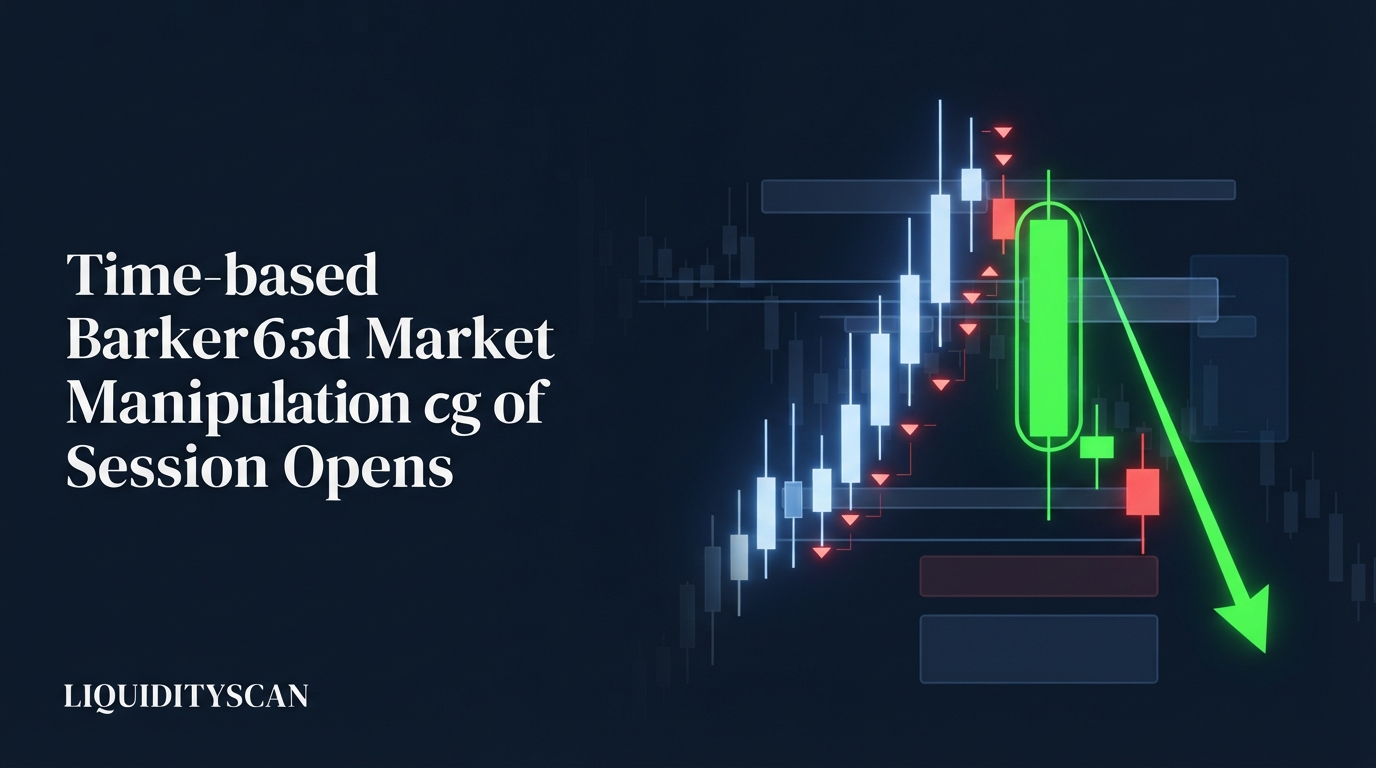
Why Does the Market Reverse Right After the Open?
The market reverses after the open because the open holds the most resting orders — overnight stops, breakout orders, and retail chasing the first candle. The algorithm runs an initial move to trigger that liquidity, then reverses toward the true daily direction.
That first move is not the real move. It is engineered. In ICT terms it is the Judas Swing — a deliberate false push at a known time that betrays traders who trust the open.
Understanding why the market reverses after open means understanding that time, not just price, is the trigger. The algorithm needs resting orders to fill institutional size, and the open is where those orders are densest and their timing most predictable.
The Step-by-Step Mechanics of the Open Reversal
An open reversal is not random. It follows a repeatable sequence built around one goal: collect the liquidity resting near the open, then deliver price to where it actually wants to go — the Draw on Liquidity. Here is the cycle.
1. The Open Sets a Reference Level
At the session or day open, price sits at a level every participant can see. The overnight range, the previous day's high and low, and equal highs or lows above and below all become obvious reference points. Stops and breakout orders stack just beyond them because that is where retail logic places them.
2. The Judas Push Takes the Obvious Liquidity
Price drives in one direction — usually the one that looks like the "breakout." It pushes above the overnight high or below the overnight low, triggering breakout buyers and stopping out shorts (or the mirror image). This is the manipulation leg. It feels like a trend beginning. It is actually the algorithm harvesting Buy-Side Liquidity (BSL) or Sell-Side Liquidity (SSL).
3. The Sweep and Reclaim
Once the pool is taken, price fails to hold beyond the swept level. It reclaims the range with a sharp rejection — a Liquidity Sweep that leaves a wick, not a body, beyond the high or low. This failure to continue is the first real tell that the open move was bait.
4. Displacement in the True Direction
The reversal delivers with force. A strong impulse candle — Displacement — breaks back through the open and often leaves a Fair Value Gap (FVG) behind it. That displacement confirms institutional intent and points the day toward its real target, the opposite liquidity pool.
So the full chain reads: open → false push (Judas) that takes obvious liquidity → sweep and reclaim → displacement and reversal toward the true daily direction. When you see all four, you are watching a time-based manipulation play out on schedule.
Why the Open Specifically Concentrates Liquidity
Reversals can happen anywhere, but they cluster at the open for a structural reason: the open is a known time when resting orders are densest. Institutions need counterparty liquidity to fill large positions without moving price against themselves, and the open hands them that liquidity on a schedule.
- Overnight stops accumulate. Positions held through the previous session carry stops that sit just beyond the overnight range. The open is the first liquid moment to run them.
- Breakout orders rest at the extremes. Retail breakout strategies place buy-stops above the range high and sell-stops below the range low. These are resting market orders — exactly the fuel a reversal needs.
- The open is a Schelling point in time. Everyone watches the same clock. Because participation and volume spike predictably at the open, the algorithm knows precisely when the most orders will be available to absorb.
This is the core of why the market reverses after open: it is not that the open is special as a price, it is special as a time. A large fill needs both a price with resting orders and a moment when those orders are dense. The open is the intersection of both.
There is a second-order reason too. Retail traders are trained to act at the open — to trade the breakout, to take the momentum, to buy strength. That behavior is predictable, and predictable behavior is exploitable.
The algorithm does not need to guess where retail will pile in; the crowd telegraphs it every session by placing the same orders at the same visible levels. The open simply supplies the volume to act on it cleanly.
The NY Open and London Open: The Classic Reversal Points
Two opens produce most of the textbook reversals: London and New York. Both sit inside ICT Kill Zones for exactly this reason — the kill zone brackets the window where manipulation and delivery are most likely.
- London Open (around 02:00–05:00 New York time). London injects the first real volume of the day after the quiet Asian session. It frequently sweeps the Asian range high or low with a Judas push, then reverses to set the day's directional tone.
- New York Open (around 07:00–10:00 New York time). The NY session often runs the London high or low first — a second manipulation — before delivering the true continuation or reversal. The 09:30 equities open adds another liquidity spike.
Opens sit inside kill zones on purpose. The kill zone is not a magic window; it is the time band where the concentration of resting orders is high enough for the algorithm to run manipulation and then displace. Trading the open reversal means aligning with these windows rather than fighting them.
How to Tell a Judas Reversal From a Genuine Open Drive
Not every open move is a fakeout. The skill is distinguishing a manipulation leg from a real directional open. Three questions separate them.
- Did it sweep a meaningful pool and reclaim? A Judas move takes a specific, obvious liquidity pool — the overnight high, equal highs, the prior day low — then closes back inside. A genuine drive keeps making new highs or lows and closes beyond them.
- Is the reversal toward the HTF draw? A real reversal points at the higher-timeframe Draw on Liquidity. If the move after the sweep heads toward the obvious HTF target, it is likely the true direction. If it fights the HTF bias, be skeptical.
- Is there displacement after the sweep? A convincing reversal delivers with an energetic impulse and usually a fresh FVG. A limp drift back into the range without displacement is weak and often just noise.
| Signal | Judas reversal (false open drive) | Genuine open drive |
|---|---|---|
| Beyond the swept level | Wick only, quick reclaim | Bodies close beyond, holds |
| Liquidity taken | Obvious pool swept then rejected | Runs into open space / expands |
| Direction vs HTF draw | Reverses toward the HTF draw | Aligned with HTF trend from the start |
| Displacement | Strong impulse after the sweep | Strong impulse in the initial move |
| Typical cause | Time-based stop raid at the open | News, strong trend continuation |
How to Trade the Open Reversal
The single most important rule: do not chase the open. The first move is designed to look tradeable. Chasing it puts your stop exactly where the algorithm is hunting. Instead, wait for the manipulation to complete and let the reversal confirm.
The Sequence to Wait For
- Mark the pools before the open. Note the overnight high and low, the prior day's high and low, and any equal highs or lows. These are the candidate targets for the Judas push.
- Let the Judas run. Watch price take one of those pools during the kill zone. Do not enter on the push itself.
- Wait for the sweep and reclaim. Price must fail beyond the level and close back inside the range.
- Demand displacement. Enter only after a strong impulse confirms the reversal, ideally on a retracement into the FVG or the origin candle left by that displacement.
- Place the stop beyond the sweep. The swept extreme is now protected structure. Your invalidation sits just past the wick, giving a tight stop against a target at the opposite draw.
Worked Example
Say EURUSD opens the New York session at 1.0850. The overnight high sits at 1.0865 with a cluster of equal highs — obvious buy-side liquidity. At 07:15 NY time, price drives up and spikes to 1.0868, tripping breakout buyers and stopping shorts.
It cannot hold. Within two candles it closes back below 1.0862, sweeping the high with a clean wick. Then a displacement candle breaks down through 1.0850 and leaves an FVG between 1.0858 and 1.0854.
You enter short on the retrace into that gap, stop at 1.0871 above the swept high, targeting the sell-side pool under 1.0820 — the HTF draw. The open drive up was the Judas; the reversal down was the real move.
When the Open Move Is Actually Real
Honesty matters here: not every open reverses. Forcing a reversal thesis onto a trending open is how traders get run over. The open move is more likely to be real — not a Judas — in these conditions.
- High-impact news at or near the open. A surprise print (CPI, NFP, a rate decision) can fuel a genuine directional expansion that does not reverse. According to the CFTC, scheduled economic releases are among the largest drivers of short-term positioning shifts, and they can override the usual manipulation pattern.
- Strong HTF trend alignment. When the daily and weekly bias both point the same way and the open drives with them, the open move is often continuation, not bait.
- No meaningful liquidity taken. If price opens and expands into open space without sweeping an obvious pool first, there was no stop raid to reverse from. Nothing was manipulated, so there is nothing to reverse.
The pattern is a tendency, not a law. Use it as a filter, not a guarantee: expect the open reversal, but stand down when news, trend, and untouched liquidity all argue for a genuine drive.
To gauge how often it holds for you, log a month of session opens and tag each as Judas reversal, genuine drive, or no setup. The hit rate you record on your own instrument and timeframe matters far more than any published figure, because open behavior shifts with volatility regime and session.
So the answer to why the market reverses after open comes back to time-based liquidity: the open concentrates the most resting orders at the most predictable moment, the algorithm runs a Judas swing to harvest them, and price then reverses toward its true draw — unless news or a dominant trend makes the first move the real one.
Frequently Asked Questions
How long after the open does the reversal usually happen?
Most Judas reversals resolve within the first 30 to 90 minutes of the session, inside the kill zone. London reversals often complete before the New York open, and New York reversals often complete before 10:00 NY time. The exact timing varies, so wait for the sweep and displacement rather than a fixed clock.
Is the open reversal the same as a stop hunt?
They overlap. A stop hunt is the mechanism — running resting stops beyond a level. The open reversal is that stop hunt executed at a specific, high-liquidity time. The Judas swing is the stop hunt scheduled to the open, followed by delivery toward the true daily direction.
Does this work on crypto and stocks, or just forex?
The logic is time-and-liquidity based, so it appears wherever there is a defined session open and clustered resting orders. Forex sessions are the cleanest, but crypto shows it around the daily candle open and equities around the 09:30 cash open. The pools differ; the manipulation logic is the same.
What if price never sweeps a pool at the open?
Then there is likely no reversal setup. If price expands into open space without taking an obvious high or low, no liquidity was engineered, so there is nothing to reverse from. Treat that as a possible genuine drive and either stand aside or trade with the trend.
Related query paths
Follow the reversal logic from the mechanism itself through timing and targets to a session-specific playbook.
- What Is the Judas Swing in ICT Trading? — the false-push mechanism behind every open reversal, defined in full.
- Why Price Reverses After a Liquidity Sweep — the order-flow reason a swept level flips into a reversal.
- ICT Power of 3 (PO3): The AMD Cycle Explained — how accumulation, manipulation, and distribution frame the open move.
- ICT Kill Zones Complete Guide: A Pro Trader's Framework — why opens sit inside kill zones and when to expect the raid.
- Draw on Liquidity (DOL) in ICT — how to find the true target the reversal is heading toward.
- A Precise New York AM Kill Zone Strategy for ICT Traders — a step-by-step playbook for trading the NY open reversal.
- Does the Silver Bullet Strategy Actually Work? — a related angle on does the silver bullet work.