
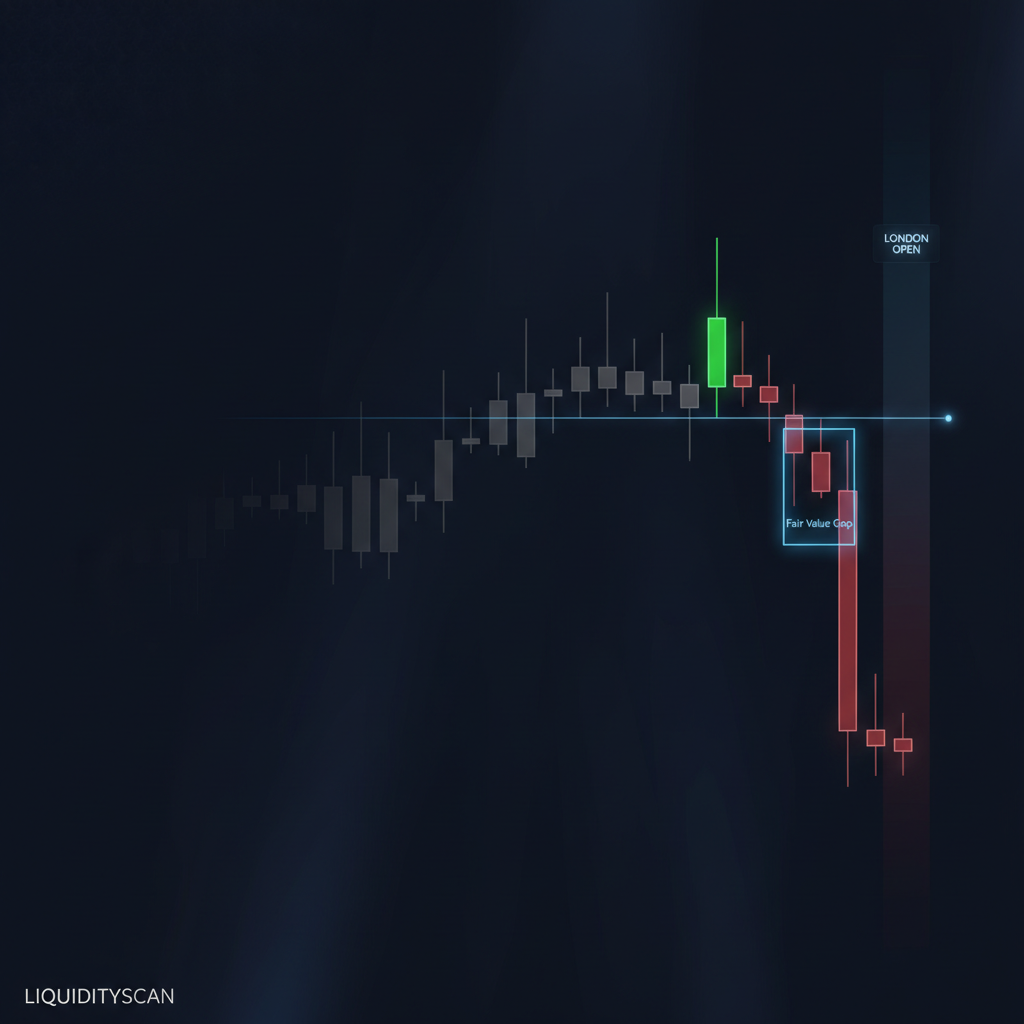
The Judas Swing is a deliberate false move at the start of a trading session that pushes price one direction to run liquidity, then reverses to deliver the actual daily move the opposite way. Named after the biblical betrayal, it is engineered to look like a genuine breakout so retail traders commit in the wrong direction. Once their stops are collected, price abandons that level and travels toward the real target for the day.
It is not a random spike. The move exists because the algorithm needs opposing orders to fill institutional positions. The open is where volume and emotion cluster, which makes it the cheapest place to manufacture that liquidity.
How the Judas Swing traps traders
It works by exploiting the two things breakout traders rely on: a fresh session and an obvious level. Price opens, drives hard past a prior high or low, and pulls in momentum buyers or sellers who read the push as confirmation. Their stops sit just beyond the level they broke.
Then price reverses. The move back through the range triggers those stops as market orders, which adds fuel to the reversal and hands the algorithm the fills it needed. Everyone who chased the open is now offside and holding a losing position that becomes late-move liquidity on the way to target.
Three ingredients make it repeatable:
- Resting liquidity — an old high, low, or equal highs/lows sitting just outside the opening range.
- An emotional entry window — the session open, when order flow and retail participation spike together.
- A reversal with intent — a displacement candle that breaks back through the range and leaves an imbalance behind.
Where and when the Judas Swing fires
It fires at session opens, most reliably London (around 02:00–05:00 New York time) and the New York AM (around 08:30–11:00 New York time). These windows carry the volume needed to manufacture and then reverse a move inside a short span. The Asian range often defines the liquidity pool London runs; the London or overnight range often defines what New York runs.
A common daily rhythm looks like this:
| Phase | What price does | Trader reaction |
|---|---|---|
| Open | Quiet consolidation near the range | Waiting for direction |
| Judas Swing | False drive past a high/low | Breakout traders enter, stops set |
| Reversal | Displacement back through the range | Trapped traders stopped out |
| Real move | Trend toward the day's target | Chasers become exit liquidity |
This maps directly onto the accumulation–manipulation–distribution cycle. The Judas Swing is the manipulation leg — the middle phase that separates the quiet open from the expansion that follows.
How to identify and trade the reversal
Trade it by waiting for the sweep to complete, not by predicting it. The setup only becomes valid once price has taken liquidity and shown it is unwilling to hold above or below the swept level. Anticipating the Judas Swing gets you trapped alongside everyone else; reacting to it is the edge.
A clean sequence to work from:
- Mark the liquidity. Before the open, note the obvious pools — prior session high and low, equal highs/lows, the overnight range extremes.
- Wait for the sweep. Let price push past one of those pools during the kill zone. The wick through the level is the tell, not a clean close beyond it.
- Demand displacement. Look for a decisive candle that reverses back through the range and leaves a fair value gap. A slow drift back is not the same as intent.
- Enter on the return. Let price retrace into the fair value gap or the order block that produced the displacement, then enter toward the real move.
- Place the stop beyond the sweep. The extreme of the Judas Swing wick is your invalidation. If price reclaims it, the read was wrong.
The confirmation piece matters most. A sweep without displacement is just noise — price can run a level and keep going. The reversal candle that breaks structure back through the range is what separates a tradable Judas Swing from a genuine breakout you should have left alone.
Judas Swing vs. a real breakout
The difference is what happens after the level breaks. A real breakout holds beyond the level and expands; a Judas Swing rejects it and reverses. You cannot always tell in the moment, which is exactly why you wait for the return through the range before committing.
The open drive is a question, not an answer. The Judas Swing is price asking who will chase — your job is to answer after it reveals its hand.
Frequently Asked Questions
Why is it called the Judas Swing?
Because the move betrays the traders who trust it. Like the biblical Judas, the early session push offers a convincing signal, then reverses against everyone who acted on it.
What timeframe should I watch it on?
Frame the liquidity on the 15-minute or 1-hour chart, then execute the reversal on a 1-to-5-minute chart where displacement and the fair value gap are precise enough to build a tight stop.
Does the Judas Swing happen every day?
No. It is a high-probability template, not a guarantee. On trending or news-driven days the open drive can be the real move, which is why displacement confirmation is non-negotiable.
Related query paths
Build out the concepts that make the Judas Swing readable in real time.
- Judas Swing vs Turtle Soup: An ICT Trader's Guide — see how the reversal template compares to its close cousin.
- Liquidity Sweep Explained: The ICT Stop Hunt — the exact mechanic that fuels the false move.
- Displacement in ICT: Reading Institutional Intent — how to confirm the reversal has real force behind it.
- ICT Power of 3 (PO3): The AMD Cycle Explained — where the Judas Swing sits in the daily accumulation-manipulation-distribution cycle.
- A Precise New York AM Kill Zone Strategy for ICT Traders — the session window where it fires most reliably.