
What Are ICT Trading Sessions?
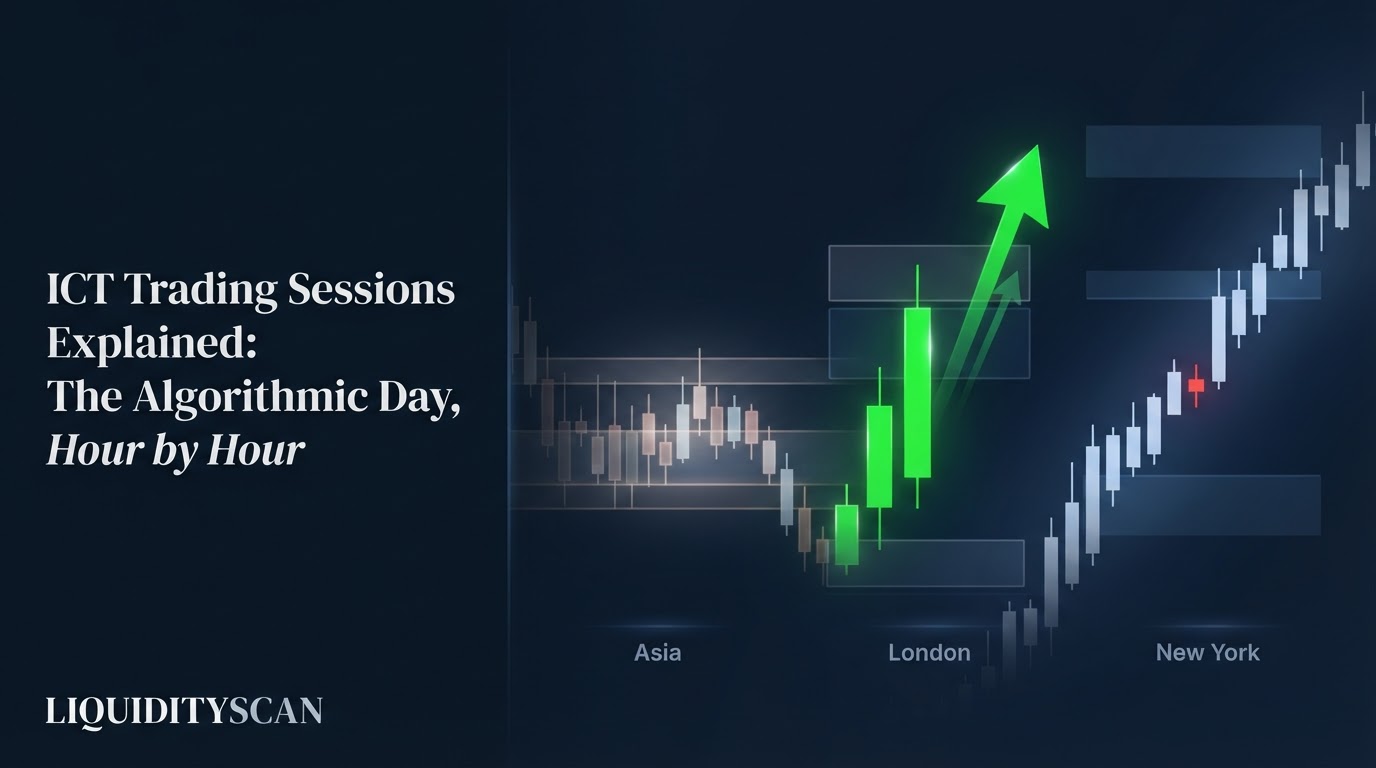
ICT trading sessions divide the 24-hour Forex day into three blocks — Asian, London, and New York — each with a fixed role in how the algorithm delivers price. Asia builds a tight range, London runs the first manipulation, and New York delivers the primary expansion or reversal.
The premise behind ICT trading sessions is that a market maker delivers price on a time schedule, not at random. Volume and volatility are not spread evenly across the day; they cluster around the London and New York opens because that is when institutional order flow concentrates.
A liquidity level that sits untouched during the Asian session behaves very differently once the London engine switches on. Time is a filter on price, and the session tells you which regime you are in.
All times below use New York time (EST/EDT) because the ICT framework anchors to the New York midnight open. The three sessions overlap real exchange hours but, for trading purposes, ICT treats them as behavioral windows rather than precise market openings.
The Three Major Sessions and Their Character
Each session has a personality. Learn the personality first, then the exact clock windows, because the behavior is what tells you whether to hunt for a range, a manipulation, or a continuation.
Asian Session (Tokyo): The Range Builder
The Asian session runs roughly 8:00 PM to midnight EST (with liquidity thinning into the early hours). Its character is consolidation. Volume is low, ranges are tight, and price typically coils inside a narrow band. This band — the Asian range — becomes engineered Liquidity: its high and low collect resting stops that London later targets.
- Behavior: sideways accumulation, small candles, frequent equal highs and equal lows.
- What it produces: a defined range whose extremes are the next session's liquidity pools.
- Trap to avoid: chasing breakouts of the Asian range — most fail, because the range is the bait.
London Session: The First Manipulation
London runs roughly 2:00 AM to 5:00 AM EST for its high-energy phase. This is where the day's first real expansion happens — and it usually starts as a manipulation.
London frequently runs one side of the Asian range to grab liquidity (a Liquidity Sweep) before reversing into the true daily direction. That false push has a name in ICT: the Judas Swing.
- Behavior: sharp expansion, a stop raid on the Asian high or low, then a reversal or a clean directional trend.
- What it produces: the day's initial Draw on Liquidity and often the session low or high of a trending day.
- Why it matters: London sets the tone; New York usually respects the direction London establishes.
New York Session: Continuation or Reversal
New York runs roughly 7:00 AM to 11:00 AM EST for its morning delivery, with a secondary afternoon window. New York either continues the London move or reverses it, depending on how liquidity was distributed earlier. The New York AM window carries scheduled news (8:30 AM releases) and the highest US participation, so it delivers the cleanest displacement of the day.
- Behavior: continuation of the London trend, or a New York reversal that traps the London move.
- What it produces: the daily high or low on most days, and the highest-quality entries around the AM window.
- Lunch caveat: 12:00 to 1:00 PM EST is low-conviction chop — a level here is not the same as a level in the AM window.
The Algorithmic Day: Accumulation, Manipulation, Distribution
The reason ICT trading sessions matter is that they map onto a single delivery cycle the market repeats daily. ICT calls it the Power of 3: accumulation, manipulation, distribution (AMD). The sessions are the clock this cycle runs on.
- Accumulation (Asia): price consolidates while positions are built quietly. The narrow Asian range is accumulation in visible form.
- Manipulation (London): price is driven against the intended direction to engineer liquidity — the Judas Swing sweeps the Asian range, tripping stops and inducing late entries.
- Distribution (New York): price expands in the true direction, distributing into the liquidity that manipulation created. This is where the move you actually want to trade delivers.
Read that way, a candle at 3:00 AM and a candle at 8:30 AM are doing different jobs. The 3:00 AM sweep is bait; the 8:30 AM displacement is the meal. Knowing which phase you are in is the difference between fading a trap and riding delivery.
How Sessions Nest With Kill Zones
Sessions are broad windows. Inside each session sits a much tighter, higher-probability sub-window called a Kill Zone — the specific hour or two where the algorithm most often delivers its setup. Kill zones are to sessions what a sniper's window is to a battlefield: same terrain, far narrower timing.
- London Open Kill Zone: ~2:00–5:00 AM EST — the manipulation-to-expansion window inside the London session.
- New York AM Kill Zone: ~7:00–10:00 AM EST — the primary US delivery window.
- New York PM / Silver Bullet: ~10:00–11:00 AM and afternoon windows for continuation setups.
The relationship is strict nesting: kill zones live inside sessions, and even tighter Macro windows (20-minute blocks) live inside kill zones. A valid ICT setup wants price arriving at a level during a kill zone, not merely inside the session.
The deeper mechanics of each kill zone are covered in the linked guides below — here the point is only that sessions set the stage and kill zones fire the trade.
Session Opens as Reference Points
Beyond the windows themselves, ICT treats specific session opens as fixed price references that the algorithm respects. These opening prices anchor bias for the hours that follow.
- Midnight Open (00:00 EST): the New York midnight price is the day's equilibrium reference. Price trading above it leans bullish for the day; below it leans bearish. Many traders draw a horizontal line here and let it split the day into premium and discount.
- London Open (~2:00–3:00 AM EST): the opening price of the London window often marks the origin of the Judas Swing — the level price manipulates away from before reversing.
- New York Open (7:00–8:30 AM EST): the NY open price frames the AM delivery; displacement away from it confirms the session's intent.
Used together, these opens turn abstract session timing into concrete horizontal levels. A sweep of the Asian high that reverses back below the midnight open, for instance, is a far stronger short signal than a sweep read in isolation.
The London–New York Overlap
The single most volatile window of the day is the London–New York overlap, roughly 8:00 AM to 11:00 AM EST, when both financial centers are active simultaneously. Liquidity is deepest and displacement is cleanest because two pools of institutional order flow are transacting at once.
Practically, the overlap is where continuation trades pay best. If London established a bearish direction by sweeping the Asian high and breaking structure down, the overlap is where New York piles into that direction — often producing the day's largest single leg.
It is also where the New York reversal, when it comes, is most violent, because the London move gets fully trapped before price snaps the other way. High reward, but it demands that your bias was set before the overlap opened, not during it.
Session-by-Session Playbook
The table below compresses the day into a decision grid. Times are EST; shift for daylight saving (see below).
| Session | EST Window | Typical Behavior | What to Look For |
|---|---|---|---|
| Asian (Tokyo) | 8:00 PM – 12:00 AM | Tight consolidation, range build | Mark the Asian range high/low as tomorrow's liquidity |
| London Open | 2:00 AM – 5:00 AM | First manipulation, Judas Swing, sweep of Asian range | Stop raid then reversal or clean trend; note the daily draw |
| NY AM | 7:00 AM – 11:00 AM | Highest volatility; London overlap from 8:00 AM; continuation or reversal | Displacement off NY open; entries in the AM kill zone |
| NY Lunch | 12:00 PM – 1:00 PM | Low-conviction chop | Stand aside; levels here are unreliable |
| NY PM | 1:30 PM – 4:00 PM | Afternoon continuation or reversal of AM | Silver-bullet continuation, or fade of the AM extreme |
How to Convert Session Times to Your Timezone
ICT windows are quoted in New York time, so you must translate them once and trade off your local clock. Two rules keep you accurate.
- Anchor to New York, not to GMT. Because the framework respects the midnight and New York opens, always convert from EST/EDT rather than from London time. A London-based trader is EST + 5 hours; a trader in Dubai is EST + 8 or +9 depending on the season.
- Account for daylight saving. The US, UK, and EU shift clocks on different dates, so for a few weeks each year the EST-to-local offset changes. This is why the London kill zone can appear to "move" by an hour. Re-verify your offset at each DST change rather than assuming a fixed number.
The cleanest habit is to set your charting platform's session boxes to New York time directly, then read your entries off the boxes instead of doing mental math mid-trade.
Weekend and Sunday Considerations
The Forex week opens Sunday evening EST and the first hours are thin and unreliable. Treat the Sunday open with caution.
- Sunday gap: price can open away from Friday's close, leaving a weekend gap. In ICT terms this is a New Week Opening Gap (NWOG) — a reference the algorithm often revisits during the week.
- Thin Asia Sunday night: the first Asian session of the week is low-liquidity and prone to false moves; most traders wait for London Monday for a genuine read.
- Friday PM: late-Friday liquidity dries up as positions square for the weekend — avoid initiating fresh trades into the close.
A Worked Day: Asia to London to New York
Consider a EURUSD day to see the sessions cooperate. Overnight, the Asian session coils between 1.0850 and 1.0875 — a 25-pip range that quietly stacks stops just above 1.0875 and below 1.0850. That range is accumulation, and its extremes are now engineered liquidity.
At the 2:00 AM London open, price pushes up and sweeps 1.0875, tagging 1.0882 and tripping breakout buyers' entries plus short-sellers' stops. That is the Judas Swing — manipulation. Within the kill zone, price rejects sharply, displaces back below the Asian range, and breaks a short-term low. Structure has shifted bearish; the daily draw is now the sell-side liquidity below 1.0850.
Into the New York AM window, price retraces into a Fair Value Gap (FVG) left by the London displacement, near 1.0860 — a level that is meaningful because it sits inside the AM kill zone. New York accepts the bearish bias, delivers continuation, and drives through 1.0850 into the sell-side pool by 9:30 AM.
Distribution is complete. A trader who read the sessions shorted the retrace into the FVG during the overlap; a trader who only saw "a level" bought the 2:00 AM breakout and got trapped at the exact high.
That single day is the entire thesis of ICT trading sessions in miniature: same chart, same levels, but the session and kill zone decided who was bait and who was aligned with delivery.
Frequently Asked Questions
What is the best session to trade in ICT?
For most traders the New York AM window (7:00–11:00 AM EST) offers the best balance of volatility, liquidity, and clean displacement, especially during the London overlap. The London open (2:00–5:00 AM EST) is preferred by those who can trade early, since it sets the day's direction and delivers the first manipulation.
Are kill zones the same as trading sessions?
No. Sessions are broad multi-hour blocks (Asia, London, New York). Kill zones are precise one-to-three-hour windows nested inside sessions where the algorithm most reliably delivers setups. Every kill zone lives inside a session, but not every hour of a session is a kill zone — the lunch hour, for example, is inside the NY session but is deliberately avoided.
Do ICT sessions work on crypto, which trades 24/7?
Yes, with a caveat. Even though crypto never closes, its volatility still concentrates around the London and New York windows because the same institutional desks and macro flows are active then. The Asian range and the London manipulation are observable on BTCUSDT, though weekend behavior differs since traditional markets are shut.
Why does a level in a kill zone behave differently than at lunch?
Because delivery is scheduled. During a kill zone, institutional order flow is present to defend or break a level, so reactions are decisive. At lunch, participation collapses, so the same level produces indecisive chop. In ICT, the level supplies the price and the session supplies the time — you need both to be valid.
Related query paths
This is the umbrella page. Follow these deeper guides in order — from the precise timing windows to the delivery mechanics that make sessions tradable.
- ICT Kill Zones Complete Guide: A Pro Trader's Framework — zoom from sessions into the precise windows where setups actually fire.
- ICT Power of 3 (PO3): The AMD Cycle Explained — the accumulation-manipulation-distribution engine that runs on the session clock.
- What Is the Judas Swing in ICT Trading? — the London manipulation move in full mechanical detail.
- The London Open Kill Zone Strategy: A Procedural Guide — a step-by-step playbook for the first expansion of the day.
- A Precise New York AM Kill Zone Strategy for ICT Traders — how to trade the highest-volatility overlap window.
- Why ICT Setups Need Both Time and Price — why the session filter is inseparable from the level.
- Do ICT Kill Zones Still Work in 2026? A Data-Driven Reality Check — a related angle on do ict kill zones still work.
- ICT midnight open: what 00:00 EST means for the daily range — Clarify the true day open before mapping each ICT trading session.