
What Is the ICT Midnight Open?
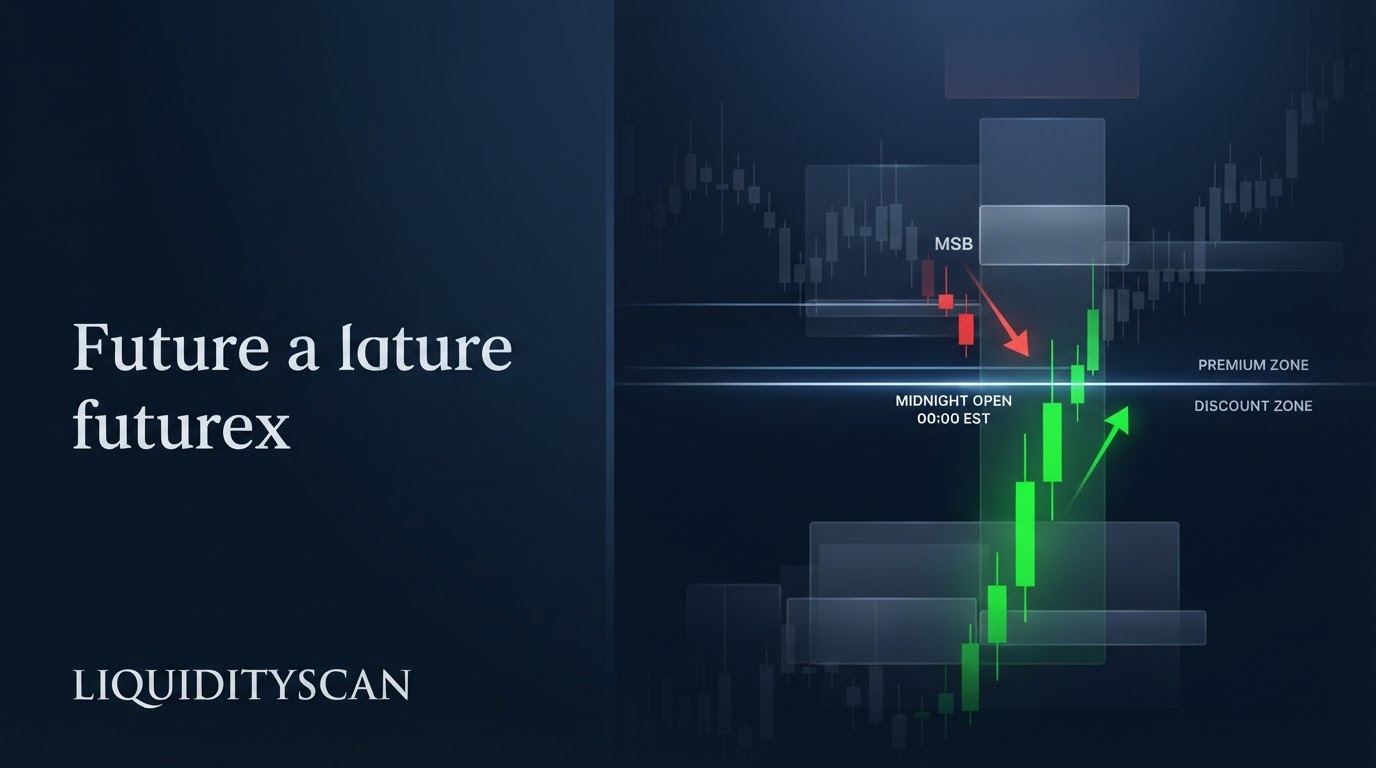
The ICT midnight open is the price at exactly 00:00 America/New_York — the opening price of the 00:00 EST candle. In ICT theory it is the algorithm's daily reset reference: price above it is premium for the day, price below it is discount.
It is drawn as a single horizontal line and left untouched until the next midnight. Everything London and New York deliver is read relative to that line. That is its whole job — to give one objective, non-repainting anchor for the day's directional frame before any session has moved price.
Concretely: if BTCUSDT prints its 00:00 EST candle open at 62,000, that 62,000 is the midnight open for the next 24 hours. Every rally to 62,800 is premium; every dip to 61,200 is discount.
You do not need a swing high, a fair-value gap, or an order block to be present. The anchor exists the instant the midnight candle opens — which is what makes it usable at the very start of the day, before any structure has formed.
Why Midnight EST, Not the Session Open?
Retail traders anchor the day to a session open — the 5pm CME rollover, the London open, or their broker's arbitrary daily candle. ICT anchors it to 00:00 EST because that is where the Interbank Price Delivery Algorithm (IPDA) is theorized to begin a fresh delivery cycle.
The true trading day, in this framework, starts at midnight New York time, not at any exchange bell.
The logic is mechanical, not mystical:
- At midnight, the prior day's manipulation and distribution are complete. The book resets to a neutral reference.
- The Asian range that forms after midnight is accumulation around this anchor — tight, low-volatility consolidation that engineers liquidity on both sides.
- London and New York then deliver away from midnight, first with a manipulation leg (the Judas Swing), then the real expansion.
Because the anchor is fixed at 00:00 EST, it is identical on every trader's chart in the world — provided their chart is set to New York time. That objectivity is the point. A session open drifts with your broker's server timezone; the midnight open does not.
Two traders on different brokers, both set to America/New_York, will draw the exact same line at the exact same price. That is rare in a discipline where most reference levels are subjective.
There is also a behavioral reason ICT stresses midnight. The Asian session that follows it is the lowest-participation window of the day, so the range built around the anchor is thin and easily engineered. Stops accumulate just above and below that quiet range, and those pools become the fuel for London's manipulation leg.
Anchoring your read to the midnight open means you are watching the exact reference the engineered move is built around, rather than a level that only becomes visible after price has already expanded.
Premium and Discount Relative to the Midnight Open
The single most practical use of the midnight open is as a premium/discount filter for the day. Draw the line, then classify where price is trading:
- Above the midnight open = premium. Price is expensive relative to the algorithm's daily reference. This favors selling — you want to be a seller in premium, into a bearish daily bias.
- Below the midnight open = discount. Price is cheap relative to the reference. This favors buying — you want longs in discount, into a bullish daily bias.
This is the same Premium and Discount logic used inside a Dealing Range, but the midnight open gives you an instant, session-agnostic split without waiting for a swing high and low to form. It pairs with — not replaces — your higher-timeframe bias.
If your daily bias is bearish and price rallies into premium above the midnight open during the London session, that premium rally is your sell location, not a reason to chase longs. The anchor does not generate the bias; it tells you whether the current price is a good place to act on the bias you already hold.
A worked example
Say EURUSD prints a midnight open at 1.0850. Through the Asian session, price coils between 1.0840 and 1.0862, straddling the anchor. At the London open, price drives up to 1.0878 — firmly into premium, ~28 pips above midnight.
If your weekly bias is bearish, that Judas push into premium is the setup: price sweeps buy-side liquidity above the Asian high, forms displacement down, and the New York AM session delivers to 1.0812 — deep discount, ~38 pips below the midnight open.
A short taken in that premium, aligned with the bearish day, is working with the algorithm rather than against it. Longs on a bullish day follow the same logic in mirror image: wait for a discount extreme below midnight, confirm the reversal, and target the premium side.
Projecting the Daily Range: Standard Deviations From Midnight
The midnight open is not only a bias filter — it is a measuring stick. ICT range projection takes the initial move off the anchor and extends it in fixed multiples to estimate where the day can reach.
- Measure the first leg. From the midnight open, mark the extreme of the initial displacement — often the Judas Swing high or low set during London.
- Define one deviation. The distance from the midnight open to that first extreme is your 1.0 standard-deviation unit.
- Project the opposite side. Extend −1, −2, −2.5 deviations through the anchor into the opposite (real-move) direction. These become logical draw-on-liquidity targets and take-profit shelves.
This mirrors the CBDR (Central Bank Dealers Range) deviation method, but uses the midnight open as the pivot instead of the 2pm–8pm range. If the midnight open is 1.0850 and London's manipulation high is 1.0878 (+28 pips = 1 deviation), the −1 deviation projects to 1.0822 and −2 to 1.0794 — clean, pre-defined targets for a bearish day.
You are not guessing where price stops; you are reading engineered symmetry around the anchor. Treat these as zones of interest, not guarantees: deviations tell you where price is likely to react, and you still confirm with structure and a liquidity target before committing.
The Midnight Open, True Day Open, and the New York Session
The midnight open is frequently called the true day open in ICT material — the genuine start of the trading day, as opposed to a broker's midnight or an exchange session open. It sets the frame; the sessions deliver against it.
The typical sequence over a day:
- 00:00 EST — anchor set. The midnight open prints. The Asian range accumulates around it.
- 02:00–05:00 EST — London manipulation. Price is pushed to a premium or discount extreme relative to midnight, sweeping liquidity. This is the Judas Swing.
- 08:30 EST — New York AM delivery. The New York open and the 8:30 economic-data window trigger the real expansion back through the midnight open toward the opposite deviation targets.
The 08:30 EST New York open is where many ICT models look for entries, but the midnight open is what tells you which direction that 8:30 move should favor.
If NY AM opens in premium above midnight with a bearish daily bias, you are hunting shorts into that premium; the anchor and the session work together — the midnight open supplies the frame, the New York AM Kill Zone supplies the timing.
This is also why the midnight open sits at the heart of the daily Power of Three (AMD) cycle: accumulation clusters at the anchor, manipulation stretches away from it, and distribution runs through it toward the deviation targets.
How to Draw the Midnight Open Correctly
Precision here is non-negotiable, because a one-hour error moves the anchor to a completely different price. Draw it like this:
- Set your chart timezone to America/New_York. Not UTC, not London, not your broker default. This is the single most common failure point — the whole concept is timezone-defined.
- Drop to a low timeframe (5m or 15m) to locate the candle that opens at 00:00.
- Take the OPEN of the 00:00 candle — not the close, not the high or low.
- Draw one horizontal ray from that open, extended right across the full trading day.
- Leave it fixed until the next 00:00 EST, then draw the new day's line.
One line, one price, one day. Do not redraw it when price moves; the value of the anchor is that it does not move. Note that America/New_York already handles daylight-saving shifts automatically — set the timezone by name, not by a fixed UTC offset, and the midnight open stays correct through both EST and EDT.
If you trade multiple instruments, an automated scanner that timestamps candles in New York time removes the manual step entirely; on LiquidityScan, session and timing logic is computed in America/New_York so the anchor stays consistent across every symbol you watch.
Common Mistakes With the ICT Midnight Open
The midnight open is simple to draw and easy to get wrong. The recurring errors:
- Confusing it with the daily candle open. On many crypto and CFD feeds the daily candle opens at 00:00 UTC or at the broker's server midnight — not New York midnight. Anchoring to that candle puts your line hours and often dozens of pips off.
- Timezone drift. Leaving the chart on UTC or a broker timezone silently corrupts the anchor. Always verify the chart clock reads America/New_York before you trust the line.
- Using the close instead of the open. The anchor is the opening price of the 00:00 candle. Grabbing the close of the 23:00 candle or the close of the 00:00 candle introduces a small but compounding error.
- Trading the line in isolation. Premium/discount off the midnight open is a filter, not a signal. It tells you where to look for entries — it does not replace a higher-timeframe bias, a liquidity target, or an entry model.
- Ignoring DST manually. Traders who hard-code a UTC offset break their anchor twice a year at the daylight-saving switch. Set the timezone by name and let the platform handle it.
Get those right and the midnight open becomes the cleanest daily reference in the ICT toolkit: one line at 00:00 EST that frames premium versus discount, anchors your standard-deviation projections, and tells you which way the New York session should deliver.
Frequently Asked Questions
Is the midnight open the same as the true day open?
Yes. In ICT terminology the midnight open and the true day open refer to the same thing: the opening price of the 00:00 America/New_York candle. It is called the true day open because ICT treats midnight EST — not any exchange session bell — as the genuine start of the algorithmic trading day.
Does the midnight open work on crypto that trades 24/7?
Yes, and arguably better, because crypto never gaps at a session open. You still anchor to the 00:00 America/New_York price on a New-York-timezone chart. The premium/discount split and deviation projections behave identically to forex; only the instrument's volatility scale changes.
What timeframe should I use to mark the midnight open?
Use a 5-minute or 15-minute chart to precisely locate the candle opening at 00:00 EST, then take its open. Higher timeframes make it harder to isolate the exact midnight candle, and a wrong candle means a wrong anchor for the entire day.
How does the midnight open relate to the 8:30 New York open?
The midnight open sets the daily frame — premium above, discount below — while the 8:30 EST New York open supplies the timing for delivery. You read the 8:30 expansion in the direction favored by where price sits relative to the midnight open and your higher-timeframe bias.
Related query paths
The midnight open only pays off inside a full premium/discount and range-projection framework. These build the model around it, from the split it defines to the sessions that deliver against it.
- How to Draw Premium & Discount Zones (ICT Guide) — turn the midnight-open split into full premium/discount zones on any chart.
- Equilibrium ICT: The 50% Level Explained — the 50% midpoint that formalizes premium versus discount.
- CBDR & Standard Deviations: ICT Range Projection — the deviation method for projecting targets off a fixed anchor.
- What Is the Judas Swing in ICT Trading? — the manipulation leg that pushes price into premium or discount after midnight.
- A Precise New York AM Kill Zone Strategy for ICT Traders — the session that delivers the real move against the midnight frame.
- ICT Power of 3 (PO3): The AMD Cycle Explained — the accumulation-manipulation-distribution cycle that unfolds around the daily anchor.
- Why Does the Market Reverse Right After the Open? The Time-Based Manipulation Logic — a related angle on why does market reverse after open.
- ICT trading sessions and session times in EST — Understand how the midnight open fits into Asia, London, and New York sessions.