
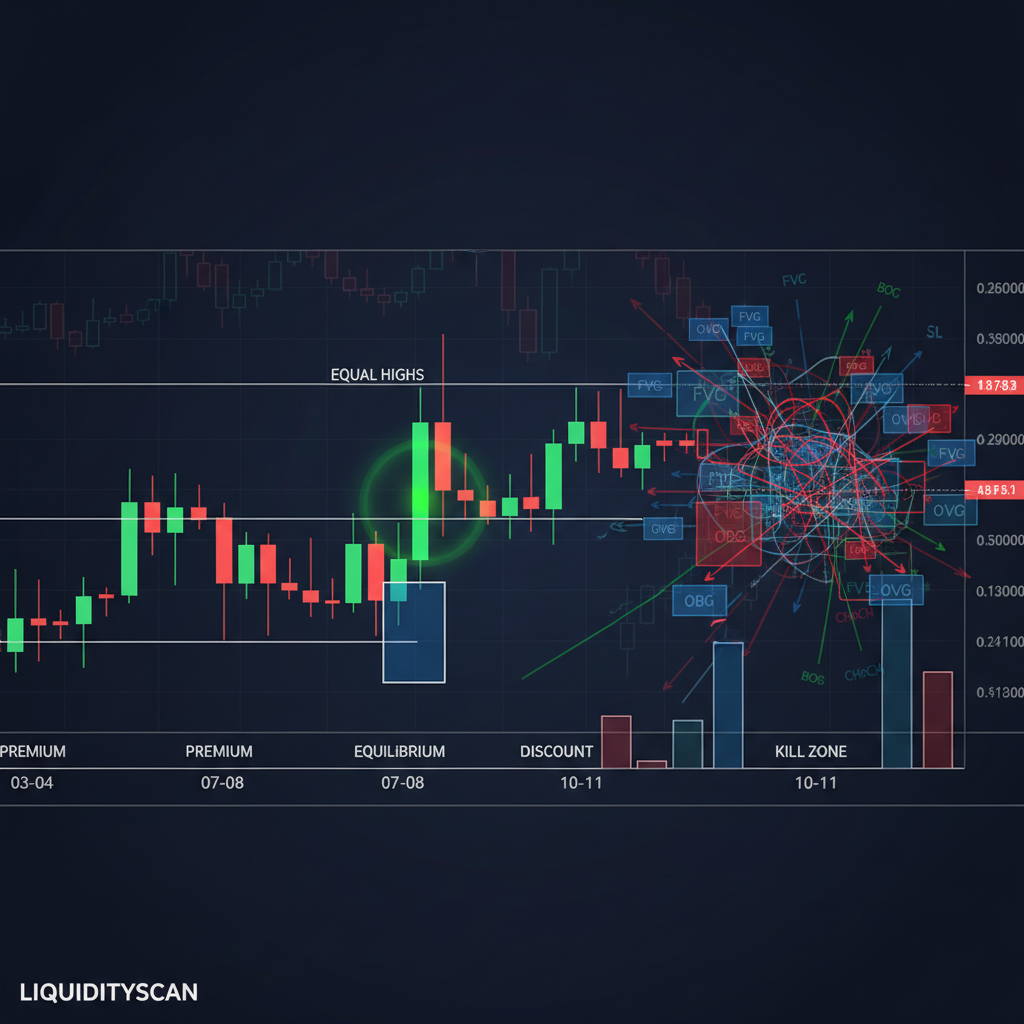
ICT traders fail because they treat the methodology as a checklist of concepts to stack rather than a decision process to follow. The concepts work. The execution breaks down over five predictable habits: over-complicating the chart, trading without a defined bias, revenge-trading inside the kill zones, ignoring risk, and chasing setups that live outside their model. Fix these five and you remove the reasons most accounts die — not because you found a secret setup, but because you stopped sabotaging the good one you already had.
The real reason isn't the concepts — it's execution
ICT gives you a complete map: liquidity, displacement, fair value gaps, order blocks, time-based delivery. None of that fails you. What fails is the gap between knowing a concept and executing it under pressure with real money on the line.
Backtests confirm the individual pieces have edge. Order blocks, FVG fills, kill-zone timing — each holds up when isolated and measured. So the loss column isn't a knowledge problem. It's a behavior problem wearing a knowledge costume. The five failure modes below are all execution failures, and every one is fixable without learning a single new concept.
The five failure modes — and the fix for each
Each failure has a specific tell and a specific correction. Read them as a diagnostic: you're probably guilty of at least two right now.
1. Over-complication: stacking every concept on one chart
The most common killer. A trader learns twenty ICT concepts and tries to see all twenty at once — order block plus FVG plus breaker plus SMT plus liquidity void plus PO3 — on a single 5-minute candle. The result is analysis paralysis, then a rushed entry once the move has already left.
The fix is subtraction. Pick one setup — say, a liquidity sweep into a displacement FVG during the New York AM kill zone — and trade only that. Every concept you remove from the screen is a decision you no longer have to make in real time. Mastery is depth in one model, not shallow coverage of ten.
2. No defined bias process
Traders who fail rarely know whether they're a buyer or a seller before the session opens. They react to whatever the 5-minute chart is doing, which means they buy tops and sell bottoms with the crowd.
A bias process is a repeatable sequence you run before every session: mark the higher-timeframe dealing range, identify which liquidity pool is the draw, note premium versus discount, and write down one directional expectation. If price hasn't reached your point of interest, you have no trade. That single rule filters out most of the impulse entries that bleed accounts.
3. Revenge-trading the kill zones
You take a valid setup, it loses, and you immediately re-enter to "get it back" before the kill zone closes. This is where a bad day becomes a blown account. The kill zone's time pressure — a 90-minute window — manufactures urgency that overrides your rules.
The fix is a hard session cap: a maximum number of trades and a maximum daily loss, both defined in writing before you open the platform. Two setups, two losses, you're done for the day regardless of how much window is left. Time-based discipline is the whole point of ICT; abandoning it the moment you're down is self-defeating.
4. Ignoring risk in favor of "high-probability" conv0iction
A clean setup tempts oversizing. The trader thinks the confluence is so strong that this one deserves 5% instead of 1%. Then the market sweeps their stop — because a strong-looking setup is still a probability, never a certainty — and one trade erases ten.
Fixed fractional risk solves this. Same percentage per trade, every trade, no exceptions for conviction. Position size flexes with stop distance, never with how good the chart looks. Your edge only compounds if you survive the losing streaks that a positive-expectancy system will still hand you.
5. Chasing setups outside your one model
You define your model, then five minutes later you take a Silver Bullet trade you never studied, or a London reversal that isn't in your playbook, because it "looked good." Every off-model trade contaminates your data — you can no longer tell whether your edge works, because you never gave it a clean sample.
The fix is a written model and the discipline to skip everything else. If a setup isn't in your plan, it's not your trade, no matter how textbook it appears. You can add models later — deliberately, one at a time, with backtested data — but never mid-session on a whim.
How the fixes compound
Fixed individually, each of these helps. Fixed together, they reinforce one another, because they all point at the same underlying skill: doing less, on purpose.
| Failure mode | The tell | The fix |
|---|---|---|
| Over-complication | Ten concepts on one chart | One setup, everything else deleted |
| No bias process | Reacting to the 5-minute | Pre-session HTF bias checklist |
| Revenge-trading | Re-entering to get it back | Written daily trade + loss cap |
| Ignoring risk | Oversizing on conviction | Fixed fractional risk, always |
| Off-model chasing | Taking untested setups | Written model, skip the rest |
Notice none of these require a new concept. They require a journal, a written plan, and the patience to let one model produce a real sample. That's the uncomfortable answer: the traders who make it aren't the ones who know the most ICT. They're the ones who execute the least chaotic version of it, every single session.
The methodology isn't your edge. Your ability to run the same clean process a hundred times without deviating is your edge.
Frequently Asked Questions
Is ICT actually profitable, or is the failure rate proof it doesn't work?
The failure rate reflects execution, not the methodology. The individual concepts hold positive expectancy in isolated backtests. Most traders lose because of the behavioral mistakes above, not because the framework is broken.
How long before I stop losing with ICT?
Expect several months of trading a single model with fixed risk and a full journal before you can even judge your edge. Traders who fail usually quit or switch models long before they've collected a clean, statistically meaningful sample.
Which failure mode should I fix first?
Risk. Position sizing and a daily loss cap keep you in the game long enough to fix everything else. You can survive bad analysis; you cannot survive a blown account.
Related query paths
If one failure mode hit close to home, these are the natural next steps.
- 5 Common Risk Management Mistakes That Invalidate ICT Strategies — the risk errors that quietly undo good analysis.
- How to Find Your Edge in ICT Trading: A Framework for Specialization — how to pick the one model worth mastering.
- How to Build a Complete ICT Trading Model (Step-by-Step) — turn "one setup" into a written, repeatable plan.
- Daily/Weekly Bias Determination & Trade Journaling — build the pre-session bias process you're missing.
- ICT Position Sizing: Risk, R-Multiples & Consistency — fix the risk failure mode first, in detail.