
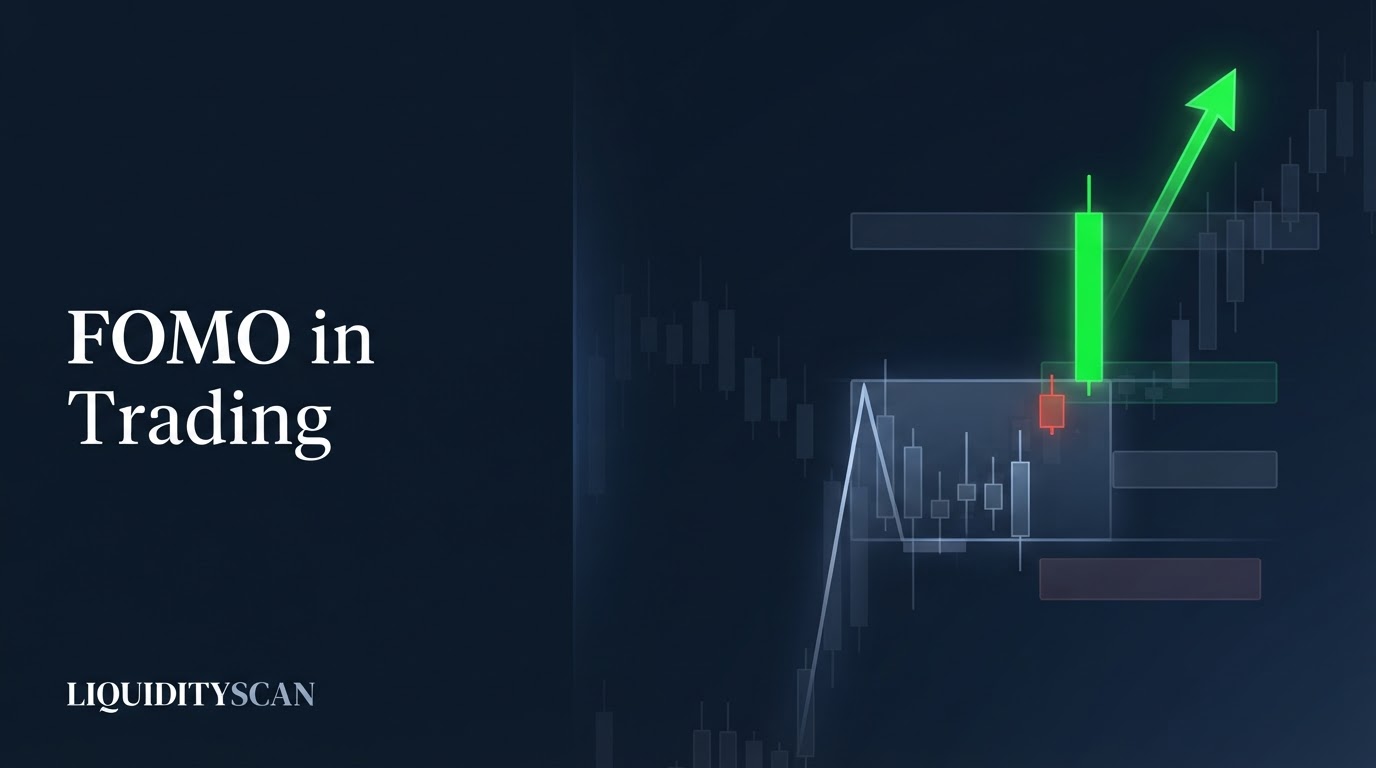
What Is FOMO in Trading?
FOMO trading is the fear of missing out: entering a trade late, at a worse price, or outside your plan simply because price is running without you.
Instead of your pre-defined zone, you buy into a move that has already left. It is the single most common way otherwise-good ICT traders bleed accounts.
The setup itself is rarely the problem. The problem is what happens in the gap between spotting a valid Order Block and price actually returning to it. That waiting window is where FOMO does its damage — you abandon the plan and chase the candle.
Why FOMO Happens: The Brain Treats a Missed Move as a Loss
Your brain does not distinguish cleanly between money lost and money not made. Watching a move run without you registers as pain, and pain demands action. So you act — late, and in the wrong place.
Three forces stack on top of each other:
- Loss framing. A missed 3R move feels like you lost 3R, even though your account is unchanged. That phantom loss creates urgency to "get it back."
- Live price pressure. Staring at a green candle sprinting away triggers a physical sense that the door is closing. The longer you watch, the louder it gets.
- Social amplification. Someone posts a screenshot of the exact long you thought about taking. Now the missed move has a face, and skipping feels like personal failure.
None of these are analysis. They are emotional signals wearing the costume of a trade idea, and acting on them means entering at the worst possible moment — after confirmation everyone else already has.
Notice the pattern: every one of these forces intensifies the longer you stare at a live chart, and none of them says anything about whether price is actually at your level. That is the tell.
Genuine analysis is calm and level-based; FOMO is loud and time-based, insisting you must act now or lose forever. When a trade urge feels urgent, the urgency itself is a signal to slow down, not speed up.
The ICT-Specific FOMO Traps
FOMO is universal, but ICT structure creates very specific chase patterns. Recognizing which one you fall into is half the fix.
1. Chasing After Price Left Your Zone
You marked a bullish Order Block or Fair Value Gap (FVG) at a discount. Price never quite reached it, then displaced upward. You buy anyway — but now you are entering at a premium, into the exact move you were supposed to catch at a discount. You have inverted your own edge.
2. Entering Mid-Displacement Instead of the Retrace
Displacement is the impulsive leg that confirms intent — it is not the entry. Buying into the middle of a displacement candle means you are paying for momentum that is about to pause. The Optimal Trade Entry (OTE) retrace almost always comes; FOMO makes you enter before it does.
3. Jumping In on the Judas Leg
The Judas Swing is manipulation — a false push designed to look like the real move and pull in exactly your kind of impatience. It has the speed and conviction of a breakout, which is precisely why it triggers FOMO. You buy the high; the algorithm reverses; your stop gets swept.
4. Trading a Pair or Session Outside Your Plan
Your plan says EURUSD in the New York AM window. But GBPJPY is ripping right now, so you jump in. You have no bias, no marked levels, and no session context on that instrument — you are trading it purely because it moves. That is FOMO, not analysis.
5. Over-Trading to Make Up for a Miss
You missed a clean setup this morning. Now every marginal pattern looks like a trade, because part of you is trying to "recover" the one that got away. Revenge-adjacent over-trading after a miss is FOMO's second act, and it usually costs more than the original miss ever would have.
Why Chasing Is Mathematically Bad
FOMO is not just a discipline problem — it directly corrupts your numbers. A worse entry price is a worse trade on every axis that matters.
- Wider stop or worse R:R. If your invalidation sits below the Order Block but you entered 40 pips higher chasing the move, your stop distance grew while your target stayed fixed. A planned 3R just became 1.5R for the same idea.
- Buying right before the retrace. Price rarely runs in a straight line. Entering mid-move means you often buy the local high, then sit through the pullback you should have used as your entry — frequently getting stopped on the very retrace that later resumes without you.
- No defined invalidation. Chased entries usually have no clean structural stop, so you either risk too much or place a tight stop in a random spot that noise takes out.
Consider BTCUSDT: your plan is a long from a 4H Fair Value Gap (FVG) at 61,200 with a stop at 60,700 and target 63,200 — a clean 4R. Price stalls at 61,600, you chase the long there, stop still at 60,700.
Same target, but now you risk 900 points to make 1,600. You turned a 4R into under 2R, and if price dips to fill the gap first, you are stopped before the move you correctly predicted.
The Antidotes: Concrete Fixes That Beat FOMO Trading
You do not beat FOMO with willpower in the moment — the moment is exactly when willpower fails. You beat it with structure set up in advance so the chase is not even available.
- Accept that missed trades cost nothing. A skipped setup leaves your account exactly where it was. The market delivers new setups every single session; there is always another one. Internalize this and the phantom loss loses its grip.
- Use limit orders at your zone. Place a resting limit at your Order Block or FVG. Either price comes to your level and fills you at your price, or it does not and you skip. There is no version where you chase — the order mechanically enforces the plan.
- Use alerts instead of watching. Watching price run is what triggers the urgency. Set an alert at your level and walk away. You get pinged when price reaches YOUR zone, turning a FOMO spiral into a single notification.
- Pre-define the setup so everything else is auto-skip. Write the exact conditions: instrument, session, structure, entry zone, invalidation. Anything that does not match all of them is not a trade — not a judgment call, an automatic no.
- Journal FOMO trades separately. Tag every chased entry. After 20 or 30 of them, look at the aggregate. The data almost always shows they lose or badly underperform your planned trades — and seeing your own numbers kills the urge faster than any rule.
The Reframe: A Good Skip Is a Win
Retail psychology says a missed trade is a failure. Professional psychology says a missed trade you correctly declined to chase is discipline working exactly as designed.
When price leaves your zone and you do not chase, you did not "miss" — you protected your average entry quality and your R:R. That protection compounds.
A trader who takes only in-plan entries and skips every chase will, over a hundred trades, sit at a materially higher expectancy than the same trader who chases even a quarter of the time, because the chased trades enter at premium and carry worse math.
There is a simple test for whether a skip was correct: would you have entered that trade walking up to the chart cold, with no memory of the move that just ran? If the answer is no — no marked level, no clean invalidation, no session context — then skipping was right regardless of what price did afterward.
Judging a decision by its outcome instead of its process is exactly how FOMO convinces you discipline was a mistake. Grade the decision, not the candle.
Reframe the scoreboard: a clean skip counts as a point for you, not against you. The market delivering a move without you is not a loss — it is proof the market delivers moves, and it will deliver the next one to your level if you let it.
This mindset ties directly to two habits: the one-setup discipline and patience. Both rest on a single belief — that there is always another qualifying setup coming, so no individual miss can matter much.
If you specialize in one repeatable pattern — say, a liquidity sweep into a Fair Value Gap (FVG) during a specific kill zone — you know precisely what your trade looks like and everything else is noise you are content to miss.
Worked example. On EURGBP, your plan is a short from a bearish Order Block at 0.8540. Price runs up to 0.8532 and stalls — close, but not your level. FOMO says short here before it drops. You hold your limit at 0.8540 instead.
Price pulls back, and 20 minutes later, taps 0.8541, filling your resting order at your price with your tight stop above the block. The move you were tempted to chase early arrived properly — patience converted a marginal chase into a clean, in-plan entry with full R:R.
That sequence repeats endlessly across pairs and sessions. Once you trust it, the fear of missing out dissolves, because you know another qualifying setup is never far away.
Automated scanning and alerts help here in a concrete way: instead of babysitting charts and getting baited into chases, you let a scanner watch your conditions across many pairs and ping you only when price reaches your level.
Common Mistakes
- Confusing displacement with an entry signal. Displacement confirms direction; it does not tell you to buy at that price. Wait for the retrace.
- Moving your stop to "make the chase work." Widening a stop to accommodate a late entry just converts a discipline error into a sizing error.
- Trading a new instrument mid-session because it moved. No bias, no marked levels, no edge — pure FOMO.
- Deleting the alert and watching manually anyway. The whole point of the alert is to remove live price pressure; watching re-introduces it.
- Not journaling the chase. If you never tag FOMO trades, you never see their true cost, so the behavior never corrects.
Frequently Asked Questions
Is FOMO the same as revenge trading?
They overlap but differ. FOMO is chasing a move you are afraid to miss; revenge trading is forcing trades to recover a realized loss. A FOMO trade often becomes the setup for a revenge trade — you chase, you lose, then you over-trade to make it back. Both stem from treating an unchanged account as a loss.
How do I stop chasing entries in real time?
You mostly cannot fix it in real time — that is the point. Remove the decision beforehand: set a resting limit order at your zone and an alert, then step away from the chart. If price does not reach your level, the trade simply does not happen and there is nothing to chase.
Does using alerts really reduce FOMO?
Yes, because FOMO is triggered by watching price move. An alert lets you stop staring; you are notified only when price reaches your pre-marked level, at which point you evaluate a setup that is actually at your zone rather than a candle running away from it. It converts urgency into a single ping.
Is missing a big move actually a problem?
No. A missed move leaves your account exactly where it was and costs you nothing. The market produces new setups every session, so any single miss is replaceable. Treating misses as losses is the core distortion behind FOMO trading — correcting that belief removes most of the pressure to chase.
Related query paths
FOMO is a psychology and discipline problem, so the strongest next reads cover the mindset, routine, and risk framework that make chasing structurally impossible.
- Why ICT Traders Fail: 5 Mistakes That Kill Accounts — see where chasing ranks among the account-killers.
- The Professional ICT Trading Routine: A Daily Playbook — the pre-defined routine that leaves no room to chase.
- ICT News Trading: Discipline Around High-Impact Events — discipline when volatility is baiting you in.
- OTE Explained: The ICT Optimal Trade Entry Zone — the retrace zone you should wait for instead of chasing.
- ICT Risk Management Framework — why a worse entry wrecks your R:R math.
- The ICT Trading Journal Template Pros Use to Build Edge — tag and quantify your FOMO trades to kill the habit.
- How Many Losses in a Row Is Normal? Losing-Streak Probability Explained — a related angle on losing streak probability.