
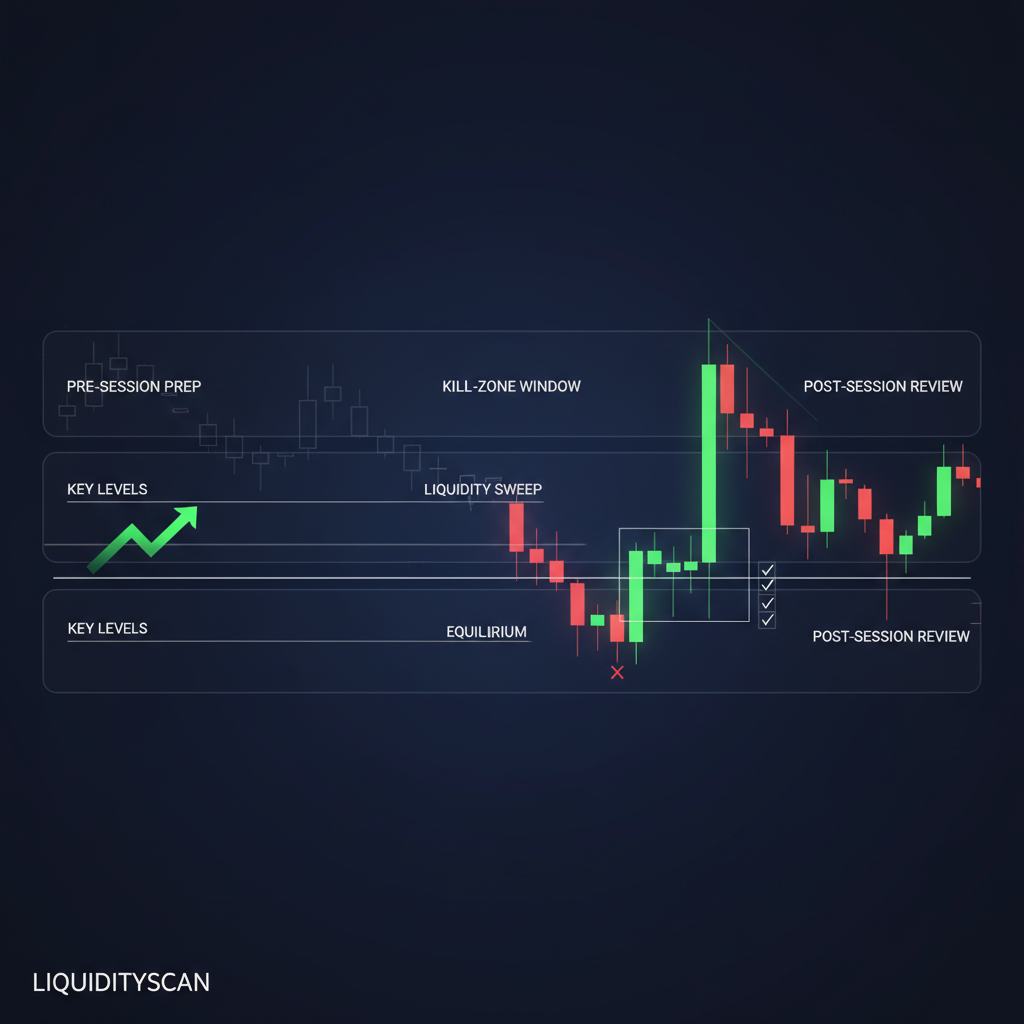
The professional ICT trading routine is a fixed four-stage loop repeated every session: pre-session preparation (bias, key levels, news), a defined kill-zone watch window, a checklist that gates every entry, and a post-session journal. The setups you already know matter less than the discipline of running this loop the same way each day. Traders who plateau usually have good pattern recognition and no process around it.
What does pre-session preparation actually involve?
Pre-session prep sets your directional bias and marks the levels price is likely to seek before you ever look for an entry. Do it before the session opens, not during it, so your read is not contaminated by live price. Fifteen focused minutes is enough once it becomes habit.
Three things get decided here:
- Bias. Where is the higher-timeframe draw on liquidity? Use the daily and 4H to decide whether price is more likely to reach for buy-side or sell-side liquidity today. One direction, written down.
- Key levels. Mark the previous day's high and low, session highs and lows, unmitigated order blocks, obvious fair value gaps, and any equal highs or lows resting as engineered liquidity.
- News. Check the calendar for high-impact releases. A red-folder event inside your kill zone changes how you size, or whether you trade at all.
Write the bias as a single sentence: "Bias is bearish; I expect a sweep of Asia highs into the 4H order block, then displacement lower." That sentence is what you defend, or invalidate, for the rest of the day.
Why does the kill-zone watch window matter more than watching all day?
The watch window concentrates your attention into the two or three hours where institutional order flow is most likely, so you are not fatigued into forcing trades during dead liquidity. Screen time outside the kill zone is where good analysis goes to die. You over-manage winners and talk yourself into setups that do not exist.
Pick your window and defend it. Most equity- and forex-focused traders anchor to the London open and the New York AM kill zone. During that window you are hunting for one thing: your pre-session narrative playing out at a level you already marked.
The watch window is not "stare at the screen." It is "wait for price to arrive at a level I pre-selected, then look for confirmation." If price never reaches your level, the correct number of trades is zero.
This is the hardest part to enforce, because doing nothing feels like failure. It isn't. A day where price never triggered your plan and you stayed flat is a day you executed the routine perfectly.
What belongs on the entry checklist?
The entry checklist is a short, non-negotiable gate that every trade must pass before you click. Its job is to convert a subjective "this looks good" into an objective yes or no. If any item fails, there is no trade — no discretion, no "but this one's different." Keep it to five or six items so it is usable in real time.
| Checklist gate | Pass condition |
|---|---|
| Bias alignment | Trade direction matches the pre-session bias sentence. |
| Time | Setup forms inside the chosen kill zone. |
| Liquidity | A sweep or clear draw on liquidity precedes the entry. |
| Confirmation | Displacement plus a valid POI (FVG, order block, or breaker). |
| Risk | Stop placement gives at least the minimum R you require. |
| News | No conflicting high-impact release inside the next candles. |
The value is in the friction. The checklist slows you down at the exact moment your emotions want speed, and that pause is where most bad trades are quietly declined. Print it. Physically tick each box on the first fifty trades until the gates are automatic.
How rigid should the checklist be?
Rigid on the gates, flexible on the read. The gates — time, bias, liquidity, confirmation, risk — never bend. How you interpret a valid point of interest can mature with experience, but you change the checklist between sessions in your journal, never live in the heat of a trade.
What does the post-session journal capture?
The post-session journal records what you did against what you planned, so tomorrow's routine is built on evidence instead of memory. Most traders journal outcomes. Professionals journal decisions. A losing trade that passed every gate is a good trade; a winning trade you took off-plan is a problem you got paid to ignore.
For each session, log:
- Your pre-session bias sentence and whether it played out.
- Every trade taken, with a screenshot and the checklist gates it passed.
- Any trade you skipped and why — skips are data too.
- One process note: what to repeat, what to cut.
Over a few weeks this journal becomes the only honest map of your edge. It tells you which kill zone actually pays you, which POI you over-trade, and whether your losses come from bad setups or broken discipline. That distinction is everything, because the fixes are completely different.
Why the routine beats the setup
Two traders can use the identical order-block model and get opposite results, and the routine is usually the reason. The one with a process trades the same way on a losing streak as on a winning one. The one without a process changes size after losses, abandons the plan mid-session, and never accumulates the repetitions needed for an edge to express itself. Sample size only counts if the samples are consistent.
Your routine does not need to look like anyone else's. It needs to be written, repeatable, and honestly reviewed. Start with these four stages, run them for thirty sessions without skipping the journal, and let the data tell you what to refine.
Frequently Asked Questions
How long should my pre-session prep take?
Fifteen to twenty minutes once it is habit. If it takes an hour you are over-analyzing; the goal is one bias sentence and a handful of marked levels, not a research paper.
What if price never reaches my levels during the kill zone?
You take no trade. A flat day where your plan never triggered is a correctly executed session, not a missed opportunity. Forcing trades outside your levels is the single most common way routines break.
Do I really need to journal every day?
Yes, including no-trade days. Skipped setups and quiet sessions are data. Without them your journal only shows outcomes, and outcomes alone cannot tell you whether your process is sound.
Related query paths
Once the routine is in place, these deepen each stage of the loop.
- Daily/Weekly Bias Determination & Trade Journaling — sharpen the bias sentence that anchors your whole session.
- ICT Kill Zones Complete Guide: A Pro Trader's Framework — choose and defend the watch window your routine runs inside.
- The ICT Trading Journal Template Pros Use to Build Edge — turn the journal stage into a structured template.
- How to Build a Complete ICT Trading Model (Step-by-Step) — assemble the setup logic your checklist gates.
- 5 Common Risk Management Mistakes That Invalidate ICT Strategies — protect the edge your routine is built to express.
- What Are the 4 Trading Zones? ICT Dealing Range
- ICT vs Traditional Technical Analysis: A Trader's Guide
- Going Full-Time With ICT Trading: An Honest Roadmap