
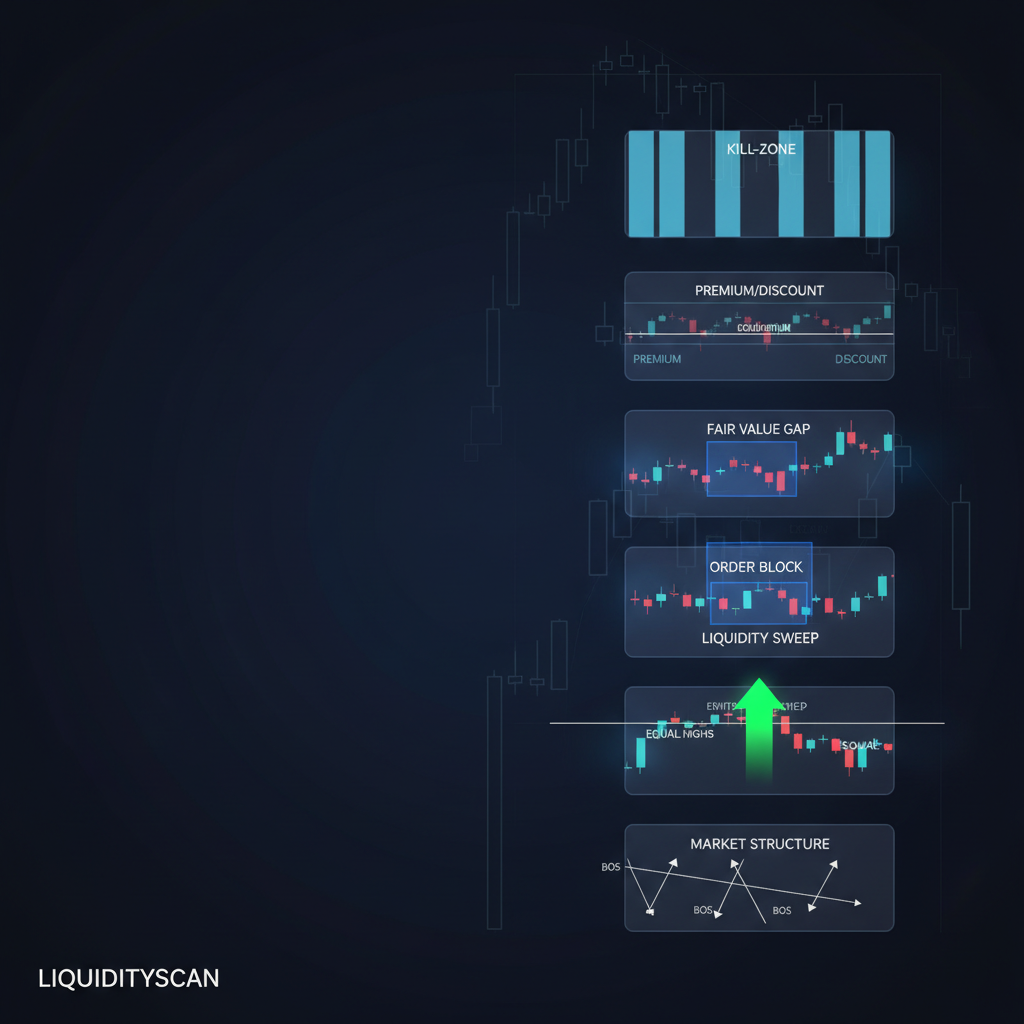
There is no single ICT book, and any listing sold as "the ICT book" is repackaged notes from someone else's coursework. Michael J. Huddleston (the Inner Circle Trader) has always taught through free YouTube video mentorships, not published texts. So the real path is not a reading list — it's a concept sequence you learn in a deliberate order, using his own material as the primary source and your chart as the workbook.
Below is the order that works, why each layer comes when it does, and how to structure the self-study so it compounds instead of scattering.
Why there's no official ICT book
ICT is a video curriculum, not a publication. The concepts evolve — the 2016 Core Content, the 2022 mentorship, and the later model refinements are teaching iterations, not editions of a book. A static text can't capture a methodology that gets revised as its author refines it, which is exactly why no authoritative print version exists.
That evolution is also why third-party ebooks and PDFs are risky. They freeze one snapshot of the material, often misattribute definitions, and skip the reasoning that makes a concept usable. When someone charges you for "the ICT PDF," you're paying for a lossy copy of something the source published for free.
The upside: the primary material is accessible to anyone. Your job is to impose structure on it, because the free content was released over years and isn't pre-sequenced for a beginner.
The concept sequence to learn in order
Learn these five layers in sequence, because each one depends on the layer beneath it. Skipping ahead to entry models before you can read structure is the single most common reason traders stall.
- Market structure — swing highs and lows, break of structure, change of character. This is the grammar of everything else. Until you can mark a trend's skeleton on any timeframe, nothing above it will read cleanly.
- Liquidity — buy-side and sell-side pools, equal highs/lows, stop hunts, inducement. Once structure makes sense, liquidity explains why price reaches for certain levels before reversing.
- PD arrays (premium/discount) — fair value gaps, order blocks, breakers, the dealing range and its equilibrium. These are the specific price levels ICT trades from, and they only make sense once you know what liquidity they're reacting to.
- Time — kill zones, macros, session behavior, killzone-to-model timing. Price levels without time context fire too often; time filters the same PD arrays down to the windows that matter.
- Models — Silver Bullet, the 2022 model, OTE entries, Power of 3. A model is just the four layers above assembled into a repeatable checklist. Build it last, from parts you already understand.
The ordering is not arbitrary. Structure defines direction, liquidity defines targets and traps, PD arrays define entries, time defines when, and models package it. Reverse the order and you get traders who memorize a Silver Bullet checklist but can't tell whether the higher-timeframe draw supports the trade.
How long each layer takes
| Layer | Realistic time | You're ready to move on when… |
|---|---|---|
| Market structure | 2–3 weeks | You mark BOS/CHoCH the same way twice on any chart. |
| Liquidity | 2–3 weeks | You can point to the draw before a move happens. |
| PD arrays | 3–4 weeks | You validate an order block or FVG without second-guessing. |
| Time | 2 weeks | You know your kill zones cold, in your own timezone. |
| Models | Ongoing | You can run one model mechanically for 20+ backtested trades. |
The official ICT resources worth your time
Use the primary source first, everything else second. The material that actually matters is free and comes straight from ICT.
- The ICT YouTube channel — the 2016 Core Content playlist and the 2022 Mentorship are the backbone. Watch in playlist order, not by cherry-picking topics that sound interesting.
- ICT's own X/Twitter posts and livestreams — where later refinements and current thinking appear before anything else.
- Your charting platform — TradingView or similar, because ICT is a screen-time skill. Every concept must be marked on live and historical charts, not just watched.
Community-made summaries, notion docs, and cheat sheets are fine as review tools once you understand a concept. They are terrible as first exposure, because a one-line definition of "order block" strips out the order-flow logic that makes it tradeable. Learn from the source, consolidate with the notes.
Treat every third-party ICT product as a study aid, never a substitute. If a resource contradicts the original mentorship, the original wins.
How to structure your self-study
Pair every concept with immediate charting and a written record. Passive watching produces recognition, not skill; the gap between "I've seen that" and "I can trade that" is closed only by repetition on your own charts.
A practical weekly loop:
- Watch one concept from the current layer — a single video, not a binge.
- Mark 10 historical examples of it on charts before moving on. Screenshot each.
- Forward-test it for a few sessions with no money on the line, logging what you see.
- Journal the misses — where your marking was wrong tells you what the video didn't land.
- Only then advance to the next concept in the layer.
Don't collect concepts you can't yet use. A trader who has genuinely mastered market structure and liquidity outperforms one who has "watched everything" and can execute nothing. Depth over coverage, every time.
Frequently Asked Questions
Is there an official ICT book to buy?
No. ICT is taught through free video mentorships on YouTube, not any published book. Listings marketed as "the ICT book" are unofficial third-party compilations, and they freeze one snapshot of a methodology that keeps evolving.
What should a complete beginner start with?
Market structure — swing points, break of structure, and change of character. It's the grammar every other ICT concept is written in, so nothing above it reads cleanly until this is automatic for you.
Are paid ICT courses on other sites worth it?
Rarely as a first source, since they repackage free material. If a paid product genuinely saves you sequencing time or adds structured practice, treat it as a study aid layered on top of the original mentorships — not a replacement for them.
Related query paths
Once you know the sequence, these are the natural next stops, layer by layer.
- The Definitive Guide to ICT Trading (Inner Circle Trader) — the full methodology overview to frame everything below.
- What Is Market Structure in ICT? — start here; it's the first layer of the sequence.
- What Are Smart Money Concepts? A Trader's Guide to Order Flow — the liquidity and order-flow logic underneath every PD array.
- How to Build a Complete ICT Trading Model (Step-by-Step) — the final layer: assembling the parts into a checklist.
- Evolution of ICT Concepts: A Timeline of Key Models — why no static book captures a methodology that keeps changing.
- ICT vs Traditional Technical Analysis: A Trader's Guide