
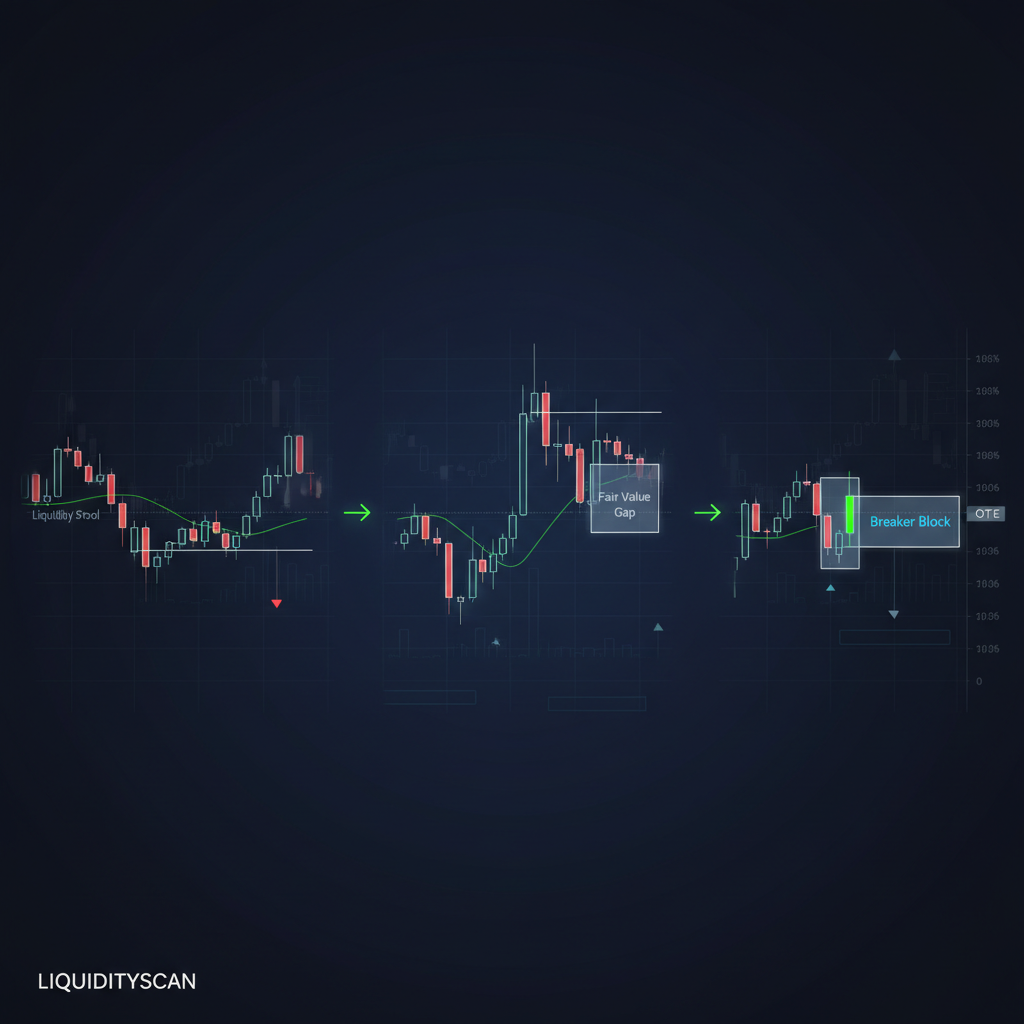
ICT's teaching evolved from a loose collection of liquidity and price-delivery ideas into strict, sequenced entry models. The early years gave traders the vocabulary — order blocks, fair value gaps, liquidity pools, optimal trade entry. The 2022 model turned that vocabulary into a checklist. The 2024 model then trimmed the checklist down to intent. Each stage exists because the previous one left traders guessing at something.
Here's the arc, and what problem each milestone actually fixed.
The early foundations gave traders a language for institutional order flow
The first wave of ICT material solved a naming problem. Retail traders had support, resistance, and trendlines — tools that described where price had been, not where liquidity sat. ICT reframed the chart around who gets filled and where stops rest.
Four ideas anchored this era:
- Market structure — reading higher highs and lower lows as the footprint of a trend, later formalized into BOS and CHoCH.
- Liquidity pools — the clusters of stops above old highs and below old lows that price is drawn toward.
- Order blocks — the last opposing candle before a strong move, marking where institutions likely positioned.
- Fair value gaps — the imbalance left by displacement, a zone price tends to revisit.
- Optimal trade entry — the 62–79% retracement band for entering with the trend at a discount or premium.
The gain here was conceptual, not mechanical. You could now describe why a level mattered. What you couldn't do reliably was know when to pull the trigger — two traders looking at the same chart would pick different order blocks and both call it ICT.
The 2022 model turned scattered concepts into a repeatable sequence
The 2022 model solved the discretion problem. Instead of asking "which order block?", it imposed an order of operations that a trader could follow the same way every session.
The sequence is three steps:
- Liquidity sweep — price runs a clear high or low, taking out stops.
- Market structure shift with displacement — a decisive move back through structure, leaving an imbalance behind. The displacement is the tell that intent changed.
- FVG entry — you enter on the retracement into the fair value gap created by that displacement, with the stop beyond the sweep.
This was the turning point for most traders. The model gave a clean invalidation (the swept extreme), a defined entry (the gap), and a reason to skip setups that didn't complete the sequence. It converted ICT from a worldview into a checklist you could backtest. The cost: it can be mechanical to a fault, firing on sweeps that lacked real displacement, so quality filters still matter.
The refinements added time, cycles, and a delivery engine
The mid-cycle refinements solved a "when" problem the 2022 model mostly ignored. A valid sequence at 3am behaves differently than the same sequence during a kill zone. Several concepts layered timing and context on top of the mechanics:
- Silver Bullet — a fixed one-hour window (like 10–11am New York) where the sweep-shift-FVG sequence is most reliable, removing the "trade all day" trap.
- Power of Three (AMD) — accumulation, manipulation, distribution as the daily shape, telling you which part of the move you're in.
- Quarterly Theory — the idea that time itself delivers in repeating quarters, giving structure to sessions and weeks.
- IPDA — the price delivery algorithm framing, treating the market as a system that engineers liquidity and rebalances gaps on schedule.
The information gain was context. The same setup now carried a probability weighting based on time and cycle, which is why "time and price" became the recurring phrase. This is also where ICT started rewarding patience over frequency.
The 2024 model stripped the sequence back to intent
The 2024 model solved an over-fitting problem. Traders had stacked so many confluences — order block plus FVG plus breaker plus OTE plus session — that many froze, waiting for a perfect alignment that rarely came.
The 2024 refinements lean harder on displacement and the immediate reaction to a liquidity raid, with cleaner definitions of what actually counts as a valid entry. Less rectangle-drawing, more reading whether price rejected a level with force. For a full side-by-side, the difference between the two models comes down to how much confirmation you demand before entering.
The through-line across every era: ICT keeps compressing the same core idea — liquidity gets taken, then price reprices through an imbalance — into fewer, sharper decisions.
A compact timeline of ICT's key milestones
| Era | Key concepts | Problem it solved |
|---|---|---|
| Foundations | Market structure, liquidity pools, order blocks, FVG, OTE | Gave traders a language for institutional order flow |
| 2022 model | Sweep → MSS/displacement → FVG entry | Removed entry discretion; made setups repeatable and testable |
| Refinements | Silver Bullet, PO3, Quarterly Theory, IPDA | Added time and cycle context to the mechanics |
| 2024 model | Displacement-led, tighter entry criteria | Cut over-confluence; refocused on intent and reaction |
How to use this timeline in your own trading
Pick one model and trade it whole before mixing eras. The 2022 sequence is the best starting point because its invalidation is unambiguous and it backtests cleanly. Once you've logged a few hundred of those, layer in timing from the refinements and let the 2024 emphasis on displacement sharpen your entry quality. Don't run all four eras at once — that's the confusion the 2024 model was built to remove.
Frequently Asked Questions
Is the 2022 model outdated now that the 2024 model exists?
No. The 2022 model is still the cleanest teaching framework and the easiest to backtest. The 2024 model refines entry criteria rather than replacing the sweep-shift-FVG logic, so most traders learn 2022 first and adopt 2024's displacement emphasis later.
Do I need to understand IPDA to trade ICT?
Not to start. IPDA is a mental model for why price delivers the way it does. You can trade the mechanical sequence without it, then use IPDA thinking to explain why certain sweeps and gaps behave predictably around time.
Which concept should an intermediate trader master first?
Displacement. It's the common thread across every era — it validates a market structure shift, creates the FVG you enter, and signals institutional intent. Get displacement right and most other concepts fall into place.
Related query paths
Follow these to go deeper on the milestones above.
- ICT 2022 Model vs 2024 Model: Key Differences — the direct comparison of the two models this timeline ends on.
- Displacement in ICT: Reading Institutional Intent — master the one concept that ties every era together.
- ICT Power of 3 (PO3): The AMD Cycle Explained — the accumulation-manipulation-distribution refinement in detail.
- ICT Quarterly Theory: Time-Based Market Cycles — how time-based delivery layers onto the mechanics.
- IPDA Explained: ICT's Price Delivery Algorithm — the delivery engine behind sweeps and gaps.
- How to Build a Complete ICT Trading Model (Step-by-Step) — assemble these eras into one model you can trade.
- ICT vs Traditional Technical Analysis: A Trader's Guide