
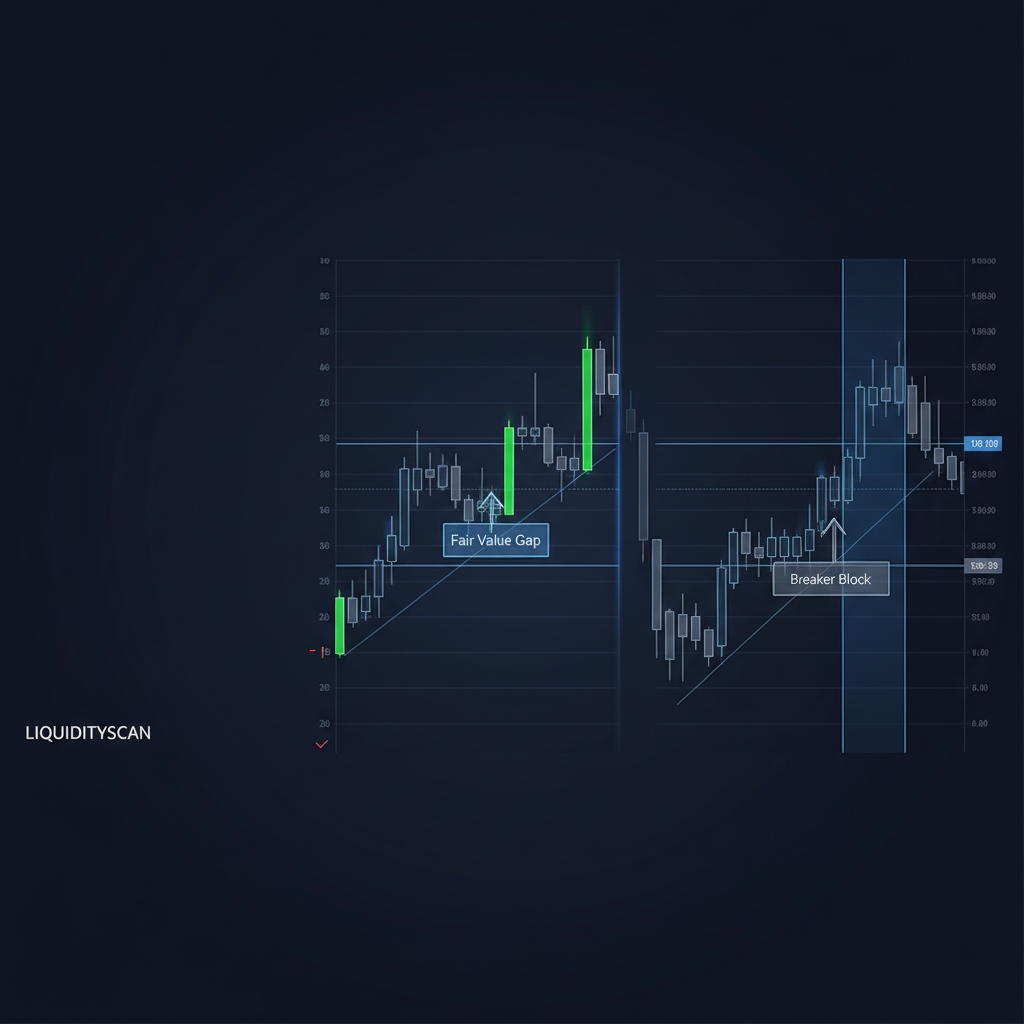
The primary difference between the ICT 2022 and 2024 models is that the 2024 model integrates specific, time-based macros and a refined set of Points of Interest (POIs) for entry, whereas the 2022 model offers a more universal framework based on a liquidity sweep, a market structure shift, and a subsequent entry on a Fair Value Gap. Understanding both, and when to deploy each, is more useful than picking a side.
Deconstructing the Classic: The ICT 2022 Model
The Core Sequence: Liquidity, Shift, Displacement, Entry
The 2022 Mentorship Model is a four-step sequence. First, price sweeps a key liquidity pool such as a session high or low. Second, a Market Structure Shift (MSS) confirms intent. Third, a sharp Displacement move creates a Fair Value Gap (FVG). Fourth, the entry triggers when price retraces into that FVG. It is elegant because it works in almost any market condition.
Anatomy of a 2022 Model Setup on EUR/USD
On EUR/USD, imagine price runs the prior session high, sweeping buy-side liquidity. It then breaks a short-term low with momentum, an MSS to the downside, leaving an FVG on the way down. Price rallies back into that gap, and the short triggers. Stop above the swept high, target the opposing liquidity below. Clean, repeatable, session-agnostic.
The Evolution: What's New in the ICT 2024 Model?
The Role of Time-Based Macros
The 2024 model refines the 2022 framework by requiring the setup to occur within specific, time-based windows known as macros, for example the 09:50–10:10 New York window. Instead of accepting a valid structure any time, it filters for the narrow minutes when institutional algorithms are most likely to deliver price, tightening the conditions for a qualified entry.
Refined Points of Interest Beyond the FVG
The 2024 approach also broadens the entry POIs. Beyond the classic FVG, it leans on Breaker Blocks and Balanced Price Ranges (BPRs) to confirm entries. These give the trader more precise objects to work with inside the macro window, which matters when moves are fast and the margin for error is small.
Side-by-Side Comparison: 2022 vs. 2024 Model
| Feature | 2022 Model | 2024 Model |
|---|---|---|
| Primary Trigger | Liquidity sweep of a key high or low | Liquidity sweep inside a defined time macro |
| Confirmation | Market Structure Shift with displacement | MSS within the macro window |
| Entry POI | Fair Value Gap | FVG, Breaker Block, or Balanced Price Range |
| Time Dependency | Low — works in most sessions | High — tied to specific macro windows |
Entry Triggers and Confirmations
Both models share the same DNA: sweep, shift, entry. The difference is the filter. The 2022 model qualifies a setup on structure alone. The 2024 model demands that the structure appears at the right minute, trading precision for a smaller number of higher-conviction opportunities.
Timeframes and Session Dependency
The 2022 model is comfortable across sessions and timeframes. The 2024 model is session-dependent by design, best suited to the New York Kill Zone and its macros, where institutional activity is known to spike, as reflected in official exchange activity documented on the CME Group trading hours page.
Practical Application: How to Trade Each Model
Identifying a 2022 Model in Real-Time
Mark your liquidity levels and higher timeframe bias before the session. When price sweeps a level and breaks structure with displacement, drop to your entry timeframe, find the FVG, and set your order. The absence of a time constraint means you can take the setup whenever it forms cleanly.
Executing a 2024 Macro-Based Entry
For the 2024 model, first mark the macro window. As it opens, watch for the sweep and MSS to occur inside those minutes. Then choose your POI, an FVG, breaker, or BPR, and execute. If the sequence completes outside the window, you pass. The discipline of the clock is the entire point.
The practical trap with the 2024 model is impatience. Because the macro window is short, traders feel pressure to take something, anything, before it closes. That urgency is exactly what the model is meant to protect you from. A macro that produces no clean sweep and shift is a macro you skip. Missing a window costs nothing; forcing a low-quality entry inside one costs real capital. Treat the empty macro as a successful outcome, because avoiding a bad trade is itself a form of edge.
Is the 2022 ICT Model Still Valid in 2024?
Yes. The 2022 model remains a core, valid, and highly effective framework for analyzing price action. Nothing about the 2024 refinement invalidates the sweep–shift–FVG logic that made the original so durable. Traders who abandoned it chasing the newest label often gave up a reliable edge for a narrower one they had not yet mastered. ICT's own material, published on the Inner Circle Trader channel, frames the newer concepts as additions to the same foundation.
Which Model Should You Use? A Decision Framework
Use the 2022 model as your all-purpose default for reading any session and timeframe. Reach for the 2024 macro model when you are specifically trading a high-activity window like the New York AM session and want maximum precision. A simple way to decide in real time: if you are analyzing price outside a defined macro, you are in 2022-model territory and should judge the setup on structure alone. If the clock has entered a macro and the higher timeframe bias is clear, you can hold the 2024 model to its stricter, time-boxed standard.
In short, the 2024 model is an enhancement for specific scenarios, not a replacement. Keep the robust framework as your base, and layer the time-sensitive refinement on top when the moment calls for it. Mastering the 2022 sequence first is what makes the 2024 macros usable at all, because every 2024 entry is still, at its core, a sweep, a shift, and a return to a point of interest.
Related query paths
To place both models inside a complete plan and master the timing they depend on, continue here:
- The Ultimate ICT Trading Strategy Framework for Professionals — see where entry models fit into the whole plan.
- ICT Macro Times: A Deep Dive into the 20-Minute Windows — master the time element central to the 2024 model.
- ICT Silver Bullet: 10am vs 3am Session Differences Explained — another example of time-specific ICT setups.
- Evolution of ICT Concepts: A Timeline of Key Models