
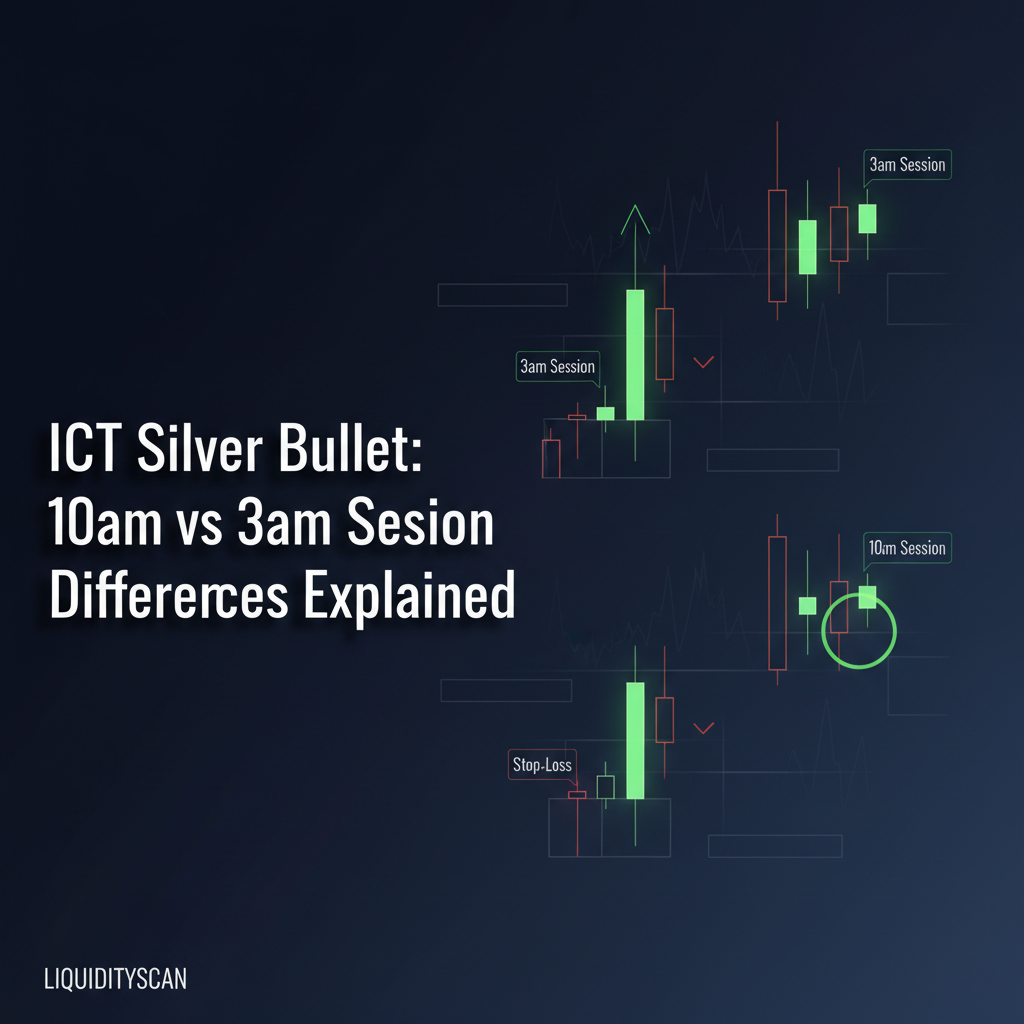
The 3 AM London Silver Bullet is usually a reversal that hunts Asian session liquidity. The 10 AM New York setup is a different animal: a high-velocity continuation of the trend London already put in motion. Get that distinction wrong and you'll trade both windows the same way and bleed on one of them.
The Silver Bullet Framework: A Quick Recap
Before we pit the sessions against each other, let's agree on what the model actually is. The ICT Silver Bullet isn't "any trade inside a magic hour." It demands a specific sequence: a clean raid on a short-term liquidity pool, an energetic displacement back the other way that leaves a Fair Value Gap behind, and then an entry inside that FVG. That's it. No sweep, no displacement, no trade. The setup only lives inside the 60-minute windows of 3-4 AM, 10-11 AM, and 2-3 PM New York local time, and these sit on top of a wider kill zone framework that tells you which window to even bother watching. Here we're zeroing in on the two busiest: the London open and the NY morning.
The 3 AM London Silver Bullet: Reversal and the Judas Swing
The London Kill Zone has one job: engineer liquidity. After the Asian session drifts sideways for hours, London arrives looking to raid the highs or lows of that prior range. The 3 AM Silver Bullet is often how it does the dirty work, and it tends to show up as a reversal.
Picture the Judas Swing. Price first lurches against the direction it actually wants to go, sweeping stops and dragging traders onto the wrong side of the book. Say EUR/USD has a bullish daily bias. The 3 AM window might open with a sharp drop that clears the Asian session low. That sweep is component one. If the rally back up displaces with real intent, it carves the FVG that hands you a high-probability long. Your target is the opposing pool, here the Asian session high. This bait-then-reverse move is close cousin to the patterns covered in our Judas Swing vs Turtle Soup breakdown, and recognizing which one you're looking at changes where you place the stop.
The numbers back up why London behaves this way. The Bank for International Settlements (BIS) Triennial Survey has shown for years that London is the deepest FX liquidity pool on the planet, carrying the largest turnover of any session. That kind of volume is exactly what's needed to run large-scale stop hunts and fuel a genuine reversal ahead of the New York open. The moves feel deliberate, almost slow at times, like price is being built rather than discovered before the real trend shows its hand.
The 10 AM New York Silver Bullet: Continuation and Velocity
If London sets the board, New York plays the checkmate. The 10 AM Silver Bullet usually extends the move London already started. By 10 AM the intraday trend is normally on the table, and the 10-11 AM window gives algorithms a clean spot to re-accumulate or re-distribute at a better price before driving toward the daily range objective.
The liquidity target shifts too. Instead of reaching back for the whole Asian range, the 10 AM setup goes after closer fuel: the high or low of the first NY hour, or a pullback level left over from the London leg. Take NAS100. London drives price higher and stamps a clear bullish order flow. The 10 AM window then prints a small, sharp pullback that snaps a recent 15-minute low, and an explosive displacement carries the move on up. That displacement FVG is your entry. Reading whether the sweep is a genuine liquidity grab or just chop is the whole game in this window.
Velocity is the real separator. The overlap with the US equity open dumps volume and volatility into the tape, and as CME Group has noted, session overlaps are the periods of peak liquidity and price movement. Displacements come faster and meaner than anything London serves up. Entries have to be precise, because that FVG can fill and get left behind inside one or two candles. Blink and the trade is gone.
| Feature | 3 AM London Silver Bullet | 10 AM New York Silver Bullet |
|---|---|---|
| Typical Narrative | Reversal of Asia session trend | Continuation of London session trend |
| Primary Liquidity Target | Asia session high or low | London session or early NY session liquidity |
| Character of Displacement | Deliberate, methodical | Fast, aggressive, high-velocity |
| Common Instruments | FX Majors (EUR/USD, GBP/USD) | US Indices (ES, NQ), Commodities, FX Majors |
| Preceding Condition | Consolidation during Asia | Clear directional bias from London |
Context Is Not Optional: Higher Timeframes and Price Arrays
This is where most traders blow themselves up. They hunt the pattern off the clock alone and ignore the structure around it. A Silver Bullet is only ever as good as the context it forms in. Time is the last filter you apply, not the first.
Before I even glance at a 3 AM setup, I'm on the 4H and Daily. Where does price sit in the broader premium/discount array? A bullish 3 AM Silver Bullet sweeping the Asia low is a far stronger trade if price is sitting inside a Daily FVG and a 4H discount zone. Flip that, with price pressing into the top of a 4H premium, and it's a low-probability setup no matter how textbook it looks on the 5-minute. The chart can lie to you at low timeframes; the array rarely does.
Same rule for the 10 AM window. I've watched plenty of traders try to long a 10 AM bullish Silver Bullet on NQ after London already shoved price into a major Daily bearish order block. Sure, it might scalp 20 points, but you're leaning into institutional order flow and the reversal risk is brutal. The continuation story only holds when there's still a higher-timeframe objective left to reach. These windows are one piece of the wider system of ICT Macro Times that algorithms run on, but they always bow to the higher-timeframe PD array.
In the end, which session suits you comes down to your style and the narrative you read best. The 3 AM reversal rewards patience and a clear grip on the broader liquidity story. The 10 AM continuation rewards fast hands and proof that the trend still has somewhere to go. The LiquidityScan scanner surfaces the moving parts, displacement, FVGs, and liquidity sweeps, in real time, but the call is still yours: synthesize that data with the higher-timeframe context. Skip that step and you're just trading the clock, and the clock on its own is a terrible indicator.