
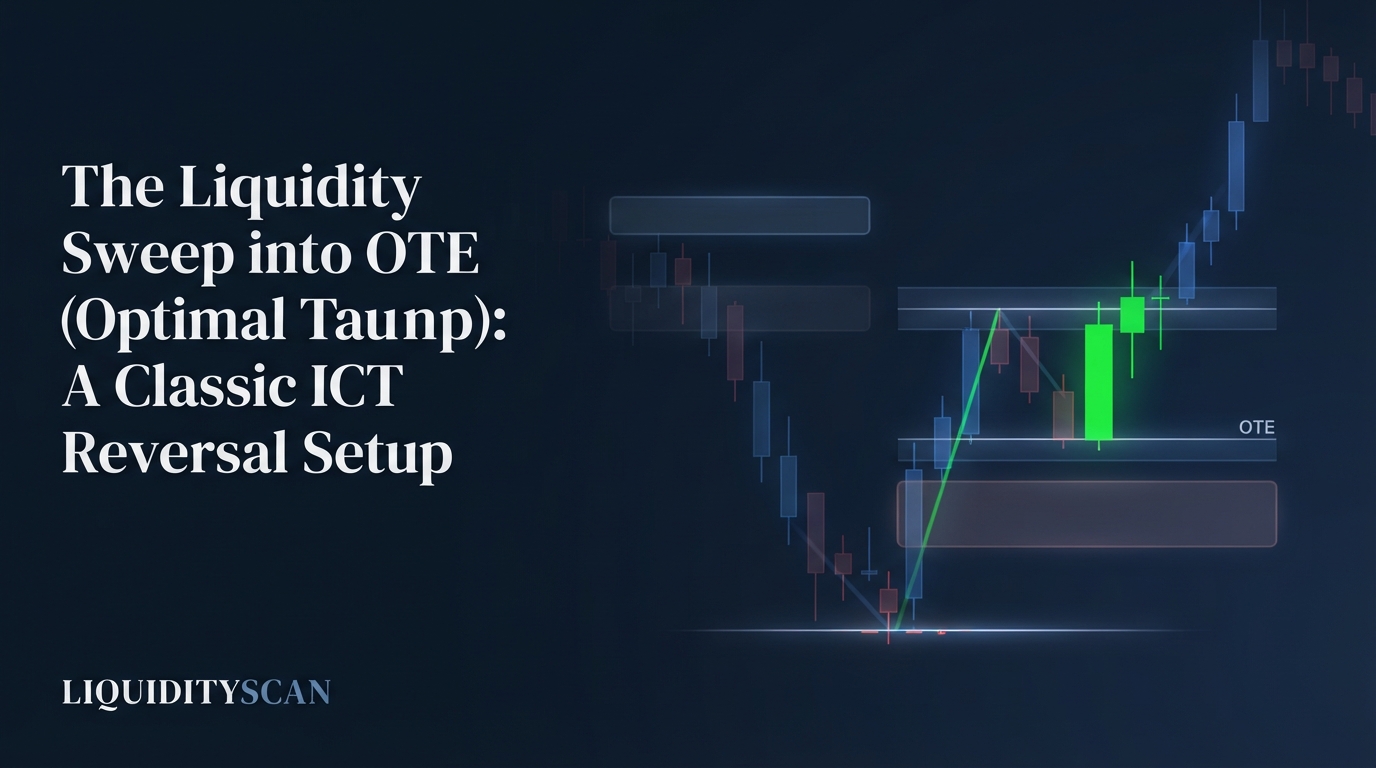
What Is the Liquidity Sweep into OTE Setup?
The liquidity sweep OTE setup is a reversal entry where price sweeps a liquidity pool (running stops beyond a swing high or low), reverses, and then retraces into the 62-79% Optimal Trade Entry (OTE) zone of the resulting impulse leg. You enter in that zone, place your stop beyond the swept extreme, and target the opposing pool.
It combines two of the strongest concepts in the ICT toolkit. The Liquidity Sweep gives you the reason price should reverse and a hard invalidation point. The OTE gives you a precise, discounted entry into the new direction. Together they produce a defined-risk trade with a favorable reward profile.
The setup is directional and mechanical. It works on any market and timeframe, but it is cleanest when the sweep occurs at a session extreme during a kill zone, and when the retracement is into a genuine premium (for shorts) or discount (for longs) relative to the impulse leg.
Why the Sweep-into-OTE Setup Works
Two mechanisms make this liquidity sweep OTE setup reliable enough to build a playbook around. The first is liquidity. Resting orders (stop-losses and breakout entries) cluster just beyond obvious swing points and equal highs/lows. Price is drawn to those pools because they are the fuel large participants need to fill size. The sweep is that fill event.
Once the pool is taken, the immediate reason to keep pushing in that direction is gone. If the move reverses hard off the sweep, it signals the run was engineered rather than a real breakout. That reversal is the impulse leg, and it defines the range you will measure your Fibonacci against.
The second mechanism is location. The OTE band (roughly the 62-79% retracement, with the 0.705 level as the sweet spot) places your entry deep inside the discount or premium of that leg.
You are not chasing; you are buying low within the new bullish leg or selling high within the new bearish leg. Deep entry plus a target at the opposite pool is what produces the high reward-to-risk.
The sweep also hands you a clean invalidation. If the reversal is real, price should not revisit the swept extreme. That extreme becomes your line in the sand, so your stop is defined by structure rather than a guess.
Does the edge hold up? Honest answer: results vary by regime, timeframe, and how strictly you filter. Published community backtests of sweep-plus-OTE reversals tend to land in a broad, illustrative 40-60% win-rate band, with the higher end reserved for setups that also require an MSS and kill-zone timing.
The reason the range is wide is that a loosely defined sweep (any wick) behaves very differently from a strict sweep (wick plus reclaim plus displacement). Rather than trust any single figure, log every trade with screenshots and grade your own hit rate by confluence tier; the setup only pays when your reward-to-risk covers your true win rate.
How to Trade the Liquidity Sweep into OTE Setup Step by Step
The procedure is five steps. Do them in order and do not skip the reclaim; entering before the reclaim is the single most common way this setup fails.
1. Identify the HTF liquidity pool and draw on liquidity
On your higher timeframe, mark the obvious pools: prior session highs and lows, equal highs and equal lows, and clean swing points. Decide your Draw on Liquidity (which pool price is most likely reaching for next). This gives you bias.
If the draw is higher, you want the sweep to happen on a low; if the draw is lower, you want the sweep on a high.
2. Wait for the sweep and the reclaim
Let price run the pool. You need a wick through the level followed by a close back inside the range on your entry timeframe. The wick is the stop hunt; the reclaim (close back inside) is confirmation that the level rejected. No reclaim, no trade. A candle that closes beyond the level is a break, not a sweep.
3. Mark the impulse leg away from the sweep
From the exact swept extreme (the wick low or high) to the swing point where the reversal move stalls, define your impulse leg. This leg must show intent. A weak, overlapping drift back is not an impulse and does not qualify. Clean Displacement away from the sweep is what you want to see.
4. Draw the OTE Fibonacci on that leg
Anchor the Fibonacci from the sweep extreme (0%) to the leg's high or low (100%). The OTE zone is the 62-79% retracement of that leg, with 0.705 as the focal level.
For a bullish leg (sweep of a low), the OTE sits below current price as a discount buy zone. For a bearish leg (sweep of a high), it sits above as a premium sell zone.
5. Enter in the OTE, stop beyond the sweep, target the opposing pool
Place your entry inside the 62-79% band. Set your stop just beyond the swept wick extreme, not at the edge of the OTE. Target the opposing liquidity pool identified in step one. This is what gives the liquidity sweep OTE setup its asymmetry: a tight structural stop against a distant, logical target.
A Worked Example with Levels
Assume EURUSD in the London kill zone. Sell-side liquidity rests under a prior low at 1.0800. Your HTF draw is higher, so you want a sweep of that low and a reversal up.
- Sweep: price wicks down to 1.0790, taking the stops below 1.0800, then closes back above 1.0800. The low is reclaimed.
- Impulse leg: price displaces up to 1.0850. Your leg is 1.0790 (0%) to 1.0850 (100%), a 60-pip leg.
- OTE zone: the 62-79% retracement of that leg falls between roughly 1.0803 (79%) and 1.0813 (62%), with 0.705 near 1.0808.
- Entry: 1.0808 at the 0.705 focal level, as price retraces down into the OTE band.
- Stop: 1.0788, two pips beyond the 1.0790 swept wick.
- Target: 1.0870, the opposing buy-side pool above.
That is roughly 20 pips of risk (1.0808 to 1.0788) for 62 pips of reward (1.0808 to 1.0870), about 3R to the first pool, and more if you trail toward a further HTF target. These are illustrative levels to show the geometry, not a signal.
The Confluence That Upgrades the Setup
A bare sweep-into-OTE is tradable. Stacking confluence is what turns it into an A+ setup. The more of the following that align at your entry, the higher the quality.
| Confluence factor | Why it upgrades the entry |
|---|---|
| Market Structure Shift after the sweep | A Market Structure Shift (MSS) confirms the reversal is structural, not just a wick. Trade the OTE of the MSS leg. |
| Order Block or FVG inside the OTE | An Order Block or Fair Value Gap (FVG) sitting within the 62-79% band gives a precise price to react to. |
| Kill-zone timing | A sweep during London or New York AM aligns with the windows where real moves originate. |
| Session extreme | A sweep of the session high or low often marks the day's turning point. |
| HTF premium/discount | The sweep happening in the correct half of the HTF dealing range adds directional weight. |
The ideal picture: a sweep at a session extreme inside a kill zone, an MSS confirming the turn, and an OB or FVG resting inside the OTE zone. When all five stack, you have the highest-conviction version of the liquidity sweep OTE setup.
Timing, Stop Placement, and R:R
Timing matters because liquidity is manufactured on a schedule. The sweep-into-OTE works best when the sweep happens in a kill zone or at a session extreme, where the market has just gathered the stops it needs. A sweep in the dead of a low-volume session is far less trustworthy and more likely to be a genuine trend continuation.
Stop placement is non-negotiable: it goes beyond the swept wick extreme, never inside the OTE. The whole thesis is that the reversal is real and price will not revisit that extreme. If you tuck the stop inside the OTE to save a few pips, a normal retracement inside your own entry zone will knock you out.
On reward-to-risk, the deep OTE entry plus a target at the opposing pool naturally produces high R. Because your stop is a fixed distance beyond the sweep while your target is a full range away, most valid setups offer 2R or better to the first pool.
Automated scanners such as LiquidityScan can flag fresh sweeps and OTE retracements in real time, so you spend your attention on the highest-quality candidates rather than watching charts all session.
Invalidation, Variations, and Common Mistakes
The setup is invalidated when the sweep is not a sweep. If price runs past the level and closes beyond it without reclaiming, that is a break and signals trend continuation, not reversal. No reclaim means no trade. Likewise, if price trades back through the swept extreme after you are in, the reversal thesis is dead and your stop should be hit.
The most common variation is the sweep to MSS to OTE sequence. Instead of measuring the raw reversal leg, you wait for price to break internal structure (the MSS), then draw your OTE on the MSS leg itself. This adds a confirmation step at the cost of a slightly later entry, and many traders prefer it for its lower failure rate.
A second variation nests timeframes: the sweep and draw are read on the 1H, but the OTE and stop are refined on the 5m for a tighter risk profile and a larger R multiple.
Three mistakes to avoid:
- Entering before the reclaim. Anticipating the sweep instead of waiting for the close back inside is how traders get run over by a real breakout.
- Drawing OTE on a leg with no narrative. An OTE means nothing without a sweep and a draw behind it. A Fibonacci on a random leg is just a retracement guess.
- Catching a falling knife. If there is no reclaim and no structure shift, you are not trading a reversal; you are hoping. Let the setup form.
Trade it with discipline and the liquidity sweep OTE setup gives you a repeatable, defined-risk reversal: the sweep supplies the liquidity and the invalidation, and the OTE supplies the precise, high-R entry into the new direction.
Frequently Asked Questions
What timeframe is best for the liquidity sweep OTE setup?
Use a top-down approach: mark liquidity pools and bias on a higher timeframe (4H or 1H), then execute the sweep, reclaim, and OTE on a lower timeframe (15m or 5m). The higher timeframe defines the draw and the pool; the lower timeframe gives you the precise entry and a tighter stop.
Where exactly do I enter within the OTE zone?
The 62-79% band is the zone; the 0.705 level is the classic sweet spot. If an Order Block or Fair Value Gap sits inside the band, enter at that array rather than a raw Fibonacci level. Prioritize a precise structural price over the exact percentage.
How is this different from a plain OTE entry?
A plain OTE is just a retracement into the 62-79% zone of any leg. The sweep-into-OTE requires a liquidity sweep and reclaim first, which supplies both the reversal narrative and the invalidation level. The sweep is what turns a generic Fibonacci entry into a high-probability reversal.
Do I need an MSS for the setup to be valid?
No, but it upgrades the trade. The base version is sweep, reclaim, impulse leg, OTE. Adding a Market Structure Shift after the sweep confirms the reversal is structural and lets you draw OTE on the MSS leg, which many traders find more reliable at the cost of a later entry.
Related query paths
Build the setup from its components, then deepen the entry mechanics and validation.
- What Is a Liquidity Sweep? — the sweep half of the setup, defined from first principles.
- OTE Explained: The ICT Optimal Trade Entry Zone — the 62-79% band and how to draw it correctly.
- Why Price Reverses After a Liquidity Sweep — the order-flow logic behind the reversal you are trading.
- Liquidity Sweep Then MSS: Reversal Guide — the sweep-to-MSS-to-OTE variation in full.
- OTE Optimal Trade Entry: The Institutional Model vs. Retail Fibs — why the OTE is more than a retail Fibonacci.
- Equilibrium vs OTE: The Right ICT Entry Level — choosing the right discount/premium level for entry.
- Confluence Trading: Combining Premium/Discount with FVGs and Order Blocks — a related angle on premium and discount confluence.
- what is a liquidity pool in ICT trading — Define liquidity pools before learning how sweeps trigger OTE reversals.