
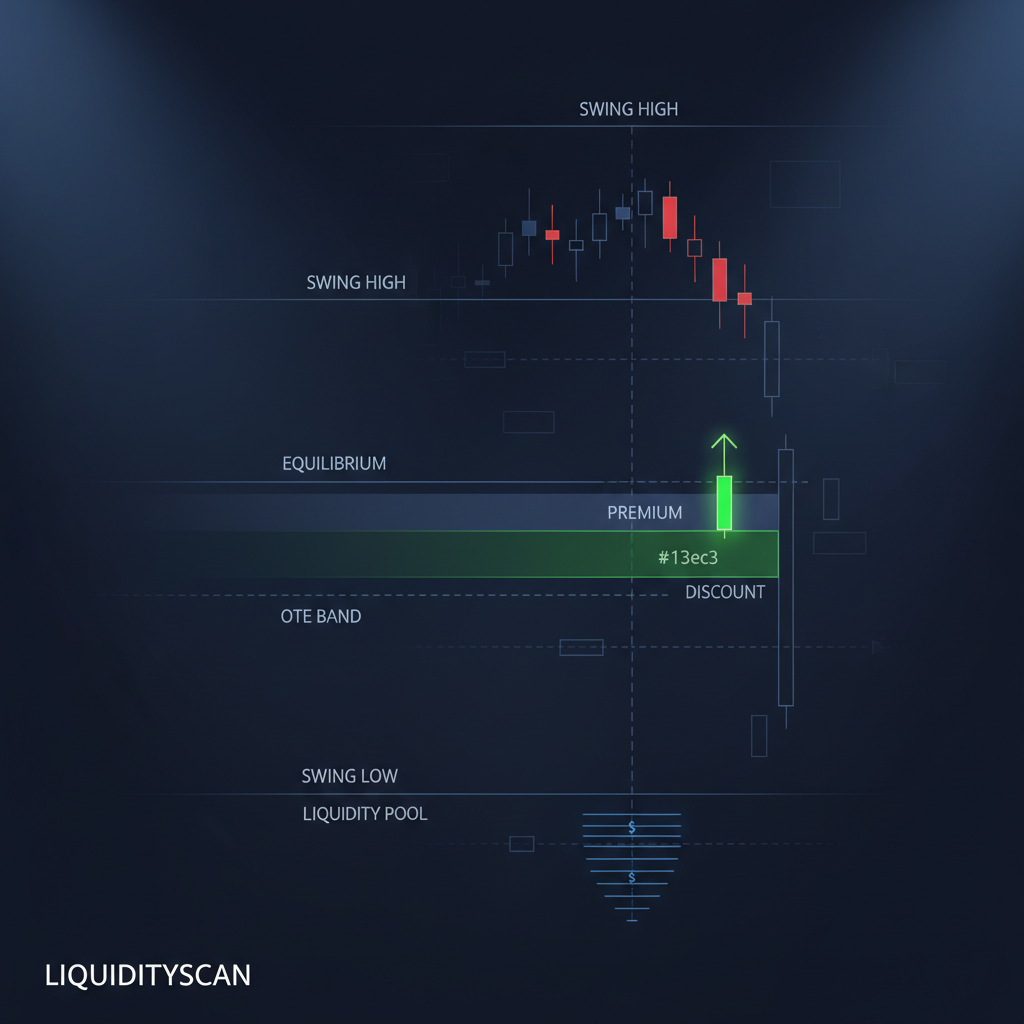
Enter at equilibrium (the 50% of a dealing range) when you're trading with strong displacement and want to catch the move before it extends. Enter in the OTE zone (the 62-79% retracement) when you want a deeper, cheaper fill with a tighter stop, and price is more likely to pull back further into discount. Both live inside the same dealing range. The choice comes down to trend strength, timeframe, and where liquidity is resting.
What equilibrium and OTE actually measure
Both levels are retracements of a single dealing range — the span from a confirmed swing high to a confirmed swing low. Draw a Fibonacci from the low to the high (or high to low for shorts), and the range splits cleanly.
Equilibrium is the 50% line. Above it, price trades at a premium; below it, at a discount. That's the whole premium/discount model in one mark. For a long, you want to be buying below equilibrium — in discount. For a short, selling above it, in premium.
OTE — Optimal Trade Entry — is a specific band deeper inside discount: the 62%, 70.5%, and 79% retracement levels. It sits past equilibrium, so an OTE entry is always in discount (for longs) by definition. The deeper fill buys you a smaller stop and a fatter reward-to-risk, at the cost of price sometimes never reaching it.
| Level | Retracement | Premium/discount | Trade-off |
|---|---|---|---|
| Equilibrium | 50% | The boundary | Fills more often, wider stop |
| OTE | 62-79% | Deep discount / premium | Tighter stop, may not fill |
The decision rule: trend, timeframe, liquidity
Use the deeper OTE when the market is ranging or the leg is weak; use equilibrium when displacement is strong and you can't afford to miss the move. Three inputs decide it.
Trend strength and displacement
Strong displacement — a violent, gap-leaving move away from a level — rarely retraces deep. Price that displaces hard often turns from the 50% or even shallower. If you insist on OTE there, you watch the trade leave without you. In those legs, equilibrium is the realistic entry.
Weak or grinding moves retrace deeper. When displacement is unconvincing and the leg looks corrective, price has room to pull back into the 62-79% band before continuing. That's OTE's home turf.
Timeframe
On higher timeframes, equilibrium of a large dealing range is often enough — the range is wide, so 50% is already a meaningful discount in absolute terms. On lower timeframes, where you're refining an entry inside a higher-timeframe zone, OTE gives you the precision to keep stops tight against a nearby structure point.
Where liquidity sits
This is the input most traders skip. Look at where the stops are resting before you pick a level.
- If there's a pool of liquidity (equal lows, a prior swing) sitting just below equilibrium, price will likely reach for it first. Don't buy the 50% — let the sweep run into OTE, then enter.
- If liquidity was already taken and equilibrium lines up with an order block or FVG, the 50% becomes a high-quality entry with confluence behind it.
- If the OTE band overlaps a point of interest — an order block, a fair value gap, a breaker — that alignment is what turns a Fib number into an actual setup.
A retracement level on its own is just a number. Both equilibrium and OTE earn their place only when they overlap a PD array and sit on the correct side of the liquidity draw.
A practical way to combine them
Treat equilibrium as the filter and OTE as the trigger. First, confirm price is on the right side of the 50% — you never want to be long in premium or short in discount. That's non-negotiable; it keeps you from buying tops.
Then, within discount, decide your entry precision. If a clean POI sits at OTE and liquidity below justifies a deeper pullback, wait for the 62-79% tap. If displacement is strong and the nearest POI sits right at equilibrium, take the 50% rather than hoping for a fill that may not come. Scaling is a middle path — a partial at equilibrium, a partial at OTE — but only when both levels carry their own confluence.
Equilibrium answers "is this even a valid side to trade?" OTE answers "where exactly do I press the button?" Ask them in that order.
Frequently Asked Questions
Is OTE always better than equilibrium?
No. OTE gives a tighter stop and better reward-to-risk, but strong displacement legs frequently reverse before reaching 62%, so the entry never fills. In fast, trending conditions equilibrium is often the only realistic entry you'll get.
Can equilibrium and OTE overlap?
Not on the same range — equilibrium is fixed at 50% and OTE starts at 62%. But equilibrium of a lower-timeframe range can sit inside the OTE zone of a higher-timeframe range. That nesting is exactly the multi-timeframe confluence worth waiting for.
Which Fib level in OTE should I actually use?
The 70.5% is the common midpoint, but let the point of interest decide. If an order block or FVG sits at 79%, use 79%; if it sits at 62%, use that. Anchor the entry to structure, not to a preferred number.
Related query paths
Sharpen the pieces this decision depends on.
- OTE Explained: The ICT Optimal Trade Entry Zone — full breakdown of the 62-79% band and how to draw it.
- PD Array ICT Explained: A Trader's Guide to Premium & Discount — the premium/discount logic equilibrium sits at the center of.
- Internal vs External Liquidity: An SMC Trader's Guide — read the liquidity draw before you pick a level.
- Displacement in ICT: Reading Institutional Intent — gauge trend strength to know how deep a retracement to expect.
- 3 High-Probability Order Block Entry Models — pair your Fib level with the POI that makes it a setup.
- How to Draw a Dealing Range in ICT (Correctly)