
What Is a Break of Structure (BOS) in ICT?
A Break of Structure (BOS) is an event where price moves decisively beyond a previously established swing high or swing low, signaling a potential continuation of the current trend. In an uptrend, a BOS occurs when price breaks and closes above a prior swing high. In a downtrend, it happens when price breaks and closes below a prior swing low. This concept is fundamental to reading institutional order flow and mapping out the market's intentions.
While traditional technical analysis acknowledges breakouts, the ICT framework refines this by demanding specific criteria to filter out false moves. A simple penetration of a level isn't enough. We need to see evidence of institutional capital being committed to the move.
The Anatomy of a Valid Break of Structure
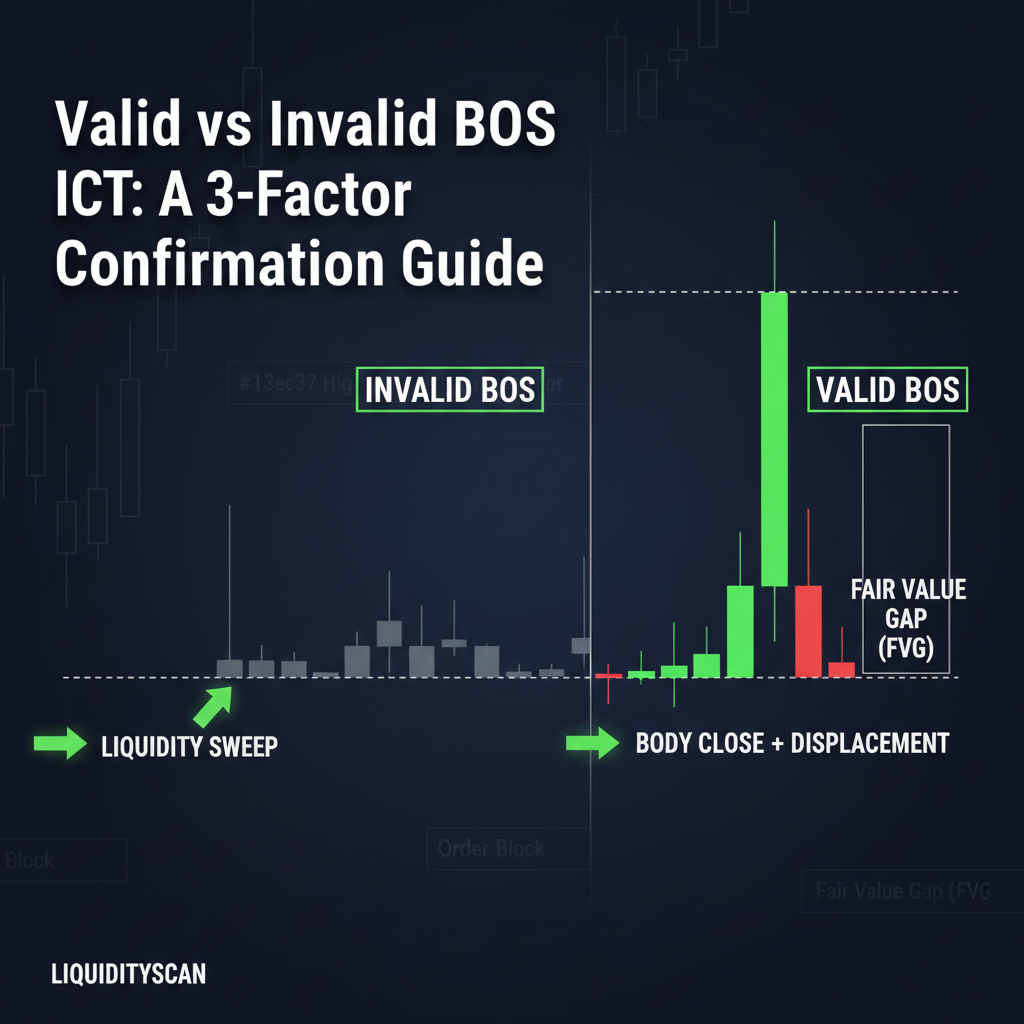
A valid Break of Structure is not a single event but a sequence of three distinct footprints left by smart money. To confidently identify a continuation move, you need to see a decisive candle body closure, confirmation through displacement, and the creation of a new Fair Value Gap. Without all three, you treat the move with suspicion.
Criterion 1: Decisive Candle Body Closure
The first and most critical filter is the candle body closure. The wick of a candle represents the full range of prices tested within that period, but the body represents where the market found consensus and value. A valid BOS requires the body of the candle to close firmly beyond the structural point. A break that only occurs with the wick is not a break of structure; it's a test of liquidity and should be treated as such.
Think of it as a battle. A wick pushing into new territory is just a scouting party. A body closing there is the army setting up a new camp. One is a probe, the other a commitment.
Criterion 2: Confirmation Through Displacement
Displacement is the signature of institutional force. It's an energetic, high-momentum price move characterized by one or more large-bodied candles that rapidly reprices the market from one level to another. A sluggish, overlapping move that grinds its way through a structural point lacks conviction.
A true BOS is powered by displacement. This energetic move shows that one side of the market has been overwhelmed, and large orders are being filled aggressively. This is not retail activity; it's the hallmark of banks and institutions executing their campaigns.
Criterion 3: The Role of a Post-Break Fair Value Gap (FVG)
The most reliable confirmation of displacement is the void it leaves behind: a Fair Value Gap (FVG). An FVG is a three-candle pattern where the impulsive move is so fast that it creates an inefficiency, or a gap, between the first and third candle's wicks. The formation of a clean FVG immediately after the breaking candle is the final seal of approval for a valid BOS.
This FVG serves a dual purpose. First, it confirms the displacement that powered the break. Second, it creates a new point of interest where price may return to rebalance before continuing the trend, often presenting a high-probability entry opportunity.
Identifying an Invalid Break of Structure (Liquidity Sweep)
An invalid BOS is a trap. It looks like a breakout, feels like a breakout, but is engineered precisely to do the opposite of what it signals. It's designed to take liquidity from unsuspecting traders before the real move begins. Conventional finance terms this a "fakeout," but in the ICT model, we see it as a targeted liquidity sweep.
The Telltale Sign: The Wick-Only Break
The most common characteristic of an invalid BOS is a wick piercing a key structural high or low, but the candle body fails to close beyond it. The candle may even close bearishly after wicking a high, or bullishly after wicking a low. This is a classic stop hunt, designed to trigger the stops of traders already positioned in the trend and to lure in breakout traders before reversing.
Understanding Intent: Stop Hunts vs. Continuation
Price has two jobs: to move efficiently to rebalance inefficiencies and to seek liquidity. A valid BOS is a function of the first job. An invalid BOS is a function of the second. Before institutions can initiate a large move, they must accumulate a significant position. The easiest way to do this is to run stops resting above old highs and below old lows. The invalid break is the mechanism for this liquidity grab, often seen as a Judas Swing during a key session like the London or New York Kill Zone.
Lack of Displacement and Follow-Through
After an invalid break, you will notice a distinct lack of momentum. There is no displacement, no FVG is created, and price often reverses sharply and attacks the opposing side of the structure. The move that swept the liquidity dies immediately because its purpose was fulfilled. Its job was not to start a new trend leg, but to fuel the reversal.
Chart Examples: Valid vs. Invalid BOS on EUR/USD (M15)
Theory is one thing, but seeing it on a chart is what matters. Let's look at two common scenarios on a EUR/USD 15-minute chart during the high-volume London session.
Example 1: A Confirmed Bullish BOS
Imagine EUR/USD has been consolidating. It forms a clear swing high at 1.08500. After a small pullback, price rallies towards this high. A single, large M15 bullish candle closes at 1.08580. The body of this candle is well above the 1.08500 high. This move leaves a clear FVG between 1.08510 and 1.08540. This is a textbook valid BOS. All three criteria are met: body closure, displacement, and an FVG. We can now anticipate a continuation higher, potentially using the FVG as a reference point for an entry.
Example 2: A Bearish Liquidity Sweep (Invalid BOS)
Now, consider a swing low at 1.08200. Price moves down and the wick of an M15 candle pierces this low, hitting 1.08180. However, by the time the candle closes, buying pressure has pushed the price back up, and the candle body closes at 1.08210, above the swing low. There is no displacement to the downside, and no FVG is formed below the low. This is an invalid BOS. It was a raid on the sell-side liquidity resting below 1.08200. The high-probability trade is now often a reversal to the upside, targeting the buy-side liquidity that was left untouched.
A Framework for Avoiding Fakeouts and False Signals
Distinguishing a valid from an invalid BOS is a skill that directly impacts your bottom line. It requires discipline and a systematic approach. Here's a simple framework to build that discipline.
Using Higher Timeframe Confluence
A break of structure on the M15 chart is infinitely more significant if it aligns with the order flow on the H1 or H4 timeframe. Before acting on an M15 BOS, zoom out. Is this break continuing the higher timeframe trend, or is it running into a higher timeframe order block or premium/discount array? Context is everything. A break that aligns across multiple timeframes carries far more weight.
Waiting for the Candle to Close
This is the simplest yet most difficult rule to follow. The fear of missing out can be overwhelming as you watch a candle push through a key level. But reacting to a live candle is gambling on its outcome. By patiently waiting for the candle to close, you trade based on confirmed information, not on speculation. This single habit will filter out the vast majority of invalid breaks.
Applying the 3-Factor Confirmation Model
Make it a checklist. Does the move have:
- A decisive candle body closure?
- Clear displacement?
- A resulting Fair Value Gap?
If the answer to all three is yes, you have a high-probability, valid Break of Structure. If any one of them is missing, you must assume it's a low-probability setup or a liquidity sweep until price proves otherwise. Once you've internalized this model, you can use tools like the LiquidityScan scanner to automatically find these high-grade setups across hundreds of markets, saving you hours of manual charting.
Frequently Asked Questions
What is the 3-bar break of structure rule?
The 3-bar break of structure is a simplified heuristic suggesting that a break is confirmed if the next two bars also close beyond the structural point. It's a way to gauge follow-through but is less precise than our 3-factor model, as it doesn't explicitly account for the critical elements of displacement and the resulting FVG, which are better indicators of institutional intent.
How do you confirm a structure break?
You confirm a structure break by verifying the presence of three key elements on a closed candle: a decisive candle body closure beyond the structural point, an energetic move known as displacement, and the creation of a Fair Value Gap (FVG) as a result of that displacement.
Does a CHoCH follow the same validation rules as a BOS?
Yes, the validation mechanics are identical. A Change of Character (CHoCH) is the first break of structure against the current trend, signaling a potential reversal. A BOS is a break of structure that continues the established trend. Both are breaks of a structural point, and both require the same 3-factor confirmation (body close, displacement, FVG) to be considered valid.
Can a valid BOS happen without an FVG?
While technically possible, a Break of Structure that does not create a Fair Value Gap should be viewed with extreme skepticism. The FVG is the direct evidence of displacement. Its absence suggests the move lacked the aggressive, one-sided order flow characteristic of a true institutional break. These setups are significantly lower probability and are often best avoided.
Related query paths
To deepen your understanding of market structure and institutional order flow, explore these related concepts in the order presented. Each builds on the last, from identifying key price levels to understanding the mechanics of price delivery.
- What Is an Order Block in ICT Trading? — Learn to identify the specific candle that institutions use to initiate moves that lead to a Break of Structure.
- What Is a Fair Value Gap (FVG) in Trading? — Master the key confirmation factor for a valid BOS and learn how to use it as a point of interest for entries.
- What Is a Liquidity Sweep in Trading? — Explore the anatomy of an invalid BOS to better understand how to avoid stop hunts and fakeouts.
- What is a CHoCH in Trading? — Understand the difference between a trend-continuing BOS and a trend-reversing CHoCH.