
What Is a Protected Swing High or Low in ICT?
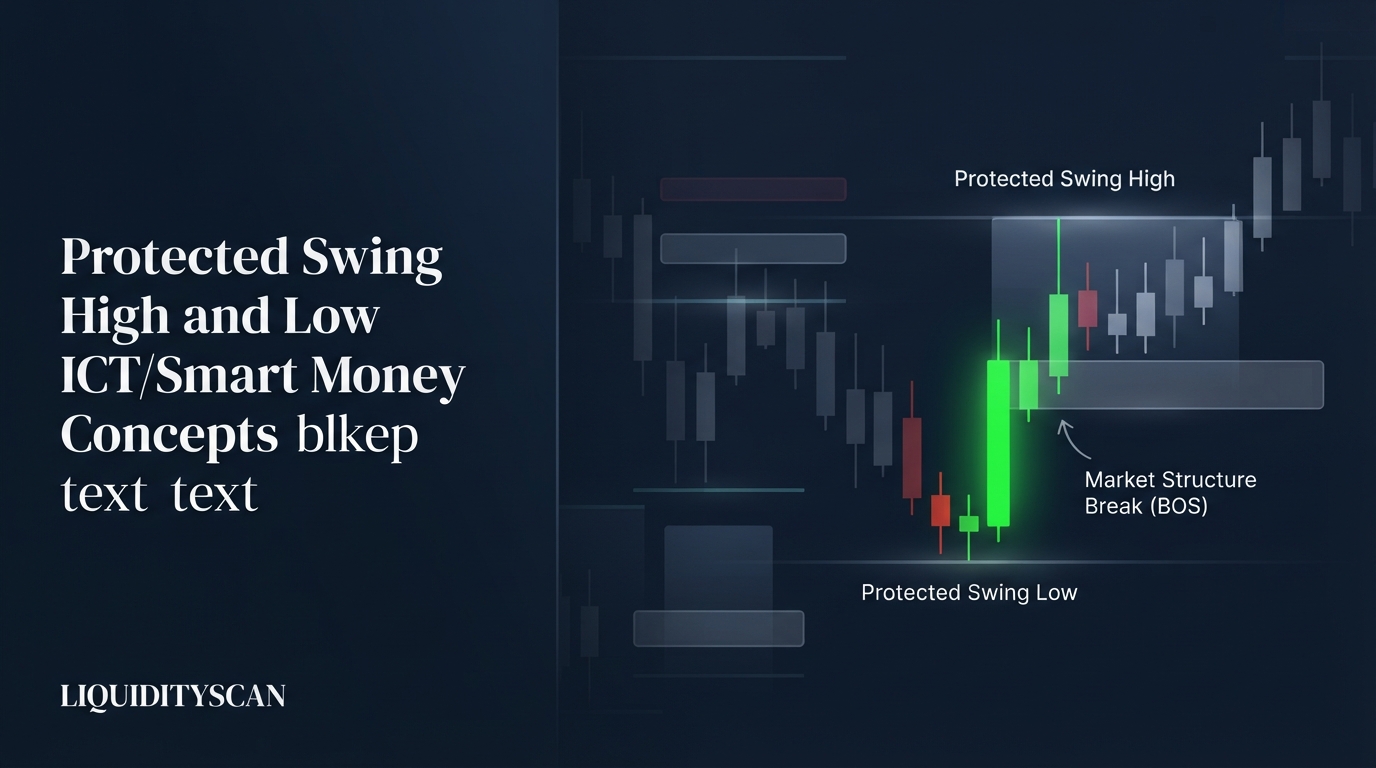
A protected swing high or low is the swing point that must hold for the current structural narrative to remain valid. In an uptrend, it is the low that swept liquidity and launched the displacement behind the most recent break of structure.
Every trend prints dozens of swing points, but they are not equal. Most are internal noise — minor pullback lows and reaction highs that price can trade through without changing anything about the larger delivery.
A protected swing is different: it is the origin of the move that broke structure. If price returns and trades through it, the break it produced is retroactively suspect, and the entire directional read has to be re-evaluated.
In ICT and Smart Money Concepts (SMC) vocabulary you will also hear this called a strong low or strong high. The terms describe the same object from two angles: “strong” describes how it formed (it took liquidity and caused displacement), while “protected” describes its role going forward (it is the level the current narrative depends on).
A protected low anchors bullish structure; a protected high anchors bearish structure.
The practical payoff is precision. Once you can name the protected swing on your trading timeframe, three decisions become mechanical: where the stop belongs, what invalidates the idea, and when the trend has genuinely reversed rather than merely pulled back.
How a Protected Swing Forms: Sweep Plus Displacement
A swing point earns protected status through a specific two-part sequence, not through size or visual prominence alone.
Part one: the liquidity event. Price trades below a prior low (in a bullish example), collecting sell-side liquidity — the sell stops of longs and the entries of breakout sellers resting under that low.
This matters mechanically: large participants need resting orders to fill against, because their size would otherwise move price against their own execution. The stop cluster below an obvious low is exactly that resting counterparty.
The scale of institutional flow is why these events exist at all — the BIS Triennial Survey puts daily FX turnover above $7 trillion, and orders of that magnitude cannot be filled at a single price without engineered liquidity.
Part two: displacement away. After the sweep, price does not drift back — it expands. One or more full-bodied candles drive away from the raided low, typically leaving a Fair Value Gap (FVG), and the expansion closes beyond a prior swing high, printing a Break of Structure (BOS) or, if the prior trend was bearish, a Change of Character (CHoCH).
The moment that break confirms, the low that originated the leg — the sweep extreme itself — becomes the protected swing low. Note what this excludes:
- A sweep with no displacement is just a lower low. Nothing is protected; the raid may simply be continuation.
- Displacement from a low that swept nothing produces a weaker anchor. Structure broke, but the origin lacks the liquidity signature, so many traders treat it as a lower-confidence protected swing.
- Minor pullback lows inside the leg are ordinary swings, no matter how clean they look.
Sweep plus displacement plus break — all three, in that order — is the formation rule.
Why “protected”? The institutional logic
The name encodes a hypothesis about who traded at that level and what they need afterward. If the sweep low is where large passive buyers absorbed the sell-side liquidity, then that price region is the cost basis of the position driving the current delivery.
Price returning through it would put that inventory underwater — so, under the hypothesis, it should be defended: re-accumulated on approach, not surrendered.
Be precise about what this does and does not claim. No desk is literally guarding a line on your chart. “Protected” is shorthand for a falsifiable statement: if institutional buying genuinely originated this move, price should not trade back through its origin.
When the level holds on a retest, the hypothesis survives and the retest is often the highest-quality entry in the trend. When the level is violated, the hypothesis is dead — you were not watching accumulation, or the campaign has been abandoned, and the honest response is to flip the read rather than defend it.
This is why protected swings outrank every other invalidation reference. An Order Block can be traded through and the trend can survive. An FVG can fill completely and the trend can survive. The protected swing cannot break with the narrative intact, because the narrative is, definitionally, “that low launched institutional delivery.”
Protected vs Ordinary Swing Points
The distinction drives every downstream decision, so it is worth stating side by side.
| Attribute | Protected swing | Ordinary swing |
|---|---|---|
| Formation | Swept liquidity, then displacement that broke structure | Any local high/low with reactions either side |
| Structural role | Anchors the current narrative; external structure | Internal structure; noise within the leg |
| Break meaning | Narrative invalidated — usually a CHoCH | Often nothing; can even be an entry (inducement) |
| Stop placement | Primary reference — stops belong beyond it | Poor reference — stops here feed the next sweep |
| Frequency | One per leg per timeframe | Many per leg |
| Expected behavior on retest | Absorption and continuation | Frequently violated by design |
The last row is the trap that costs retail traders the most. Ordinary swing lows are where stops accumulate — they are the fuel for the next liquidity raid, the mechanic behind inducement.
Placing a stop under a minor pullback low means volunteering for the sweep that forms the next protected swing. Placing it beyond the protected swing means the market must invalidate the entire structural read to take you out.
How to Identify the Protected Swing After Each BOS or CHoCH
Identification is a short backward trace from the most recent structural break. Run it fresh after every confirmed BOS or CHoCH on your timeframe.
Step 1: Anchor on the latest confirmed break
Find the most recent candle close beyond a legitimate swing high (bullish case) or swing low (bearish case). Wicks through the level do not count — a wick beyond a high with a close back inside is a sweep of that high, the opposite signal.
Confirm the swing being broken is a real fractal (a high with lower highs on both sides), not a micro pivot.
Step 2: Trace the leg that caused the break
Walk left from the breaking candle to the origin of that impulse — the point where the up-leg began. Ignore every minor pullback low inside the leg; you want the birthplace of the expansion, not waypoints along it.
Step 3: Verify the liquidity signature at the origin
Check what that origin low did. Did it trade below a prior low, equal lows, or a session extreme before the impulse launched? If yes, you have the full sweep-plus-displacement sequence and a textbook protected swing low.
If the origin swept nothing, it still functions as your structural invalidation, but grade the setup lower and consider deferring to the next timeframe up for your true anchor.
Step 4: Mark the extreme, wick included
The protected level is the absolute extreme of the origin — the wick low, not the candle body. Mark it as a horizontal level, not a zone. It remains the protected swing until either a new BOS in trend direction promotes a newer origin low, or price closes through it and the structure flips.
The most common mapping error is scale-mixing: taking a 5-minute origin low and treating it as protection for a 4-hour narrative. Each timeframe has its own protected swing, and the higher timeframe’s level always outranks the lower’s.
Tools that mark BOS and CHoCH mechanically — LiquidityScan’s market structure scanner does this across timeframes — remove most of the subjectivity from Step 1, which is where manual mapping usually goes wrong.
Using Protected Swings for Stops, Invalidation, and Trailing
The protected swing converts structure theory into three concrete risk rules.
Stop placement. The stop belongs beyond the protected swing plus a buffer for spread and noise — a few ticks on indices, a structure-scaled buffer such as 0.1–0.3 ATR on crypto. Not under the entry FVG, not under the nearest minor low.
Yes, this widens the stop versus an aggressive placement; compensate by reducing size to hold constant dollar risk, not by tucking the stop somewhere structurally meaningless. A stop that is cheaper but sits inside the sweep zone has negative expected value: it pays the full loss on moves that would have gone on to work.
Invalidation definition. Decide in advance — mechanically — what “broken” means for you: any tick through the level, or a candle body close through it. Tick-based is stricter and suits wick-heavy markets poorly; close-based tolerates deep sweeps but concedes more when wrong. Either rule beats deciding in the moment.
Whatever you choose, the protected swing is the trade’s invalidation, not just the chart’s: if it breaks, the reason you entered no longer exists.
Trailing structure. Trends advance as a chain of sweeps and breaks, and each new BOS promotes a new origin. The trailing rule falls out naturally: after each confirmed BOS, move the stop behind the newest protected swing low and retire the old one.
You are never trailing by a fixed distance or a moving average — you are trailing the market’s own invalidation level. This keeps you in trends through deep pullbacks (which routinely violate ordinary lows) while guaranteeing an exit the moment the structure that justified the position dies.
When a Protected Swing Breaks: The Failure Case
A genuine violation of the protected swing is the single most information-rich event in structure trading. In a bullish sequence, price closing through the protected low means the leg that broke structure has been fully unwound — the accumulation read was wrong or has been abandoned.
On most charts this is the Change of Character: internal lows breaking meant nothing, but the protected low breaking flips the external narrative from bullish to bearish in one event.
Two disciplined responses follow. First, exit and stand down — do not instantly reverse. A broken protected swing tells you the old narrative is dead; it does not yet give the new one an anchor.
Wait for the mirror sequence: a raid on buy-side liquidity above a recent high, displacement down, and a bearish break — which creates the first protected swing high of the new downtrend.
Second, watch the corpse of the old level. The failed protected low and the order block at its origin frequently become a Breaker Block — the zone where trapped longs exit on the retest and continuation sellers engage. The level’s importance survives its failure; only its polarity flips.
Distinguish violation from a sweep of the protected swing itself. Higher-timeframe players do run these levels: a wick through the protected low followed by an immediate, aggressive reclaim and displacement up is a liquidity grab against the obvious stops, not a structural failure — and it typically produces an even stronger protected low at the new extreme.
Your pre-committed tick-versus-close rule is what keeps this call honest in real time.
Worked Example: Trailing Protected Lows on BTCUSDT 4H
A concrete bullish sequence, level by level.
- Setup. BTCUSDT ranges after a decline. A 4H swing low sits at 62,850 with equal lows at 62,880 — visible sell-side liquidity. The last lower high of the downtrend is 63,900.
- Sweep. Price drops to 62,610, trading through both lows, then closes the 4H candle back at 62,940. Liquidity taken; nothing protected yet.
- Displacement and break. Two expansion candles drive to 64,150, closing decisively above 63,900 and leaving an FVG at 63,350–63,520. This close is a CHoCH — and it retroactively crowns 62,610 as the protected swing low. Invalidation for any long is now a close below 62,610.
- Retest entry. Price pulls back into the FVG at 63,420 — an ordinary internal low forms at 63,380. A long here risks roughly 810 points to the protected level (stop ~62,590 with buffer), not 40 points to the minor low.
- Second break. The leg from 63,380 extends to 65,240, closing above the 64,150 swing high left by the first expansion — a BOS. The origin of this breaking leg is 63,380, so the protected swing is promoted: retire 62,610, trail the stop to below 63,380.
- Resolution. If price later closes below 63,380, the bullish structure is invalidated — exit, expect a CHoCH, and wait for a protected high to form before considering shorts. If 63,380 merely wicks to 63,310 and displacement resumes upward, the sweep created a stronger low, and 63,310 becomes the new protection.
The pattern generalizes to any market and timeframe: one load-bearing level per leg, promoted with each break, and honored until price proves it wrong. Map the protected swing before you map anything else — every stop, invalidation, and trend-health judgment in an ICT model ultimately hangs on it.
Frequently Asked Questions
Is a protected swing the same as a strong low in SMC?
Functionally yes. “Strong low” (or strong high) describes the formation — the swing swept liquidity and produced the displacement that broke structure. “Protected” describes its ongoing role as the level current structure depends on. SMC content tends to say strong/weak; ICT-derived content says protected/unprotected. Both contrast with weak swings, which exist to be swept.
Can a protected swing be wicked without being invalidated?
Yes, if your invalidation rule is close-based. A wick through the protected low that immediately reclaims and displaces upward is a sweep of the protected swing — a stop hunt against obvious liquidity — and often strengthens the trend, minting a new protected low at the deeper extreme. Define tick-based or close-based invalidation before the trade, and apply it without exception.
Does every BOS create a new protected swing?
Every confirmed BOS promotes one: the origin low (or high) of the leg that produced the break becomes the new protected swing, replacing the previous one. The strength of that anchor varies, though — origins that swept clear liquidity pools are more reliable than origins that swept nothing, so grade each promotion rather than treating all equally.
Which timeframe should I take my protected swing from?
The timeframe that defines your trade. Structure is fractal: a 15-minute protected low can break while the 4-hour one holds comfortably. Use the higher-timeframe protected swing for directional bias and position invalidation, and lower-timeframe protected swings only for entry refinement and early-warning — never as the stop reference for a higher-timeframe idea.
Related query paths
Protected swings sit inside a larger structural toolkit — these are the logical next reads, from foundations to execution.
- What Is Market Structure in ICT? — the foundation: how swings, legs, and trends are defined before any level is “protected.”
- What is a Break of Structure (BOS)? — the event that crowns each protected swing; what counts as a valid break.
- BOS vs. CHoCH: The Definitive Guide for SMC Traders — continuation versus reversal breaks, and why a protected-swing violation is usually the CHoCH.
- Displacement in ICT: Reading Institutional Intent — the expansion signature that separates protected origins from ordinary lows.
- Liquidity Sweep Explained: The ICT Stop Hunt — the raid mechanics that create protected swings in the first place.
- The Institutional SMC Stop Loss and Take Profit Strategy — turning protected-swing invalidation into a complete stop and target framework.
- What Is a Swing High and Swing Low in ICT? The 3-Candle Rule — how it connects to swing high and swing low.