
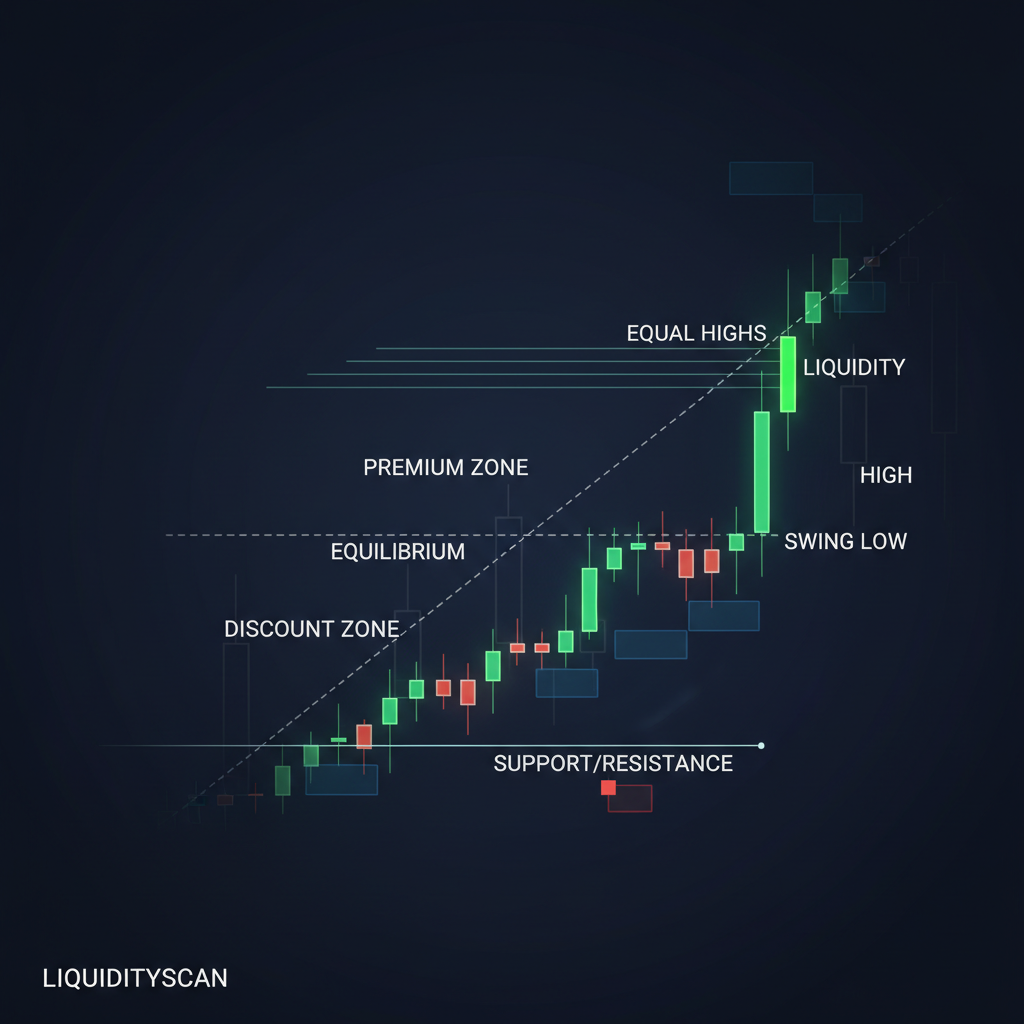
The short answer: support and resistance marks price levels where reactions happened before, and it assumes those levels will hold again because traders remember them. Premium and discount ignores memory entirely. It asks one question — is price expensive or cheap relative to the current dealing range — and answers it by measuring against the range's 50% equilibrium. Same chart, two different logics. One is reactive; the other is a valuation framework the algorithm actually delivers price through.
Support and resistance is a reactive horizontal level
Traditional S/R draws a line across a price where buyers or sellers previously stepped in. The reasoning is behavioral: enough participants remember the level, so orders cluster there and price reacts. It works often enough to feel real, and that is exactly the problem.
Because everyone can see the same horizontal line, stops pile up in the obvious place — just above resistance, just below support. That cluster is not a wall. It is fuel. Price is repeatedly pulled through visible S/R to reach the resting orders on the other side, then reverses. If your whole thesis is "short resistance," you are positioned exactly where the move is engineered to hunt you.
S/R also has no concept of expensive or cheap. A resistance line at 1.1050 is just a level. It tells you nothing about whether price is in the upper or lower half of the leg that produced it. You are trading a coordinate, not a valuation.
Premium and discount values price against the dealing range
Premium and discount starts by defining a dealing range — a meaningful swing low to swing high (or high to low) that frames the current move. Draw a Fibonacci or simple midpoint across it and you get the equilibrium at 50%.
Everything above equilibrium is premium: price is expensive, and it is the zone to look for shorts. Everything below is discount: price is cheap, the zone to look for longs. The framework is relative by design. The same price of 1.1050 is a sell in one dealing range and a buy in another, depending on where the range sits.
- Reference point: S/R references a past price. Premium/discount references the whole current range.
- Question answered: S/R asks "did price react here before?" Premium/discount asks "is price expensive or cheap right now?"
- The 50% line: equilibrium is the pivot of intent — the algorithm tends to deliver price away from it toward the opposite side.
This is why ICT treats the dealing range as tied to price delivery rather than crowd psychology. The range and its equilibrium are anchors the algorithm respects, not lines drawn from memory.
Why ICT sells premium into liquidity, not resistance
An ICT short is not "price hit resistance, so sell." It is "price is in premium, above a pool of buy-side liquidity has just been swept, and displacement confirms the turn — so sell the retracement back into a premium array." The trigger is the liquidity grab, not the level.
Picture equal highs sitting above the range. A retail S/R trader shorts as price approaches those highs and gets stopped when price spikes through them. The ICT trader waits for price to sweep those highs — running the stops — while sitting deep in premium, then sells the failure. The exact move that invalidates the S/R short is the ICT entry.
Resistance is where the crowd sells. Premium above swept liquidity is where the crowd's stops get taken. You want to be on the second side of that trade.
The distinction matters most on your target too. S/R aims at the next horizontal line. Premium/discount aims at the opposing liquidity — sell-side resting below the range, or the discount array on the other side of equilibrium. You are not trading to a level; you are trading from expensive to cheap, following where price is engineered to go.
Quick contrast
| Support & Resistance | Premium & Discount | |
|---|---|---|
| Logic | Horizontal price memory | Range-relative valuation |
| Anchor | A past reaction price | Dealing-range equilibrium (50%) |
| Sell signal | Price touches resistance | Premium + liquidity sweep + displacement |
| Stops sit | Just past the visible level | Framework treats those stops as the target |
| Target | Next horizontal level | Opposing liquidity across equilibrium |
Frequently Asked Questions
Can I use support and resistance and premium/discount together?
Yes, but reframe the S/R level as a liquidity indicator, not an entry signal. A resistance line tells you where stops rest. Premium/discount tells you whether price is expensive enough to sell that pool. Use the level to locate liquidity, use the range to decide if it is worth engaging.
How do I pick the right dealing range?
Use the most recent clear swing that price is currently working within on your trading timeframe, and confirm it aligns with a higher-timeframe range. If your entries keep sitting near equilibrium, your range is probably mismatched to the timeframe you are trading.
Related query paths
Natural next steps to sharpen the valuation-plus-liquidity read.
- PD Array ICT Explained: A Trader's Guide to Premium & Discount — the full array map inside premium and discount zones.
- Liquidity Sweep Explained: The ICT Stop Hunt — how the sweep that breaks S/R becomes your entry trigger.
- Buy-Side vs Sell-Side Liquidity (BSL/SSL) Identification — locate the pools premium shorts and discount longs aim at.
- Displacement in ICT: Reading Institutional Intent — confirm the turn after a premium sweep before you sell.
- OTE Explained: The ICT Optimal Trade Entry Zone — the precise retracement entry within a premium or discount leg.
- ICT structure vs price action — Clarifies how ICT market structure differs from traditional support and resistance.
- liquidity in ICT: buy-side vs sell-side liquidity — Clarifies the liquidity pools that premium and discount setups target.